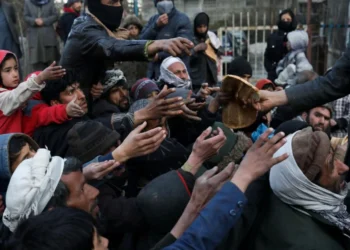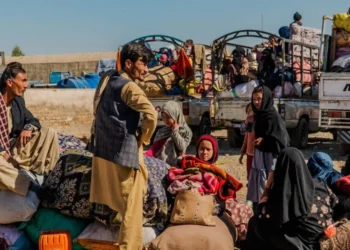
The author is not on the battlefield. She sits in her room and watches, on her television screen at home, the fall of women, the fall of men, and the fall of her country. When she lifts the glass of tea to her lips, she trembles, because she is reminded of twenty-five years ago. Her memories and experiences are reflected in her mind. The Taliban’s lashings, the story of the wars and the bitterness of those days spin through her head like a TV series. Her eyes are fixed on a screen that carries no news, only collapse, helplessness, and the roar of victory from the mouths of people whose very names strike terror in her heart.
Twenty-five years ago, she was a teenage girl scarred by war. She had witnessed the killing of several people at the hands of the Taliban and took great care not to be killed herself. Now she is a mother with a home and a child, and she fears losing her son. The grief of losing a son, the grief of the fall, the onslaught of memories, and the sight of renewed displacement and ruin weigh on her and turn life bitter. She does not know where in the night to hide.
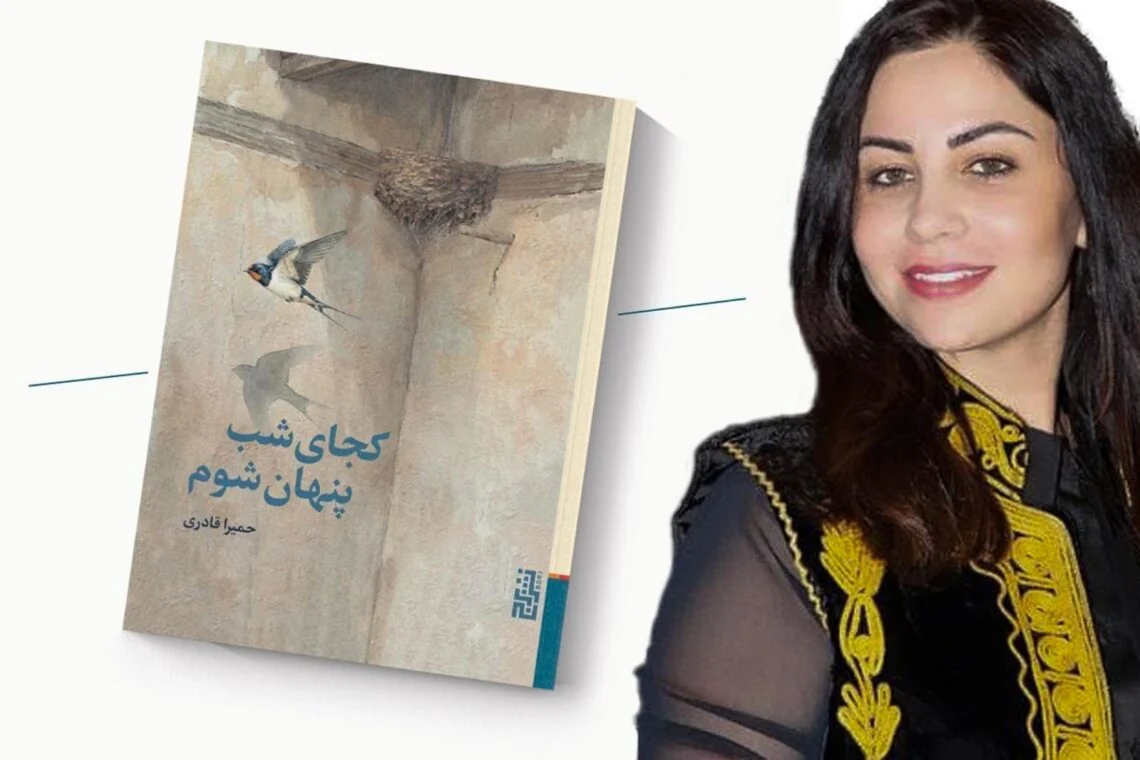
Five years after the fall, she has published a book that takes others back into the fall once again. I ask: Why should we narrate the fall of Kabul? Why should the suffering of women in Afghanistan be narrated? And what is the cost of writing about women’s suffering? What kind of night does the book Where in the Night Should I Hide¹ speak of: the night of one woman, the night of one fall, or the night of the collapse of a history? Can this book be regarded as a literary document of the fall of Kabul, or should it be read independently of the political event, as a work about human beings and destiny? And she answers: “Many people should not read this book.”
Who Is Homeira Qaderi?
Homeira Qaderi was born in 1979 in Kabul. She is originally from Herat. She received her primary education in Kabul and continued her university studies up to the doctoral level in Persian language and literature at Allameh Tabataba’i University (ATU) in Iran. In 2014, she also earned a doctorate from a university in India. After completing her studies, she returned to the country, became a university lecturer, and began working as an adviser to the Minister of Labor and Social Affairs (MoLSA).
Her path in fiction writing began in 1992. In that same year, she wrote her first stories and began publishing them. In the early years, her stories appeared in various periodicals, including Ettefaq-e Islam newspaper, Orang-e Hashtom, Qalam-e Haftom, Hezar-o-Yek Shab, and Hari magazine. In 2008, two of her books were published by Roozgar Publications: a collection of short stories titled Anis’s Earring² and a research work titled A Study of the Trend of Fiction Writing in Afghanistan³.
In 2004, her story If Only the Rain Would Fall Again⁴ earned her a certificate of appreciation at the third round of the Sadegh Hedayat Literary Award. She is the first writer from Afghanistan to receive this honor. Dancing in the Mosque⁵ is her most famous book, which was written in English. The New York Times (NYT) placed the book at the top of its list of books recommended to literature enthusiasts. People magazine, one of the highest-circulation magazines in the United States, introduced it as its “Book of the Week.” USA Today also named it in fourth place, after the memoir of former United States President Barack Obama, as one of five books that should not be overlooked. Where in the Night Should I Hide, her latest work, is the focus of this conversation.
Hasht-e Subh Daily: The title of your new book is Where in the Night Should I Hide, which seems to be a question full of anxiety, loneliness, and helplessness. What does night mean in this title? What kind of night are we facing: the night of a woman, the night of a land, or a night full of stories?
Homeira Qaderi: Where in the Night Should I Hide is an account of the days of the fall of Afghanistan in August 2021. During those days, I was in Kabul with my son, Siawash, witnessing the collapse of a city in which I had built my home and my life. The book begins with the news of the fall of Herat and reaches the days of the fall of Kabul. Amid family phone calls, news of the war, worry for my brothers, and efforts to keep Siawash safe, I try to continue everyday life. But with each day, my options shrink, and finally I face the difficult question of whether to stay or leave.
The “night” in the title of my book is both the night of a woman and the night of a land. It is the night of the fear of losing my child. It is the night of the fall of Kabul, and the night of the bitter memories that have stayed with me since 1996. When the Taliban reached Kabul again in August 2021, all the fears of twenty-five years ago came back with me. It was as if the unhappy adolescence I thought I had left behind had come alive again. This time, though, I was not the teenage girl of 1996. I was a mother with a son I had to take care of. I had a home, I had built a life, and I was hopeful about the future. Suddenly everything collapsed before my eyes.
To be honest, I do not like to divide the fall of Afghanistan into female and male. The Taliban have brought calamity on everyone. The men of Afghanistan have also lost their homes, jobs, freedom, loved ones, and future. But I cannot deny that the return of the Taliban brings a doubled pain for women. I experienced this pain once in my adolescence, and now, after twenty-five years, I am facing it again.
In this book, you meet a woman who is alone. She is both hopeful and hopeless, sometimes brave and sometimes deeply terrified, with reasons to stay and reasons to leave. She doubts her own decisions, but she still believes in speaking and writing.
In those bitter days, we kept trying to live as we did on ordinary days. At night, I told Siawash stories, we cooked soup, and we sat around the table with my family members who had come to Kabul, talking and laughing. We even went out of the house to go shopping. We wanted to show ourselves and each other that everything was fine, that we could still have an ordinary life. Sometimes we behaved as if nothing had happened, while all of us knew what had happened to our city. We did not want to believe that everything was over. I wanted to show this part of our life in the book too.
Perhaps for this reason, the title of the book is a question: Where in the night should I hide? In those days, I truly did not know where I could protect myself and my child. But amid all that fear and doubt, I knew one thing: I did not want to remain silent.
Hasht-e Subh Daily: Why should the suffering of women in Afghanistan be narrated? Is writing about women of Afghanistan a way for them to reclaim the right to narrate for themselves?
Qaderi: In my view, Hélène Cixous answered the question of why women should write years ago in her brilliant essay “The Laugh of the Medusa.” I love this essay very much, especially where she says that a woman must write herself, must write about women, and must bring women into the field of writing. Cixous asks us to bring ourselves into the text, the world, and history. I think this is one of the most important things ever said about women’s writing.
But why should we do so? Because for centuries others have written about us. They have written about our bodies, our desires, our morals, our motherhood, our silence, and even about what should make us happy. Others have created characters for us and determined our fate, and sometimes, even when we spoke, they said that what we really meant was something else. In one part of the essay, Cixous says that women must escape the trap of silence. Yet in Afghanistan, I have heard many times that a woman must be restrained and quiet to be seen as dignified, to be called a “Bibi.” As a woman from Afghanistan, this sentence is tied to my own life and to the history of the women among whom I grew up.
I think we women of Afghanistan should have written with much greater strength long before the Taliban returned, because I do not date the history of the suppression of women in Afghanistan from the day Kabul fell. Even before the Taliban, some women could not speak freely about their lives. I myself was insulted for writing. You know that our society has set limits on women’s speech. For example, I had the right to education, but the right to narrate did not come to me easily.
One of Cixous’s important points is that women must free themselves from the image others have made of them. She says a woman must write so that she can be present in the world from a place other than silence. I think we badly need this in Afghanistan. We must write about our mothers and grandmothers, about women who spent their whole lives at home and whom perhaps no one ever asked what they wanted. We must write about girls who studied and built dreams and suddenly saw that they were no longer allowed to go to school. But we must also write about women’s joys, loves, friendships, angers, mistakes and choices. I do not want the woman of Afghanistan to remain in literature only as a suffering human being.
This point is very important to me. When we write only about women’s suffering, we may unintentionally repeat the very image that others have made of the woman of Afghanistan for years: a woman who is always a victim, always waiting to be rescued, and whose life holds nothing but calamity. But the women of Afghanistan have lived, loved, made decisions, resisted, and made mistakes, and sometimes, in very difficult circumstances, they have found a way to go on. All of this must enter our literature.
Cixous makes another point in her essay that is very dear to me. She says that when women write, their personal history connects with the history of other women and with national and world history. I feel this deeply in my own experience of writing. When I write about the life of a woman in Kabul, her story may have taken place in one house or one alley, but her life is not separate from war, politics, religion, tradition, and the decisions others have made about the fate of the country. What happened in her house is a part of the history of Afghanistan that has not been recorded in any official document.
Writing is our right, but we should not demand this right only from the Taliban. We must defend it against any power that wants to speak in place of a woman, belittle her experience, or set limits on her narrative.
I wish for a day to come when women of Afghanistan will not have to struggle to prove their right to write, a day when a woman’s writing is read first as literature, not merely as the testimony of a victim. Until that day arrives, I believe we must write. We must narrate our own lives with all their complexities and contradictions, because if we do not, others will again write in our place.
Hasht-e Subh Daily: Can literature resist historical amnesia? Can books and memoir writing preserve the part of the human truth of an event that is left out of the frame of the news?
Qaderi: In answering this question, I would like to focus more on memoir writing. In our land, memoir writing is not very common among women. The society we live in has divided women’s lives into two spheres, private and public, and it regards many things that happen in a woman’s life as belonging to the private sphere. Yet if we look at the lives of these very women, we see that many of their problems are rooted in politics, the economy, culture, tradition, and sometimes religious interpretations.
For example, imagine a woman whose husband has been killed in war. The news of her husband’s death becomes part of the history of the war, and perhaps the man’s name is recorded in reports and casualty statistics. But if the same woman wants to write about her life after her husband’s death, about loneliness, economic hardship, the behavior of her husband’s family, raising her children, or even her own wishes and dreams, she is told these are private matters. Yet that woman’s life is a continuation of the same war. The war did not end for her with her husband’s death. Its consequences entered her home, her table, her family relationships, and her children’s future. Why should we consider this part of history private and prevent it from being narrated?
When I think about this, I remember my grandmother. My grandmother used to tell her sorrows to the water of the well. This image has stayed with me for years. I think a woman who has to talk to well water surely has many things she cannot tell the people around her. The well water was a listener for her that neither blamed her nor passed her words on to others. But how sad it is that a woman, to say what has happened to her, takes refuge in water instead of people.
I sometimes think about how many women of Afghanistan have told their sorrows to water, told them to walls, kept them in their hearts, and taken them to the grave. How many lives and experiences have been erased from our history only because a woman was not allowed to speak about them? Perhaps if my grandmother could have written her memoirs, I would know things about her life today that I have never heard. Perhaps I would better understand what she went through and how she faced the hardships of her life.
Memoir writing inevitably enters the home. It enters the relationship between husband and wife and between mother and child, and it enters the fears, disputes, and decisions that others prefer not to be spoken about. That is why many of our women are afraid of narrating. They fear being accused of bringing disgrace on the family or of saying things they should not have said.
I think narration can untie many of the tight knots in a society. When a woman writes about her life, we get the chance to understand how a political decision, a war, or a social tradition has affected people’s real lives. Then perhaps we can think about changing those conditions. For me, narrating means negotiating: negotiating with society, history, tradition, and even with those who disagree with us. Narration gives us the possibility of speaking about things we have kept silent about for years.
For this reason, I think memoir writing can resist historical amnesia. News tells us what has happened, but memoirs can show how that event continued in people’s lives. It is important to me that the history of Afghanistan is not only the history of wars, governments, falls, and victories. The lives of women whose names have perhaps never appeared in the news must also be recorded in it. I wish that women of Afghanistan, instead of telling their sorrows to well water, could write them down and know that their voices are worth hearing.
Hasht-e Subh Daily: When a writer writes about real experiences of war and the collapse of a political system, she faces a dilemma. In this book, how faithful did you remain to reality and eyewitness accounts, and how much did you draw on literary and fictional elements?
Qaderi: For me, art matters before message. I am first of all a writer, and I believe that for any kind of writing, one must know its principles. Memoir writing has its own principles too. Where to begin, which scene to choose, how to move time forward in the narrative, how to bring dialogue and characters into the text, and how to link memories with present events all relate to the art of writing. In my view, good memoir writing is both faithful to reality and makes use of the art of narration.
In Where in the Night Should I Hide, I have opened the door of my own home to the reader in the days of the fall of Kabul. You enter our home and see my family members. I have written about my brothers’ quarrels over government and politics, about one brother’s jokes with his wife about the burqa, and about the food we put on the table that no one had the appetite to eat. Sometimes we sat together, talked, and even laughed. Then we turned the television on again and watched the news of the fall and of the airport. Our life passed between these ordinary moments and the horrifying news.
For example, I have written about the day of the suicide bombing at the airport, about the moments when I was afraid, from the news and the television images, that I might have lost several of my loved ones at once. Perhaps readers have read in news reports the number of people killed that day, but I wanted them to know what a person waiting at home for news of her loved ones endures. I have written about the fear of losing Siawash again. Before the fall, I had fought in court to keep my child, and now I feared that the Taliban’s laws would take him from me again.
We all more or less know what happened to the government of Afghanistan in August 2021. I did not want to write a book about who made which decision and who was to blame. I wanted to show what these events did to the life of an ordinary family, a family that was not involved in politics.
Hasht-e Subh Daily: What is the cost of writing about fresh wounds? How can one write about a wound without writing turning into a permanent reproduction of that same wound?
Qaderi: On this, I can speak only from my own experience. Writing reconciles me with my past, but it does not make me forget it. I still remember the bitterness of the first period of Taliban rule bit by bit. So how could I forget the loss of my home and my life in 2021?
Sometimes I close my eyes and, in my imagination, walk around Kabul University (KU). You do not know with what enthusiasm I lived on the other side of the city. I had a home, I wrote, and I was hopeful about the future. In the afternoons, I sang and danced with my maternal uncle’s young sons. I enjoyed their happiness. I was happy with these simple things in life. Now all of this has become a wound for me. Even the memory of my joys hurts. It is as if I carry a beautiful dream soaked in blood.
Can the book Where in the Night Should I Hide heal this wound? No. I have no such expectation of writing. Writing does not give me my home back. It does not return Kabul to the days before the fall, and I cannot live those afternoons and those joys again. But when I write, I can return to that life, look at it and talk about it.
We, the people of Afghanistan, have experienced war, fall, migration and loss again and again. But how much have we talked about what has happened to us? How much have we learned from our own experiences? I think one of our problems is precisely this historical forgetfulness. Every time, a group of political opportunists arrives with new promises and throws us once more into the same well we had fallen into before.
For this reason, I do not consider writing a path to forgetting. On the contrary, I want to remember what I have lost. I want that house, that city, those people and those joys to remain in my writing. The cost of writing, for me, is that I must return many times to days whose memory still bleeds in my chest. But not writing also has a cost. If I do not write, what should I do with all these memories?
Hasht-e Subh Daily: While writing Where in the Night Should I Hide, did you reach the point where language was inadequate in the face of the reality of the fall of Kabul?
Qaderi: I do not know how inadequate language was in the face of the fall of Kabul, but I know that while writing this book, I fell again and again. Many people should not read this book.
Footnotes
¹ Where in the Night Should I Hide: کجای شب پنهان شوم
² Anis’s Earring: گوشواره انیس
³ A Study of the Trend of Fiction Writing in Afghanistan: بررسی روند داستاننویسی در افغانستان
⁴ If Only the Rain Would Fall Again: باز باران اگر میبارید
⁵ Dancing in the Mosque: رقص در مسجد
You can read the Persian version of this interview here: