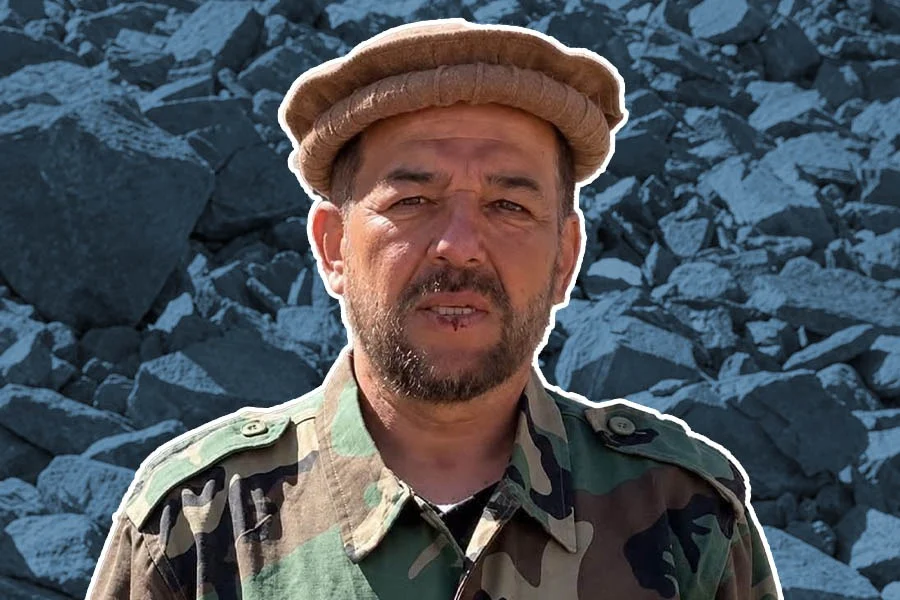
There is no doubt that Saleh Mohammad Rigestani is an experienced and battle-hardened commander. He fought the Taliban in the past, and apparently he is fighting them now. Recently, by releasing repeated videos, he has announced his renewed presence in the foothills of the Hindu Kush, news that has been met with a wave of both praise and controversy. The question being raised is this: why is it necessary to publish such videos repeatedly? If the purpose of Rigestani’s presence in the Hindu Kush is to begin or organize a new phase of resistance, why should the location and manner of his life be exposed to the public in such detail, especially to the Taliban? Why should the camera go all the way to the spring to show his cracked lips, his sleeping place, and the way he drinks water, so that the audience, especially the Taliban, knows under what conditions Rigestani lives?
This question becomes more serious when we consider that over the past five years, images and videos of National Resistance Front (NRF) commanders in the mountains and valleys have been published repeatedly, and in some cases, this very exposure has led to pursuit by the Taliban and to the death or capture of resistance members. The mountain, the valley, the type of clothing, the route of movement, the available equipment, the time of filming, the number of people present, and even details that the video makers may consider insignificant can hold “intelligence value” for the Taliban.
So the question is not whether Rigestani is brave. The question is whether bravery must necessarily be put on display. A commander can sleep on a rock, drink from a spring, endure hardship and remain loyal to his cause; but to prove this loyalty, is it necessary for a camera to witness all these moments? This is precisely where a clear line must be drawn between “resistance” and the “performance of resistance.” The insistence on display has led many to speak of a “Facebook resistance,” to the point that even when something noteworthy is accomplished, it is ignored.
It may be argued that publishing these videos is necessary to boost the morale of supporters, to prove that commanders are alive and present in the field, or to show that the resistance continues. But this argument raises another question: has the experience of the past five years shown that this propaganda method has truly strengthened the resistance? If there is no strong and clear answer, then the repetition of this pattern should be reconsidered. It is also only logical that in a guerrilla movement, the safety of the commander and the forces should not be sacrificed to the production of images and videos. If a video creates a wave of excitement and praise on social media for only a few hours or a few days, but at the same time opens even the smallest gap for identifying the position of the forces, the balance between its benefit and its cost must be weighed again.
For Rigestani and others, the mountain is a stronghold only as long as the enemy does not know exactly where they are. When a stronghold turns into a stage for display, it loses part of its security function. This does not mean, of course, that every video published from the mountains necessarily reveals the exact location or necessarily endangers someone’s life. But in wartime, the principle of caution must prevail over the principle of display, especially when the past experience of the Resistance Front has raised serious questions about the gains and losses of such displays. Perhaps it would be better for Rigestani and his colleagues, instead of proving the hardness of the rock and the coldness of the spring to the audience each time, to let their political and military performance speak. Resistance is not measured by the number of videos it publishes from its stronghold; it is measured by the degree of organization, endurance, impact,t and so on.
However, there is another issue in these videos that may be more important than the issue of revealing the location: the image of a commander’s military power presented to the audience. Rigestani is now the General Military Commander of the NRF. So one must ask why he is alone in the published videos. Only Rigestani himself is seen, along with a few rocks and pieces of mountain around him. There is no column of fighters, no military movement, no expanse of geography, and no clear sign of an organized military structure. All of this may exist outside the frame of the video; but when we do not witness any serious and effective activity, what use is it?
Here a serious contradiction emerges. If the only goal is to preserve security, perhaps no such video should be published at all; but if a video is to be published to convey a message of power, return, and military presence, why should such a small and limited image be presented? For a neutral viewer, this image can produce questions instead of power: where is the General Commander? Where are his forces? Where is the structure under his command? How far does his operational geography extend?
A commander can drink from a spring and sleep on a rock; these may be signs of endurance and sacrifice. But a general commander must ultimately represent something more than personal endurance: organization, command, network building, striking the enemy, staying safe from the enemy’s blows,s and so on. If none of these is going to be shown, it might be wiser not to turn on the camera at all. In such circumstances, a weak image does not merely convey information; it also shapes perception. If the resistance is to be taken seriously, it should not be caught between two bad choices: either publishing videos that may carry a security cost, or publishing videos that unintentionally create an image of loneliness and limitation.
Here, it is worth making a comparison between the Resistance Front and the Taliban; a comparison that does not necessarily mean endorsing the Taliban, but comes from a wartime experience that the group’s opponents cannot ignore. In their twenty-year war against the republic and foreign forces, the Taliban distinguished between “propaganda” and “self-exposure.” They sent messages, published statements, had spokespersons, and delivered their narrative to the media; but in many cases they tried to keep their faces, locations, structure, and operational details out of the reach of the opposing side. Even at the highest level, this logic was visible, and to some extent it still holds. Given this, can the Resistance Front not tell the people that Rigestani has returned, without displaying his face, surroundings, way of life,e and the geographical markers around him?
Another issue that should be examined more frankly is the reaction of the two main audiences of the videos: the Taliban and the outside world. The experience of the past five years has shown that the Taliban are not necessarily frightened by watching such videos, to say nothing of the fact that they also examine them seriously as leads. For the Taliban, it does not matter whether Rigestani slept on a rock or drank spring water; what matters is knowing where he is, who is with him, and how they can find him.
Regarding the second audience (the world), one must also be realistic. To date, no foreign government has officially stood beside the NRF or recognized it as an alternative force, not even Tajikistan. Governments have largely pursued a policy of engaging with the “ruling reality” regarding Afghanistan, even in circumstances where they have not recognized the Taliban regime.
So if such videos are going to neither intimidate the Taliban nor change the policy of the world, what is the necessity of publishing and broadcasting them? That a commander is alive in the Hindu Kush, sleeps on a rock and drinks from a spring may be a sign of personal endurance; but others have more important questions for a commander: what organization stands behind him? What capacity does he have? What geography is under his control? What plan does he have? What social force supports him? And can he change, even slightly, the situation prevailing in the country? None of these questions is answered by the image of a commander among boulders.
You can read the Persian version of this analysis article here: