Introduction
From the very moment human beings attain self-awareness, they confront fundamental questions. Why have we come into the world? What is the meaning of life? Why do we suffer? How does death relate to existence? Does life, with all its beauty and pleasures, ultimately end in nothingness? Can a person move beyond their existential anxiety and attain a kind of peace, meaning, and inner contentment? These questions have been among the most fundamental concerns of philosophy, mysticism and literature, and every thinker, in keeping with their own worldview, has given a different answer to them.
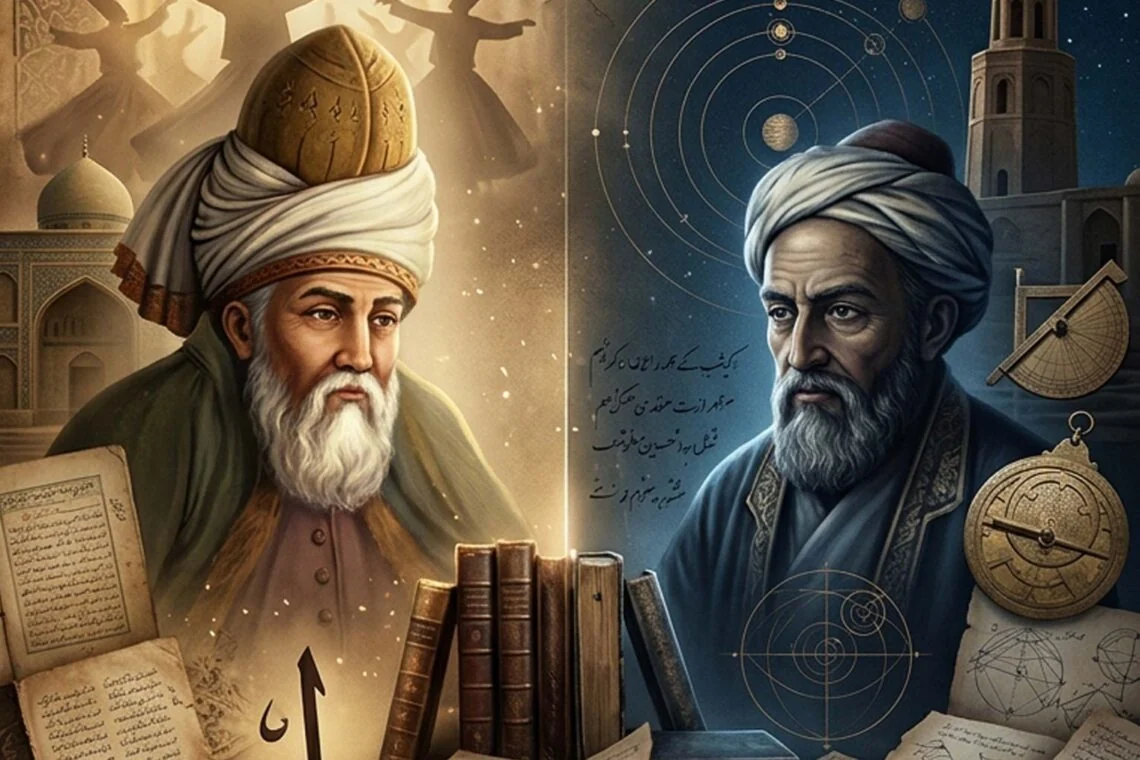
Among the great thinkers and poets of the Persian language, Omar Khayyam and Mawlana Jalaluddin Muhammad Balkhi (Rumi) are two prominent examples of confronting the tragic nature of existence. Both are aware of the impermanence of the world, of death, of suffering and of the limits of human understanding. Both speak of the sleep of heedlessness, and each in his own way strives to bring human beings face to face with the truth of life. Nevertheless, the main difference between them lies not in observing suffering but in interpreting it, and in the path each proposes for confronting it.
Facing an impermanent world and the enigmatic mystery of existence, Khayyam emphasizes seizing the moment, making use of the opportunity that life offers and accepting the limits of human knowledge. Rumi, by contrast, does not regard suffering and extinction as an end point. Rather, he sees them as a threshold for passing from the outward to the inward, from self-regard to love and from anxiety to a kind of spiritual peace.
In this article, we use the two expressions Khayyam’s thought and Rumi’s thought to refer to two existential approaches. We mean neither two fully systematic philosophical schools nor a reduction of the entire intellectual legacy of Khayyam and Rumi to a few simple propositions. The aim is to examine two ways of facing life. The first, confronted with the mystery and impermanence of existence, arrives at acceptance of limits and at seizing the moment. The second, from within this same awareness, seeks the possibility of love, transformation and a higher meaning. The central question of this article is whether human beings are inevitably bound to take refuge in surrender, doubt and merrymaking in the face of the tragedy of existence, or whether, from within suffering and awareness, they can discover a new horizon of meaning and life.
1. The Tragedy of Existence and the Awakening of Humanity from Heedlessness
One of the important sources of wisdom is a serious confrontation with suffering and mortality. When a person faces death, loss, failure, loneliness, and the impermanence of the world, they withdraw from everyday life and begin to reflect on questions to which they pay little attention under ordinary circumstances. This experience can become the foundation of a deeper kind of awareness, one that pulls a person out of heedlessness and prompts reflection on the nature of existence and the meaning of life. In different philosophical and spiritual traditions, suffering holds an important place. The Buddha regards suffering as one of the most fundamental truths of life and seeks the path of liberation from it by understanding the origin of suffering and moving beyond attachments. Schopenhauer, likewise, emphasizing humanity’s endless will, sees life as trapped in a cycle of desire, frustration, and suffering.
In Khayyam’s thought, awareness of death and of the impermanence of the world confronts a person with a difficult question: if everything ultimately ends in nothingness, what is the meaning of effort, aspiration and living? These questions bring a person to a point where they can no longer easily ignore their existential anxiety through everyday distractions, simple hopes, or ready-made answers.
Rumi also begins from this same point. He knows well that human beings are heedless of their condition in the world and, to escape painful awareness, take refuge in distraction, habit, busyness and even outward spirituality. In the Masnavi, heedlessness is one of the main obstacles to knowing the truth. A person may spend their whole life on activities that seemingly keep them occupied but in reality prevent an honest confrontation with themselves.
Nevertheless, the difference between Rumi and Khayyam is that Rumi does not reach a dead end from painful awareness. He sees suffering, but he does not consider it the whole truth of the world. In other words, in Rumi’s view, suffering is real, but reality is not only suffering.
2. Khayyam’s Thought: Awareness of Mortality and Seizing the Moment
Khayyam cannot be regarded as a simple-minded, carefree, or merely pleasure-seeking poet. The philosophy of joyful living in the quatrains attributed to him, if properly understood, is a response to a deep awareness of the world’s impermanence and of the limits of human knowledge. Observing the turning of the heavens, the passing of life and the death of human beings, Khayyam draws attention to the truth that life is short and the opportunity to live is limited. A person can neither return to a lost past nor be certain of an unknown future. Therefore, the only thing directly at their disposal is the present moment.
He says:
“Of yesterday, which has passed, keep no remembrance,
Of tomorrow, which has not come, raise no lament,
On what has not come and what has passed, build no foundation,
Be happy in the present, and do not squander your life.” [1]
In this view, seizing the moment is not a superficial reaction to life. Rather, it is the product of understanding human limitation in the face of death and time. Khayyam seeks to arrive at a kind of practical peace from the weight of questions that have no definitive answer. If a person cannot fully unlock the mystery of the world, they can at least make use of the brief opportunity that life offers. In Khayyam’s quatrains, the world at times resembles an unstable caravanserai, a fleeting place of passage, or a place between two nothingnesses. A person enters this world, lives in it for a while and finally leaves it, without any certain knowledge of the ultimate truth of their own coming and going.
For this reason, Khayyam asks:
“What gain is there in our coming and going?
What gain is there in the unraveling of our warp and weft?
Since so many come into this world and depart,
What gain is there in this coming and going of ours?” [2]
This question expresses a kind of philosophical bewilderment in the face of the mystery of existence. Khayyam does not wish to conceal human anxiety with easy answers. Instead of offering a definitive and consoling truth, he confronts human beings with the limits of their own knowledge. In such a horizon, Khayyamian joyful living should be regarded as a kind of resistance to suffering, a resistance that begins from the acceptance of the world’s impermanence. Khayyam does not want a person to spend their entire life waiting to discover secrets that may never be revealed. He reminds people that the opportunity of life, amid unanswered questions, remains valuable. Therefore, Khayyam’s thought should not be reduced to irresponsibility, extreme pleasure-seeking, or the denial of moral values. In its existential formulation, this thought is a kind of vigilance in the face of death and human limitation, a vigilance that, instead of promising final liberation, emphasizes the value of a limited and fleeting life.
3. Rumi: Accepting Suffering, but Moving Beyond It
Rumi, too, is not oblivious to the impermanence of the world, to death and to human suffering. He knows well that human beings are exposed to loss, anxiety, failure, and death. Nevertheless, Rumi’s fundamental difference from Khayyam is that he does not consider this experience the end of the road. Rumi does not tell a person that suffering does not exist; rather, he says that suffering is not the whole truth of existence. The world does not have only a dark and sorrowful face. Alongside extinction, there is the possibility of renewal; alongside death, the possibility of transformation; alongside anxiety, the possibility of love; and alongside bewilderment, the possibility of mystical insight. In Rumi’s mystical reading, the outward world is not the whole of existence. What a person experiences at the sensory level is only a part of the truth. If a person stops at the surface of things and the impermanence of forms, they may arrive at despair and anxiety, but if they pass from the outward to the inward, they can discover, in this very impermanent world, signs of meaning and of the renewal of existence.
Rumi says:
“How blessed a place this nonexistence is,
For the aids of existence come from nonexistence.” [3]
This verse is one of the keys to understanding the difference between Rumi’s view and Khayyam’s. In the Khayyamian conception, nonexistence can mean an end, a threat, and annihilation. In Rumi’s mystical conception, however, nonexistence at times means the unseen, possibility, the wellspring of renewal and the transcending of existing forms. It must, of course, be noted that this difference is not so much a linguistic disagreement over the word “nonexistence” as a difference in worldview. In his quatrains, Khayyam confronts the limits of knowledge and the mystery of death, while Rumi, within the framework of Islamic mysticism, interprets death and extinction in relation to a truth beyond the sensory world.
From here, it can be said that Rumi proposes a different path in the face of the tragedy of existence: not the denial of suffering, not an escape from awareness, but a transformation of the human relationship with suffering. A person may not be able to remove death from the world, but they can change their view of death. They may not be able to eliminate all the pains of life, but they can discover a new meaning in the face of pain. They may not be able to answer all philosophical questions, but through love and spiritual experience, they can transform their way of living. In this sense, Rumi does not ask a person to flee from the world. Rather, he invites them to move beyond the limits of the outward view and to discover the stronger possibilities of life.
4. Two Conceptions of Nonexistence: Nothingness or a Source of Renewal?
One of the most important intellectual differences between Khayyam and Rumi becomes apparent in how they confront nonexistence. Arash Naraghi, in his discussion of the experience of nonexistence in the work of these two poets, regards this difference as one of the fundamental axes for understanding Khayyamian wisdom and Rumi’s mysticism. In this analysis, nonexistence in the Khayyamian horizon is more closely linked to the end, extinction, annihilation, and the threat to being. In the face of nonexistence, a person confronts a truth that they cannot easily tame or move beyond. Death is the end of opportunities, and the world offers no definitive and clear answer to human questions. In Rumi’s horizon, however, nonexistence takes on a different meaning: it does not necessarily mean absolute nothingness, but can point to the realm of the unseen, to possibility and to the wellspring of renewal. What appears in the outward to be nonexistent may, in the inward, be the possibility of being and transformation.
Rumi says:
“He showed the nonexistent as existent and magnificent,
He showed the existent in the form of nonexistence.” [4]
And elsewhere:
“Let me be drunk on nonexistence, not on what exists,
For the beloved that is nonexistence is more faithful.” [5]
In this view, the sensory world and existing forms are not the whole truth. Being can transform from one form to another, and what appears to be the end of one form of life may, in Rumi’s mystical horizon, be the possibility of a beginning and a renewal. This conception turns death from an absolute end into a kind of spiritual passage. With this interpretation, Rumi enables a person, instead of being caught in the fear of nonexistence, to understand it within a broader horizon of being. Nevertheless, this difference should not be taken as a philosophical proof of immortality or as a definitive rejection of Khayyam’s view. Rumi speaks from the horizon of faith and mystical experience; Khayyam speaks from the horizon of bewilderment, doubt, and the limits of knowledge. Both approach the same question, but by two different routes. That is, in the face of nonexistence, Khayyam thinks of seizing a limited life, while Rumi seeks the possibility of moving beyond the limits of the forms of life.
5. The Three Faces of Rumi: From the School to Love
To understand Rumi’s intellectual and spiritual transformation, one can speak metaphorically of three faces or three stages. This division is neither a precise historical outline nor three completely separate periods, but a way of explaining his inner transformation.
The First Rumi: Education and the School
At this stage, Rumi is situated in the world of formal religious education, jurisprudence, the Islamic sciences, and the scholarly tradition of his time. He is the child of a scholarly and religious family and, from the very beginning, is bound up with knowledge, teaching, and upbringing. This stage can be regarded as the period in which Rumi’s scholarly and religious personality was formed. At this stage, he becomes acquainted with the heritage of the tradition and builds the initial frameworks of his thought.
The Second Rumi: Jurist and Scholar of Sharia
After years of education, Rumi becomes a well-known figure in the field of religious sciences. He holds scholarly and social standing; students and disciples gather around him, and within the framework of the religious tradition, he is regarded as a reputable figure. This stage is the Rumi of the scholar and teacher, a man who holds an established position within the scholarly and religious structures of his time.
The Third Rumi: Love, Wonder and Transformation
The meeting with Shams Tabrizi was an important turning point in Rumi’s life. This meeting cannot be regarded merely as the transmission of a few new teachings from a master to a student. Rather, it must be seen as a deep and transformative experience in Rumi’s spiritual life. Rumi moves from the established position of scholar and teacher toward the experience of passion, wonder, love, and inner transformation. The Ghazals of Shams are a manifestation of this change, a language in which conventional reason, established identity and the usual boundaries of experience are challenged by the passion of love. This Rumi is no longer only a teacher and jurist; he is a lover who rediscovers the world through the experience of love. Poetry, music, dance, and the sama ceremony at this stage express a kind of liberation from the limits of the established self. Of course, this transformation should not be taken to mean the complete rejection of Sharia or of Rumi’s earlier knowledge. Rumi does not set aside his past knowledge; rather, he rereads it in a new horizon. Love in his life is not a simple substitute for knowledge, but a transformation in the way the world is experienced and understood. The third Rumi, in this sense, is the Rumi of passage from knowing to experiencing, from purely conceptual understanding to a kind of existential and intuitive understanding.
6. Why Does Rumi Place Love Against Suffering?
In Rumi’s thought, love is not merely a personal feeling or a romantic emotion. Love is a force that carries a person beyond the limits of self-regard, fear, isolation, and attachment to outward forms. When a person places themselves at the center of their own world, they measure everything in terms of profit, loss, possession, fear, and self-preservation. In such a situation, every loss becomes a threat to their identity, and every change creates anxiety.
Love, however, in Rumi’s sense, shakes this limited centrality. The lover no longer lives only within the confines of the self; they connect with another person, with nature, with the world and with a truth beyond themselves. Love transforms the world from a collection of unconnected objects into a network of connections and meanings. In this experience, a person is no longer merely an observer of the world; rather, they see themselves as part of the flow of existence.
Rumi says:
“The sorrowful drink wine, and we are happier of heart from the wine,
Turn, O cupbearer, to the prisoners of grief and give them your opium.” [6]
In this verse, Rumi distinguishes between two kinds of intoxication: the intoxication used to forget suffering, and the intoxication that springs from the experience of love and meaning. Khayyam also speaks of wine, but in the Khayyamian existential reading, wine can be a symbol of making use of the limited opportunity of life and of soothing the anxiety of death. In Rumi, wine is at times a symbol of mystical experience and of liberation from the limited self. Therefore, the main difference is not in the wine itself, but in the meaning each gives to it. In one place, wine is a means of bearing the burden of existence, and in another, it is a symbol of an experience that carries a person beyond sorrow and self-regard. This difference reminds us that not every kind of joy is liberating. A person may distance themselves from confronting the truth of life through entertainment, consumption, fame, power, or even study and cultural activities. But the joy that springs from love, connection, and awareness can lead to a kind of inner transformation.
Notes: Original Persian Verses
[1]
از دی که گذشت هیچ از او یاد مکن
فردا که نیامدهست فریاد مکن
بر نامده و گذشته بنیاد مکن
حالی خوش باش و عمر بر باد مکن
[2]
از آمدنورفتن ما سودی کو؟
وز تارشدن تاروپود ما سودی کو؟
از بس که در این جهان میآیند و روند
این آمدنورفتن ما را سودی کو؟
[3]
این عدم خود چه مبارک جایی است
که مددهای وجود از عدم است
[4]
نیست را بنمود هست و محتشم
هست را بنمود بر شکل عدم
[5]
بر عدم باشم نه بر موجود مست
زانکه معشوق عدم وافیتر است
[6]
باده غمگینان خورند و ما ز می خوشدلتریم
رو به محبوسان غم ده ساقیا افیون خویش
You can read the Persian version of this article here: