


Introduction
Some time ago, Jawad Sultani conducted an interview with Abbas Arifi on @TheSayehPodcast on YouTube, which was, frankly, one of his better conversations since his emigration. Personally, I learned a great deal from it and benefited greatly. In Sultani’s hour-and-a-half interview, a reference was made to Mullah Faiz Muhammad Katib, and that was enough for the other important parts of the conversation to be overlooked and for everything to revolve around Katib. In other words, this part of his remarks affected the collective memory of the Hazara community more than any other. That opportunity led to the publication of notes about Katib, and many people followed with articles of their own.
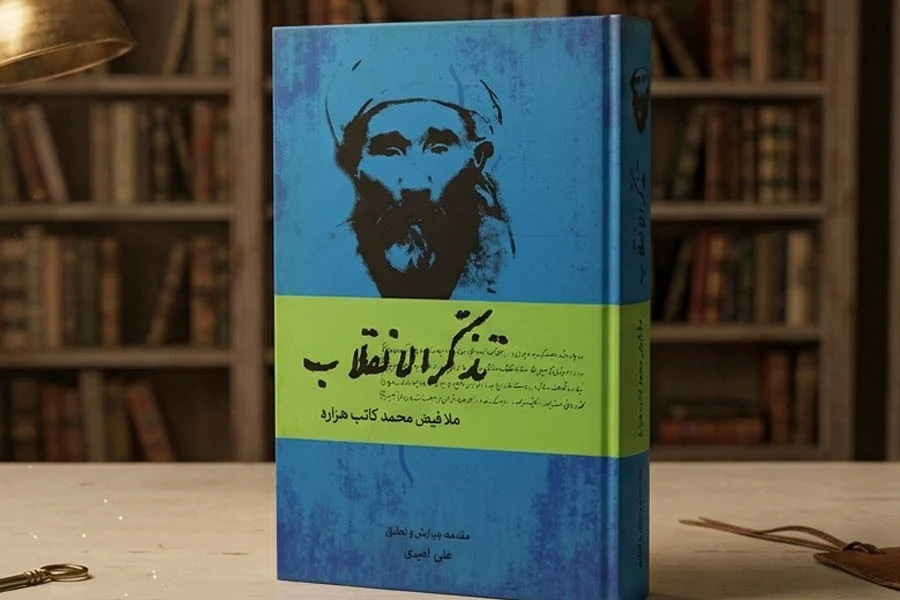
In the meantime, Shafaq Khavati addressed Katib at length and regarded him as qualified in several fields. One of the titles he gave him was that of a sociologist. Khavati further emphasized that Tazkirat al-Inqilab is a sociological book. This conversation and the points raised became a pretext for me to reread the book in Ali Amiri’s new edition, and as a result, this short piece took shape. This note examines the views of Amiri in the book’s introduction, as well as those of Khavati, both of whom have discussed Katib and his thought in parts of their writings.
I consider it necessary to mention that I previously had the honor of being a student of both at Ibn Sina University. It would have been better to publish this note at the height of the debate about Katib, but unfortunately the opportunity did not arise. My assumption is that Amiri’s introduction is exaggerated and contains unnecessary descriptions of Katib, even though Katib holds a special place in the history of Afghanistan without these descriptions. Regarding Katib as a sociologist is also unnecessary. By no method or criterion can Katib be linked to the science of sociology, although a sociological reading of his works is a separate discussion.
Notes Titled Tazkirat al-Inqilab
The importance of Katib in a land like Afghanistan stems, first and foremost, from his recording and documenting of several periods of this country’s history. Katib is important and deserving of appreciation first of all in his capacity as a “scribe,” regardless of whose side he took in history or what his orientations were. Today, part of our history is understandable and traceable thanks to his works.
Much could be said about Katib the historian, whom Amiri considers the only person after Abu al-Fadl Bayhaqi to have revived and recreated the wisdom of historiography, but this note lacks the space to address all dimensions of the subject. Therefore, we return to Amiri’s introduction and pursue this topic briefly. On page 12, Amiri writes: “This book (Tazkirat al-Inqilab) is the daily memoir of Mullah Faiz Muhammad Katib Hazara, written over seven months during the era of Habibullah Kalakani, known as Bacha-i Saqao, and it covers the turmoil of that period.” This first statement by Amiri about the book is very important, particularly because his later claims can also be examined from this angle. On page 18, when the logic of Katib’s historiography is discussed, we read: “Katib is renowned for the volume of his works and writings and for his precision in reporting, especially his meticulous detail, attention to particulars, and recording of the catastrophe in all its dimensions and components. However, little attention has been paid to the fact that he is the last representative of rationalist historiography in the Persian-language sphere, who turned reason and rationality into the standard and criterion of historical writing, and who, through cause-and-effect analysis of history and the explanation of historical events based on rational principles, lit the torch of rationalism of the golden age of Islamic history precisely at a time when rationalist thought had suffered a total decline, and cultural rupture and the collapse of historical experience had cast a shadow everywhere.”
Several important points can be made about this paragraph:
- It is a very important and noteworthy matter that if someone wishes to write an introduction to a text, the introduction must be consistent with the main text so that the reader understands what kind of text they are facing. One of the criticisms that has been or is being leveled at the edition of the book Afghanistan in the Course of History is that the text has been modernized and has moved away from Ghubar’s written style. This criticism also applies to Amiri’s introduction, because the language of the introduction to Tazkirat al-Inqilab does not match the original text. The words and concepts used in this introduction are not to be seen anywhere in the book. As a result, the reader faces two versions of Tazkirat al-Inqilab: one that Amiri writes about, and the other the original text that Katib wrote. This difference also applies to the author. The Katib introduced in the introduction is clearly different from the Katib known from the original text.
- This is a very broad and noteworthy matter and could by itself be the subject of a detailed study, especially since there is no reference in the text for this claim. That Katib is the last representative of rationalist historiography in the Persian-language sphere means that, across the entire domain of the Persian language, Katib alone represents reason in historiography. But the root and origin of this claim is not made clear in the introduction. Amiri goes on to not limit himself to the domain of the Persian language and considers the whole of Islamic history. In this way, according to him, when reason was in decline in the Islamic world, Katib arose from Afghanistan, lit its torch, and saved history from collapse and cultural rupture. As I said earlier, no reference has been provided for these claims.
Amiri writes: “Katib is the kindler of the light of reason between two darknesses and the link between past and future in an age of rupture… Abu al-Fadl Bayhaqi, Ata-Malik Juvayni, and Katib Hazara were the chroniclers of their own times and eras.” Statements and paragraphs of this kind are repeated many times in the introduction. On page 22, Amiri places Katib alongside Bayhaqi and Juvayni and seats him in a special position in historiography, to the extent that, in terms of the logic of historiography, he is considered exceptional. According to Amiri, “In terms of the logic of historiography, Katib occupies a unique and exceptional position.” He believes that this very exceptional quality of Katib has caused most contemporary writers to remain unable to analyze his works.
On page 24, we encounter a contradictory statement: “But where Katib brings his personal judgment into matters, his tone is critical and often harsh and biting; the venomous sting of his criticism, however, is always cold and has the substance of reason and logic.” This claim is made even though earlier there were repeated discussions of the reason and logic of Katib’s historiography, and it was emphasized that he had a distinct style of historical writing.
The contradiction becomes clearer as the author of the introduction admits: “We have no documents showing that Katib was familiar with modern political thought, but when he casts the political matter within the framework of the concepts of classical Islamic political philosophy, it can be understood that what he means by constitutionalism is also the modern state.” This statement clearly shows how Amiri imposes his own view on the reader and substitutes his own interpretation of Katib for Katib’s view, especially since he provides no reference to Katib’s writings for this interpretation either.
Final Word
As noted at the beginning, Katib is important in the history of Afghanistan for various reasons. Before we place him on a par with Juvayni and Bayhaqi, we must examine his position within the historical context of Afghanistan. Therefore, there seems to be no need for this kind of “Hatam-like generosity” in describing him.
Another serious criticism of Amiri’s introduction, in addition to its being exaggerated, is that instead of focusing on the book for which it was written, it covers the entire body of Katib’s writing career. This introduction could just as well have been written for Siraj al-Tawarikh or his other books.
Between the introduction to Tazkirat al-Inqilab and the original text, there is a great gap and difference in terms of written style. Therefore, Amiri’s first statement, “This book is the daily memoir of Mullah Faiz Muhammad Katib Hazara, written over seven months during the era of Habibullah Kalakani…”, has also not been addressed. Instead of addressing the importance of memoir writing in the history of Afghanistan and the function of this written tradition in history, especially the history of Afghanistan, Amiri has become preoccupied with exaggerated descriptions of Katib. Therefore, Amiri’s claims, rather than resting on logic and scholarly reasons, show his special attachment and partiality toward Katib.
You can read the Persian version of this analysis article here:



