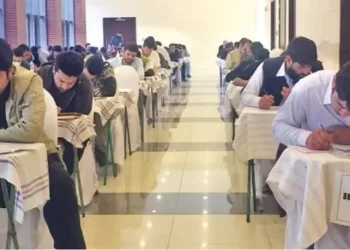
With the Taliban taking control of Afghanistan, students’ interest in continuing their education under the rule of this group has significantly declined. Sources from public universities confirm that around 50% of students have dropped out. According to these sources, even science-related disciplines have faced more than a 50% dropout rate. One informed source states that in one university, the number of students in mathematics and physics programs has dwindled to just five. At the same time, sources confirm that there is currently an imbalance between student enrollment and the availability of faculty and specialized staff in universities. If the situation persists, universities will soon be emptied of students, with only Taliban-affiliated clerics remaining in these institutions. Students cite an uncertain future, lack of financial resources, concerns over job opportunities, the Taliban’s strong support for religious school clerics, and the group’s disregard for modern knowledge and expertise as reasons for their dropout. Some students have also left due to Taliban threats and retaliatory actions against themselves and their families, leading them to migrate.
Since the Taliban’s takeover and their ideological dominance over educational institutions, an atmosphere of hopelessness has grown among students and professors in both public and private universities. Over the past three years, the Taliban’s Ministry of Higher Education has viewed academic institutions with suspicion, dismissing several university professors and replacing them with their affiliated clerics. Simultaneously, the group has confined hundreds of female professors to their homes, significantly impacting the educational system in the country. Many students state that universities are becoming increasingly Talibanized, leaving them with no motivation to continue their education or remain in Afghanistan under Taliban rule.
Meanwhile, a reliable source at Kabul University of Education states that many students have dropped out due to disillusionment with the current situation and Taliban pressures. According to this source, dropout rates vary across disciplines, with nearly 50% of students in non-science fields having abandoned their studies.
Another source from the northern region of the country reports that at the university where they worked, some academic programs have enrolled fewer than five students this year. This source adds that the physics and mathematics departments now share a single classroom with only five students. Previously, there was a balance between faculty and students, but currently, operational costs far exceed the defined benefits.
One student cites Taliban threats and intimidation as the reason for dropping out. He states that he was threatened by someone he had known previously. According to him, this individual, a Taliban member who had been part of the group’s underground forces during the previous government, warned him that any opposition to the Taliban regime would result in his arrest.
Fazl (pseudonym), a fourth-year, seventh-semester economics student at Badakhshan University, also decided to drop out. Despite being only one semester away from completing his bachelor’s degree, he lost motivation and decided not to continue. His disillusionment with the prevailing situation and Taliban pressures led him to abandon his four years of hard work before completing his studies.
Hedayatullah studied up to the fifth semester but was unable to continue due to financial and psychological difficulties. With the Taliban’s takeover, Afghanistan’s economic situation deteriorated, and most people lost their livelihoods. This economic hardship has led to widespread psychological distress, with many feeling that pursuing education under Taliban rule is meaningless, given the group’s focus on promoting jihadist and religious schools while allocating government positions to graduates of such institutions.
Najmuddin, a fourth-semester student in the Faculty of Sharia at one of the country’s universities, also abandoned his studies due to his disappointment with the academic environment and faculty attitudes. Many other students who have dropped out express similar sentiments, stating that under Taliban rule, they no longer see a reason to continue their education and have instead turned to daily labor to support themselves and their families.
Another student who left university mentions that his brother also dropped out due to financial constraints. According to him, the loss of job opportunities, lack of faith in the future, and the general atmosphere of despair in the country have driven many students, including himself and his brother, to leave their studies unfinished.
A former supporter of university students, who financially assisted several students before the Taliban’s rise, states that around 20% of economically disadvantaged students had to abandon their education after the fall of the previous government. He explains that after losing his job, he could no longer support his friends, forcing them to leave university. According to him, two of his friends have now migrated to Iran to work as laborers.
Ahmad (pseudonym), a former sociology student at Kabul University of Education, also says he was unable to continue his studies due to financial difficulties and his inability to afford transportation costs.
Recently, the Hasht-e Subh Daily published an investigative report revealing that the Taliban have begun systematically replacing university professors with clerics from religious schools, particularly in Kabul.
According to the report, in just a few days, the Taliban dismissed 26 professors from the Sharia faculties of four public universities in Kabul and replaced them with their affiliated clerics. Many university professors warn that this purge is spreading to other academic fields as well. The Taliban appear intent on fully embedding their ideology within universities, transforming these institutions into large religious and jihadist training centers to recruit fighters and strengthen their regime.
You can read the Persian version of this daily report here:
سلطه طالبانیسم بر دانشگاهها؛ حدود ۵۰ درصد دانشجویان ترک تحصیل کردهاند | روزنامه ۸صبح