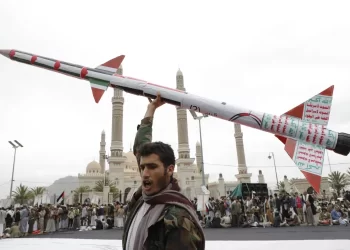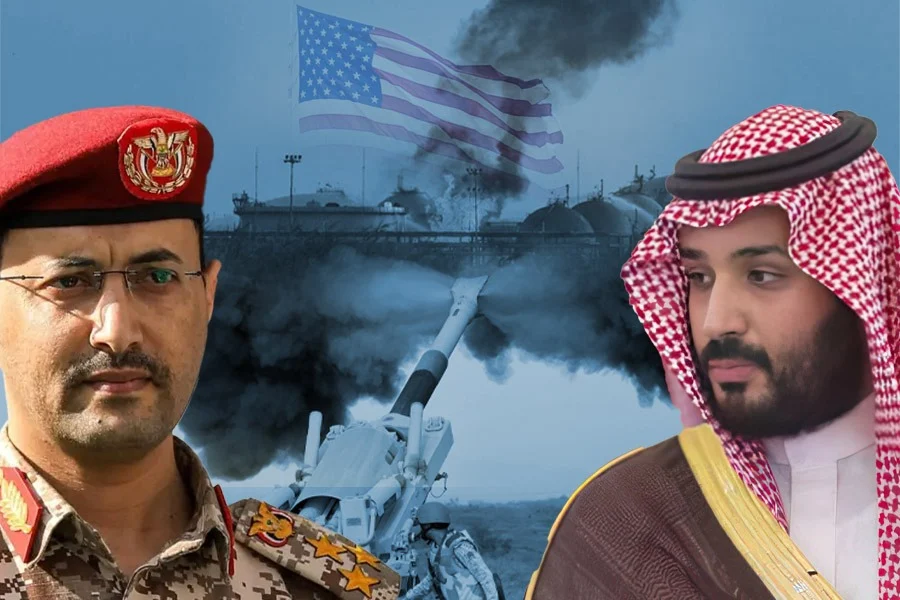
Recent Houthi attacks on Saudi Arabia have once again raised the question of whether a strategic relationship with the United States and access to advanced weaponry are enough to guarantee Saudi security. The damage that Houthi missiles have inflicted on Saudi infrastructure, together with the group’s advances in Yemen and the pushing back of forces allied with Riyadh, shows that conventional military power alone cannot protect a country against asymmetric attacks.
Even so, the issue is not only the capability of the Houthis or the weakness of Saudi defenses. More important are the limits of America’s security commitments to Riyadh and the extent to which the latter relies on the former in a “moment of crisis.” So far, the United States has refrained from direct and full-scale involvement in the war against the Houthis, although it has pledged support to Saudi Arabia in words. If this continues, the question grows louder in Saudi Arabia: if Riyadh’s security faces a real threat, when will the strategic relationship with the United States translate into “practical action”?
Still, this situation does not allow the conclusion that Saudi Arabia will soon distance itself from the United States or that the decades-long partnership between the two countries is ending. The military, arms, intelligence, and economic ties between Riyadh and Washington are deep and durable, and replacing them in the short term is not easy. However, Saudi Arabia’s perception of the relationship may change: instead of relying mainly on one particular foreign power, it may broaden its security options. This does not necessarily mean a break with the United States, but a reduction in exclusive dependence on it.
In this context, the “Mecca Pact” between Saudi Arabia, Pakistan, and Türkiye gains importance. The activation of the pact’s defense clause amid intensified Houthi attacks shows that Riyadh is seeking to strengthen regional security mechanisms. Even if this pact can increase Saudi Arabia’s defensive and political capacity, it is still too early to regard it as a replacement for the United States.
Expanding relations with China and Russia may also be part of Saudi Arabia’s policy of “diversification.” Nevertheless, there is a difference between increasing engagement with these powers and replacing the United States with them. For example, China can play an effective role in economic, energy, and regional diplomatic arenas, and Russia can do the same in certain other areas. But turning these relations into a practical and immediate guarantee for defending Saudi Arabia against external attacks is a separate matter.
Moreover, Saudi security does not depend only on the choice of “military partners”; part of it comes down to the decision Riyadh will make about the Yemen war itself. If continued military operations fail to stop Houthi attacks, and the cost of protecting infrastructure, airports, and trade routes keeps rising, Saudi Arabia may conclude that the threat cannot be contained by military means alone. In that case, a limited agreement with the Houthis could be an option: an agreement aimed at halting the attacks, not necessarily at accepting all of the Houthis’ demands or abandoning the government backed by Riyadh in Yemen.
Meanwhile, Iran’s offer of mediation carries particular significance. Abbas Araghchi, Iran’s Minister of Foreign Affairs, in a phone call with his Saudi counterpart Faisal bin Farhan, expressed Tehran’s readiness to help facilitate dialogue between Saudi Arabia and the Houthis. This offer could be both a diplomatic opportunity and a difficult test for Riyadh. However, the relationship between Tehran and the Houthis should not be described as though the group was unquestioningly subordinate to Iran’s will. Yes, the Islamic Republic influences the Houthis, but this does not mean Tehran has absolute control over the group’s behavior.
Despite these limitations, if the Islamic Republic’s efforts lead to a halt in the attacks, Saudi Arabia will be compelled to take Tehran’s role in Yemen more seriously, and may even come to understand that easing tensions with Iran is, in some circumstances, as important as military cooperation with major powers. Such a development, however, would not necessarily mean a strategic rapprochement between the two countries.
On the other hand, it can be hypothesized that Saudi Arabia might benefit from the weakening of Iran as a result of confrontation with the United States, since a reduction in Tehran’s regional power could, from Riyadh’s perspective, limit Iranian support for the Houthis and other aligned groups. Even so, there is a difference between possibly benefiting from a rival’s weakening and being interested in expanding a war between Iran and the United States.
Furthermore, a broad war with Iran will not necessarily work in Saudi Arabia’s favor; it may well backfire, particularly if we consider the Islamic Republic’s warning that if Iran’s infrastructure is attacked, infrastructure across the region will be targeted. Even supposing Iran is weakened, this does not guarantee that the Houthis will immediately lose the ability to attack Saudi Arabia or will abandon the continuation of the war.
In light of what has been stated, Saudi Arabia’s policy should not be reduced to a simple choice between the United States, Iran, China, or Russia. Riyadh may simultaneously continue strengthening its defensive capacity with American support, use the Mecca Pact to gain regional backing, expand its relations with China and Russia, and at the same time keep open a channel of dialogue with Iran and the Houthis.
You can read the Persian version of this analysis article here: