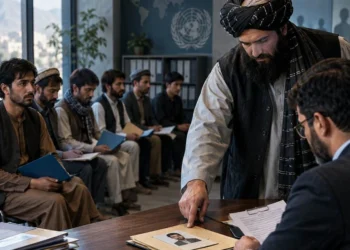

The Taliban’s control over Afghanistan has persisted for almost three years, yet their practice of purging non-Pashtun commanders continues. Although more than 90% of the Taliban’s leaders and high-ranking officials are Pashtuns, the group still targets the few Tajik, Uzbek, and Hazara commanders within their ranks. Recently, Taliban forces arrested Ghulam Hussain, a Tajik commander from Takhar province, and transferred him to Directorate 40 of Intelligence in Kabul. Sources confirm that, alongside Ghulam Hussain, they also disarmed at least six of his close associates and over 350 of his men. This arrest has triggered significant public outcry, with many citizens condemning the detention of Taliban commanders based on ethnic and linguistic differences as clear ethnic discrimination. They are urging Mullah Hibatullah to address and prevent ethnic biases within the Taliban’s military ranks.
Ruhollah, a resident of Rustaq District in Takhar province, told the Hasht-e Subh Daily: “The Taliban do not only oppose political figures who do not share their views; they also have issues with political figures who are like-minded but not of the same ethnicity or language. Since the establishment of the second Islamic Emirate of the Taliban, we have not heard of a single Pashtun commander being arrested or detained by the Taliban. It’s always Uzbek, Tajik, and other ethnic commanders who are detained or dismissed.”
This resident of Takhar added: “When a Tajik or Uzbek commander is detained, their subordinates are also removed from the ranks. Each commander has hundreds of like-minded and same-faith followers under them, but they are ignored. This behavior by the Taliban is blatant and unjust discrimination.”
Farid, a resident of Kabul, said: “Ethnic discrimination by the Taliban is evident in every sphere. If we focus solely on the military aspect, the percentage presence of ethnic groups in the Taliban’s army, police, and intelligence agencies makes it clear that the Taliban do not maintain ethnic balance, and this is no coincidence. The Taliban cannot stand having a Tajik, Hazara, or Uzbek individual standing beside them and receiving a salary from their system.”
Farid added: “Ghulam Hussain is not the first Tajik Taliban commander to be arrested and disarmed, and he won’t be the last. All non-Pashtun commanders and soldiers aligned with the Taliban must realize that they will be forced to leave the Taliban ranks under various pretexts and conspiracies.”
A large number of social media users have also reacted to the series of arrests of non-Pashtun commanders from the Taliban’s military ranks, criticizing the Taliban’s discriminatory actions against their comrades.
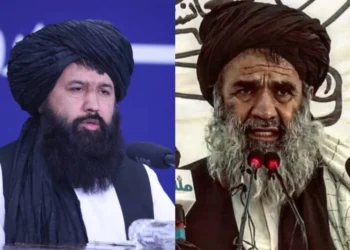
Zia Farahmand, one of these users, posted photos of Mawlawi Mahdi Mujahid, Abdul Hamid Khorasani, and Ghulam Hussain on his Facebook page and wrote: “Those whose usage terms are over become a nuisance and must be eliminated.” He further explained that the short-sightedness of these commanders was in aligning with the Taliban, knowing that there is no place for non-Pashtun fighters in the Taliban ranks.
These reactions come as sources confirm to the Hasht-e Subh Daily that on Tuesday, July 9, Taliban forces attacked Chah Ab District in Takhar and arrested Haji Ghulam Hussain, a Tajik commander, along with six of his close associates.
According to sources, Ghulam Hussain was first transferred to the 217th Omari Corps in Kunduz and then to Directorate 40 of the Taliban’s intelligence in Kabul. In addition to arresting Ghulam Hussain, Taliban forces disarmed about 350 of his men.
Ghulam Hussain, known as “Hussain Jundi,” hails from Izna village in Chah Ab District, Takhar province. He joined the Taliban in 2016 and played a prominent role in the Taliban’s fight against the former government’s military forces in Takhar. A day after his arrest, Taliban forces surrounded and searched the homes of his relatives and close associates in Chah Ab City.
Over the past three years, the Taliban have repeatedly arrested, disarmed, and expelled their non-Pashtun commanders from military ranks. Ethnic and regional tensions have occasionally caused conflicts and even clashes within the Taliban.
Previously, several Taliban commanders had complained about ethnic discrimination within the group’s regime and left their military ranks. About two and a half months ago, Abdul Hamid Khorasani, a Tajik Taliban commander, left the Taliban ranks due to ethnic discrimination. Khorasani, originally from Panjshir, was a commander in the Taliban’s Badri Unit and had joined the Taliban before the fall of the Republic, leading several military attacks in Panjshir during the Republic era. Before leaving the Taliban ranks, Khorasani openly complained about ethnic and regional discrimination within the group’s regime.
A report by the Middle East Research Institute (MERI) published on June 11 of this year shows that a very small percentage of non-Pashtun ethnic groups are present in the Taliban regime. According to the institute’s findings, out of 1,137 high-ranking Taliban officials, only 87 are Tajiks, Uzbeks, and Hazaras. The research report indicates that only 5% of the Taliban’s high-ranking officials are Tajiks, 3% are Uzbeks, and half a percent are Hazaras.
You can read the Persian version of this daily report here:
سه سال حاکمیت مملو از تبعیض؛ چرخه تصفیه فرماندهان غیرپشتون از صفوف طالبان ادامه دارد | روزنامه ۸صبح