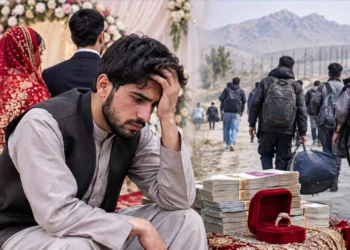
Several educated young people in Kabul say that since the Taliban takeover, unemployment among them has increased to an unprecedented level. They add that despite holding university degrees, they face an uncertain future. They stress that the level of unemployment has reached such an extent that they are not even accepted for daily wage labor.
Several young women and men who spoke with the Hasht-e Subh Daily say that bribery and patronage remain widespread in government offices under Taliban control and even in private institutions, and that their professional skills are given no consideration. They also describe the country’s education system as being far removed from the real needs of the labor market. According to these youths, the continuation of this situation will force them to leave Afghanistan in search of better opportunities.
Nargis, a graduate of the Faculty of Journalism, says she has been unemployed for the past year. She adds that every day she spends hours searching for suitable work on the “Akbar” website and other job platforms, but so far she has not found a single job opportunity related to her field or even in other fields.
Nargis says: “I graduated from Kabul University with top honors and worked at a news agency, but after U.S. aid was cut, they dismissed us from our jobs. God is my witness, it has been a year since I have been searching for work. One day on the Akbar website, I saw a vacancy posted for a welding worker, but there was nothing for us journalists.”
Nargis is not alone. Amrullah, one of the graduates of the law faculty, says that despite great effort, he has also been unable to secure a job. He adds: “One day, out of desperation, I went and stood among daily wage laborers and said I would accept any kind of work, but everyone was picked except me. It was very hard, because I had spent 16 years studying in the hope of a better life, not in the hope of things getting worse.”
Mahdi, another graduate, says that 90 percent of the people around him are educated, but due to the lack of suitable job opportunities, they are forced to do daily wage work. He adds, “Believe me, young people who are educated, meaning 90 percent of them, are engaged in work outside their fields. One is selling jackets, another is selling plastic goods, and others are doing different kinds of daily labor.”
Rashid Amin, a graduate, says that nepotism and bribery have prevented educated youth from obtaining their desired jobs. He adds, “Government positions are scarce for everyone. Many educated young people are forced to go abroad and even sell their assets in order to be able to work. Even when they return to Afghanistan, they are not allowed to work. There are many problems in this area, and the main culprit of the current situation is the Taliban.”
However, concerns are not limited only to graduates inside the country. Students who are studying outside Afghanistan are also worried about their uncertain future in the country. Some of these students are even unwilling to return.
Gholam Sakhi Halamis, a civil engineering student in Iran, says he is worried that he will remain unemployed after returning to the country. He adds, “Unemployment is one of the acute social problems in Afghanistan. When we study with great effort in other countries and return, we expect at least to find a job. But when we face the reality prevailing in Afghanistan, we become disillusioned or are forced into migration.”
Malekuddin, another student, says that due to the lack of job opportunities in Afghanistan, he does not know whether to stay in Iran or return to the country. He adds, “I am working on my thesis, but I am very worried. After completing my studies, I am truly concerned about whether I will find work in Afghanistan or not.”
At the same time, several economic experts consider unemployment among educated youth to be the result of a mismatch between university standards and the real needs of the country’s labor market. They say that Afghanistan’s education system still does not strengthen the skills and specializations required by the labor market among students, and many graduates with university degrees but without practical skills enter the job market. According to these experts, the continuation of this situation will lead to an increase in the migration of graduates, the growth of despair among young people, and the draining of the country’s human capital, with serious economic and social consequences.
Shaker Yaqubi, an economic expert, says: “To address the problem of unemployment in Afghanistan, there is a need for more practical measures. These measures can include strengthening the private sector, establishing industrial parks and manufacturing factories, attracting foreign investment, and reforming the education system in line with labor market needs. The expansion of vocational training and entrepreneurship for young people, the digitalization of government services, and increased transparency are also measures that can help reduce unemployment.”
Seyar Qureshi, another economic expert, says: “Unfortunately, it must be said that unemployment among educated youth in Afghanistan has increased. The country’s economy is weak and is compounded by the political problems that the Taliban are currently grappling with. The aid that used to be allocated annually, between 8 to 9 billion dollars for budget support and projects such as those of the World Bank and the Asian Bank, has all been halted.”
Abdul Nasir Rashtia, an economic expert, says: “We will only witness a reduction in poverty and unemployment in Afghanistan when investment in the country increases, the economy becomes production-oriented, and dependence on imports is minimized. In most countries that are not productive and rely on imports, poverty and unemployment rates are high.”
Qutbuddin Yaqubi, an economic expert, says: “Unemployment is a social problem that has unfortunately existed in the country for a long time. Now, with the Taliban takeover, many opportunities have been lost, causing young people to leave the country and creating a labor vacuum in Afghanistan. In my view, the only way out of this problem is the creation of job opportunities by the young people themselves.”
The World Bank, in its latest figures, has announced that the unemployment rate in Afghanistan has reached 13.3 percent. According to these statistics, the forced deportation of Afghanistan citizens from Iran and Pakistan, the wars of more than four decades, and international sanctions have placed Afghanistan 21st in the world in terms of the unemployment rate.
The World Health Organization (WHO) has also announced that widespread unemployment among young people has led to an increase in mental disorders such as depression, anxiety, and feelings of worthlessness. According to the organization, young people who studied for years under harsh economic and wartime conditions are now facing closed doors in the job market, and this sense of injustice and hopelessness has severely affected their mental health.
In addition, the United Nations Children’s Fund (UNICEF) has reported that rising hopelessness, especially among young girls and boys, has been accompanied by a growing wave of self-harm and even suicide.
You can read the Persian version of this report here:
بحران بیکاری زیر سایه طالبان؛ تحصیلکردهگانی که حتا به کارگری روزمزد پذیرفته نمیشوند