
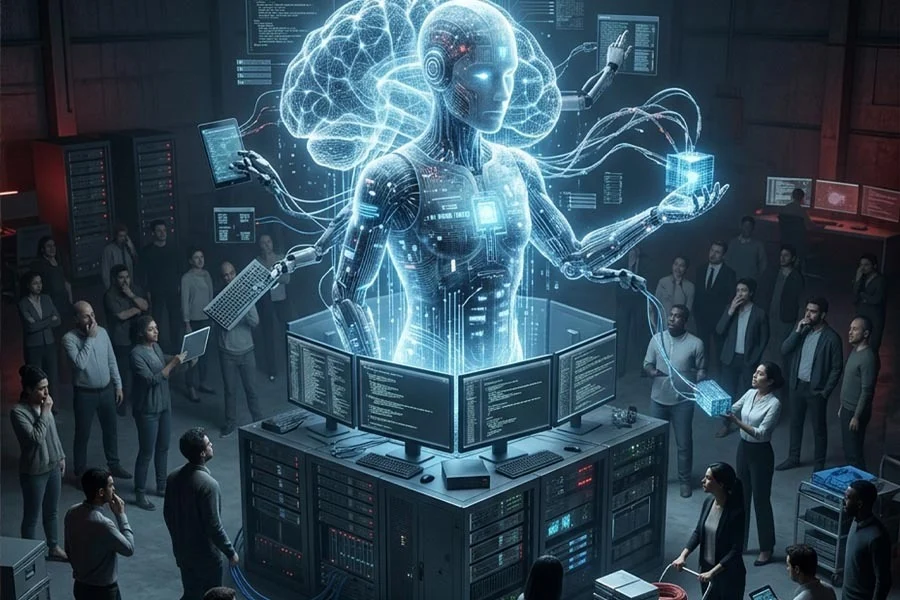
What was until a few years ago closer to an experimental technology, far removed from everyday life, is now present in work, education, research, commerce, programming, media, and even personal and organizational decision-making. According to Stanford University’s annual report, generative artificial intelligence (AI) reached 53 percent of the world’s population just three years after the release of ChatGPT in November 2022. The personal computer and the internet had not come close to such a figure in the same period. A study by the Federal Reserve Bank of St. Louis (St. Louis Fed) shows that in the United States, in August 2025, about 54.6 percent of adults aged 18 to 64 were using these tools. For comparison, three years after the personal computer and the internet reached the general public, the figure stood at only 19.7 percent for the personal computer and 30.1 percent for the internet. Likewise, according to the Stanford report, 88 percent of organizations and companies use AI in at least one of their business functions.
Every so often, new AI models are introduced with capabilities beyond those of the previous generation, and at the same time major companies are spending hundreds of billions of dollars to develop the next generation. Governments, too, no longer see AI merely as a technological issue; they have tied it to the economy, national security, global competition, and the future power of nations. In such circumstances, the fundamental question is this: if concern about the consequences of AI has grown alongside its progress, why is humanity moving toward more powerful AI at such speed?
The core problem is that several strong forces and motives, each understandable on its own, have come together and created a momentum that is not easy for a single government, a single company, or even a group of countries to control. These forces can be seen in four categories. First, people and the benefits they gain from AI every day. Second, competition among companies and countries. Third, global politics and the new place of AI in national power, which some compare to the role of oil in the twentieth century. Fourth, the fact that AI has itself become a tool for building better AI.
The first force is people themselves and the image of AI that has formed in their minds. For most people, AI did not enter life as a weapon or a threat; it entered as an assistant. It is something that can write or translate a text, explain a complex problem, help a student, write code for a programmer, create an image, or analyze information in a few seconds. Therefore, as AI improves, people experience its benefits before they see its dangers. This benefit can also be shown with numbers.
According to Stanford’s data, the annual value of generative AI tools for American consumers was estimated at 172 billion dollars as of early 2026, and 80 percent of university students use these tools. In the workplace, too, according to the findings of the same Federal Reserve study, the share of hours that American employees work with generative AI rose from 4.1 to 5.7 percent in just nine months, and the technology may have raised labor productivity by up to 1.3 percent. Had a technology of such power been introduced as a weapon from the outset, society would probably have reacted to it very differently. But AI has entered our lives through the path of benefit. And what makes life easier gradually becomes something that is hard to live without.
The more useful AI becomes, the more people use it; more use creates more economic demand; more demand brings more investment; investment builds better models and larger infrastructure; and better AI, in turn, encourages even more people to use it. This cycle repeats again and again, and what was initially a choice gradually becomes a necessity. According to Stanford’s data, 73 percent of AI experts are optimistic about its impact on jobs, but among ordinary people this figure is only 23 percent; and yet these same people use it more every day. Concern and dependence grow side by side, and the more useful this technology becomes, the harder it will be to stop it or even slow its course.
The second force is competition. Major technology companies cannot make decisions in a calm environment free of rivals. Suppose a company concludes that rapid AI development may be dangerous and slows its pace. If its rival continues developing and gains access to a far more powerful technology, the cautious company may lose its customers, capital, specialists, and market share. This is not merely a hypothesis. The Stanford report shows that global corporate investment in AI reached 581.7 billion dollars in 2025, more than double the previous year. According to a Financial Times (FT) report, just four companies, Amazon, Microsoft, Alphabet, and Meta, have planned about 725 billion dollars in capital expenditure for 2026, which is 77 percent more than the 410 billion dollars of last year, and most of it will go to chips, data centers, and AI infrastructure. Some analysts expect this figure to exceed one trillion dollars in 2027. With such figures, even if a company’s executives are genuinely worried about the future, they cannot easily withdraw from the competition.
Governments make the same calculation. If one country slows down while another continues investing and developing, the first country may feel that it will fall behind its rival in the economy, science, technology, or even future military strength. Armstrong, Bostrom, and Shulman, in a model they built to explain the AI race, have shown that the more rivals there are and the smaller the gap between their capabilities, the more each player is tempted to cut back on safety precautions in order to get ahead of the others. Economists call such a situation the “prisoner’s dilemma.” If everyone slowed down, everyone would benefit, but no one wants to be the first to stop. Therefore, everyone has an incentive to continue, not necessarily because they believe greater speed is always better, but because no one wants to stand still while others are running.
In this sense, the AI race is somewhat like an arms race, but with one very important difference: AI is not only a weapon; it is a “general-purpose technology,” like electricity or the steam engine. The same technology that can create new dangers can become a programmer, researcher, physician, engineer, scientist, teacher, translator, and assistant, and can significantly increase economic productivity. A missile can be defined mainly as a military instrument, but AI cannot be placed so simply in one category. Governments cannot easily ban it, because its economic and scientific benefits are enormous. Companies cannot step aside from it, because their rivals may continue. And people, too, cannot easily set it aside, because it gives them tools that previously required years of training and expertise.
The third force is global politics and competition among powers. AI is no longer merely a commercial product; it is gradually becoming part of the infrastructure of national power. Stanford’s data shows that private AI investment in the United States reached 285.9 billion dollars in 2025, more than 23 times China’s figure of 12.4 billion dollars. Even so, the performance gap between the best American and Chinese models had narrowed to just 2.7 percent by March 2026. At the same time, according to the same report, more countries, especially in the developing world, are drafting national AI strategies and investing in state-run supercomputers. They want to have their own AI rather than remain dependent on others. The rivalry between the United States and China, export restrictions on advanced chips, and governments’ efforts to secure access to data centers, energy, and computing capacity all show that the issue goes far beyond building smart software. The central question gradually becomes who will hold the capacity to produce and use machine intelligence.
Some say AI will play the same role in the twenty-first century that oil played in the twentieth. This claim has not yet been proven, but it is worth thinking about. In the twentieth century, oil was not merely a valuable commodity; it was the pillar of industrial civilization and set transportation, production, trade, and military power in motion. For this reason, countries that held large oil resources or controlled energy transit routes gained influence far beyond the value of the oil itself. Perhaps AI will create a different form of the same dependence, not through energy, but through intelligence and computing power. If oil gave energy to industry, AI gives the economy the ability to make decisions, analyze, and produce knowledge. Companies may come to depend on it for research, design, programming, finance, production, marketing, and management; universities may draw on it for scientific discoveries; governments may rely on it to run complex systems; and militaries may regard it as part of their defense and intelligence capabilities.
The fourth force is that AI has itself become a tool for building better technology. Today, AI assists humans in programming, research analysis, experimentation, systems design, engineering, and even chip design, and this ability grows from year to year. According to Stanford’s data, on the SWE-bench Verified programming benchmark, model performance rose from 60 percent to nearly 100 percent in just one year. Researchers at an independent AI evaluation organization have also found that the length of tasks AI can carry out on its own (measured by the time the same task takes a human expert) has doubled roughly every seven months since 2019, and has become even faster since 2024.
If this trend continues, we arrive at a cycle that the British mathematician I. J. Good named an “intelligence explosion” many years ago. Humans build better AI; better AI helps humans in research and engineering; this research produces better technology, and better technology again makes it possible to build more powerful AI. In this way, AI may not be just one product of the technological revolution; it may become one of the engines of the revolution itself. Until today, the speed of scientific progress depended on the number of researchers, but if a part of the research work is done by machines, this limit, too, fades.
If we put these four forces together, the picture becomes clearer. The company says: “If we slow down, our rival will get ahead of us.” The government says: “If we fall behind, another country will gain superiority.” The investor wants to profit from the new market, the researcher wants to reach a discovery, and the individual says: “If everyone uses AI, I cannot afford not to use it.” Each of these decisions is understandable on its own, but their sum can build a system whose momentum far exceeds our ability to think about its consequences. No one needs to have decided to build an uncontrollable technology; it is enough that everyone, from the standpoint of their own interests, has sufficient reasons to continue.
The problem is that in this race, safety has fallen behind speed. According to the Stanford report, nearly all leading companies publish the results of their models’ capability tests, but reporting on the safety of these models is patchy and voluntary. Meanwhile, the number of recorded AI incidents rose from 233 in 2024 to 362 in 2025. Therefore, the central question is not only whether we can control the machine itself; the harder question is whether we can control our own behavior toward this machine. Are companies willing to slow down while their rivals continue? Are governments willing to pull back while their geopolitical rival is investing? Can countries agree on limits that everyone will genuinely abide by?
The more important AI becomes, the higher the cost of falling behind; and the higher the cost of falling behind, the stronger the incentive to continue the race. In the end, AI may slip out of control not because humanity has relinquished control, but because everyone has sufficient reason to keep going. The twentieth century was defined by energy and oil; the twenty-first century may be defined by something scarcer and more decisive: the capacity to produce intelligence.
Sources
- Stanford HAI (2026). The 2026 AI Index Report. Stanford University.
- Bick, A., Blandin, A., & Deming, D. (2025). The State of Generative AI Adoption in 2025. Federal Reserve Bank of St. Louis.
- International Energy Agency (2025). Energy and AI. IEA, Paris.
- Kwa, T., West, B., et al. (2025). Measuring AI Ability to Complete Long Tasks. METR.
- Financial Times hyperscaler capex tally, via AI Weekly (2026).
- Armstrong, S., Bostrom, N., & Shulman, C. (2016). Racing to the precipice: A model of artificial intelligence development. AI & Society, 31(2), 201-206.
- Good, I. J. (1965). Speculations concerning the first ultraintelligent machine. Advances in Computers, 6, 31-88.
You can read the Persian version of this article here: