When I enter Ziba’s beauty salon, the first thing I notice is the mirrors. Large mirrors cover the walls, reflecting the images of women who have each come here to spend a few hours taking care of themselves. The smell of hairspray, perfume, creams and cosmetics fills the air. Brushes, combs, hair dryers, makeup tools, hair dye and other equipment are neatly arranged on the tables.
Several young women in neat clothes and with styled hair are busy working. One has sectioned a client’s hair and is carefully blow-drying it strand by strand. Another is shaping a client’s eyebrows, using delicate movements to change the form of her face. A third woman gently applies eyeshadow to a client’s eyelids, stepping back every so often to check the result in the mirror.
Hairdressing here is not simply a few movements with a brush, powder or lipstick. Every task has its own technique and rules: understanding skin tones, choosing hair colors, combining colors, shaping eyebrows, matching makeup to the face, styling hair and even knowing what does not suit a particular face.
Ziba says beauty, when done professionally, is not meant to change a woman’s face. It is meant to bring out the beauty she already has.
In one corner, a young woman prepares a client’s hair for an updo. She divides the hair, twists it, secures it with pins and checks it again in the mirror. She lets a few strands fall loose before arranging them again. For a good updo, not even a single strand of hair is left out of place without purpose.
It is here that one can understand that behind what people call “makeup” is a complete profession, one that requires training, practice, skill and years of experience.
Ziba learned this profession in Iran. She went to Iran to study hairdressing and later returned to Afghanistan, not simply to open a salon, but to put the skills she had learned to use in her own country.
Before the Taliban returned to power, Ziba’s salon was one of the larger salons. Many women worked there and earned an income through their profession. Each had her own skills, and every customer who entered the salon helped keep the livelihoods of several other women going.
Ziba says those days were not only busier. There was a different sense of energy and life in the salon: “Before the Taliban came to power, our work was very different. We had a lot of motivation. The sound of cheerful local music filled the salon. For women who came for weddings, their celebration started here. Before people even reached the wedding hall, they could already feel the joy of the occasion.”
In those days, a bride could enter the salon without fear. She could have her hair done, put on her makeup, get dressed and take photos with the groom in the special space Ziba had prepared for photography: “The groom could come with the bride. They would take photos in the photography area we had prepared in the salon. People could come and go freely, and no one was afraid.”
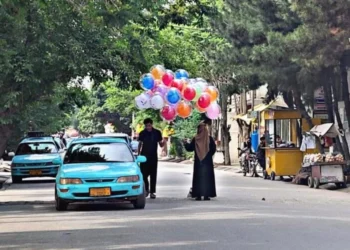
Today, however, the same salon, with the same mirrors and equipment, has a different atmosphere. Ziba sits behind her desk. Her mobile phone is on one side, while the screen showing the security cameras is on the other. Four areas outside the salon appear in several small images: the alley, the street, the entrance and the area around the building.
Every few minutes, Ziba stops working and looks at the screen. She checks the images one by one. Is someone standing too close? Has an unfamiliar vehicle been parked there for too long? Is anything outside unusual? Once she feels reassured, she returns to the salon.
This has also become part of her profession. Alongside knowing skin tones and facial shapes, she must now monitor what is happening outside. She has to know when a client should arrive, when she should leave and what might attract unwanted attention.
Ziba says that today, even the way a client arrives has to be carefully considered: “Now people have to come and go carefully so that no one notices. For example, a decorated wedding car should not come close to the salon because it is dangerous.”
Once, a decorated car was a sign of a wedding and the beginning of a celebration. Today, the same car can draw attention toward the salon that Ziba does not want. Yet despite all these precautions, women still come.
One of the clients looks at herself in the mirror as her hair is prepared for an updo. The hairstylist makes the final touches to her makeup. The woman smiles and says: “There are more restrictions now, but we do not bow our heads. We come, take care of ourselves and do not forget our beauty because we are women. Maybe we cannot do everything as freely as before, but at least we can have a few hours for ourselves.”
Her words are simple, but behind them lies a world of change. For many women, taking care of their appearance is not simply a luxury. Sometimes, sitting in front of a mirror for a few hours is an opportunity to see themselves again, to remember that amid all the restrictions and pressures of life, they still have themselves.
A woman may come to have her hair done, but she may leave with something more than neatly styled hair: confidence, a sense of well-being and a few hours of peace.
Ziba says the number of her clients has not decreased and that many women still come to the salon for makeup and beauty services. Many women also work there and earn an income through the profession: “Although the environment has become frightening, our clients have not decreased. Many women work here. The only difference is that we used to have peace of mind, music and the freedom to work without fear. Now everything has to be done carefully.”
Still, the sounds of work can be heard in the salon. The sound of hair dryers, brushes moving through hair and makeup drawers opening, along with the occasional laughter of the young women who, for a few moments, forget about the heavy atmosphere outside.
Ziba wants these sounds to continue. For her, hairdressing is more than a job. She spent years training to reach this point, and now she wants to pass what she has learned on to other girls: “This is our profession. We learned it and we will continue. We will also teach other girls so that this profession does not disappear.”
She knows that every girl who learns hairdressing may one day be able to work for herself. She may open her own salon, have her own clients and earn an income from a skill she learned with her own hands. That independence is deeply valuable to Ziba. She does not want the girls who have worked alongside her for years to abandon the profession they have worked hard to learn simply because of fear.
In one corner of the salon, one of the young women secures the final pins in an updo. The woman in front of the mirror turns her head slightly to see the result. When she sees her reflection, she smiles. Ziba looks at her and smiles too.
For a few seconds, there are no cameras outside, no suspicious vehicles, no fear and no need for caution. There is only a woman, a mirror and a face that is happy to see itself.
Perhaps that smile captures the entire philosophy behind Ziba’s work: despite everything that has changed, women still want to see themselves, take care of themselves and keep their beauty alive.
Ziba’s salon is no longer the place filled with music and activity that it once was. But its mirrors are still lit, the hands of its young workers are still busy and women still walk through its doors, unwilling to let restrictions take away their right to feel beautiful and feel good about themselves.
And perhaps, for Ziba, it is enough to open the salon door every day, check the cameras outside, tell the girls, “Work and be independent,” and sit behind her desk again, somewhere between fear and beauty, between caution and hope.