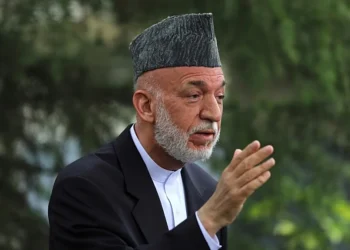
Zalmay Khalilzad, former U.S. Special Envoy for Afghan Peace, has recently lashed out at Gulbuddin Hekmatyar, the leader of Hezb-e-Islami Afghanistan, calling him the “Butcher of Kabul” in a post shared in Persian, Pashto, and English on X. Hekmatyar, for his part, had previously described Khalilzad as the “invisible president of Afghanistan.” Khalilzad’s latest remarks came in direct response to that jibe. Moreover, reacting to Khalilzad’s criticism of jihadist leaders, Hekmatyar stated: “A retired foreign official has no right to insult the mujahideen and jihadist leaders, especially in defense of one faction.” By “faction,” Hekmatyar was clearly referring to the Taliban, whom Khalilzad has repeatedly praised.
Several points are worth noting in this regard:
1) The reality is that Khalilzad has openly and unapologetically supported the Taliban and appears willing to go to great lengths to justify the actions of their regime. At times, he expresses this support explicitly. But when he senses that overt praise could spark controversy, he shifts to a subtler tactic, discrediting the Taliban’s rivals. This, too, amounts to a defense of the group, often more effectively than outright endorsement. Khalilzad’s preferred targets are those figures who seem capable of mobilizing resistance and rallying forces against the Taliban, Hekmatyar included.
Indeed, one way to rationalize the Taliban’s behavior is by dismissing their political opponents, or more broadly, by discrediting the former republic. The truth is that the Afghan Republic was deeply flawed, yet constantly denigrating it only helps normalize the Taliban’s Islamic Emirate, or worse, creates a climate where the current regime is viewed as more favorable than its predecessor. For now, Afghanistan faces only two active forces: the Taliban and the remnants of the Republic. These are the only choices available. A third force, democratic, independent from both the Taliban and the Republic, has yet to emerge.
2) Hekmatyar, for better or worse, has not formally aligned himself with the Taliban. On the contrary, he occasionally issues statements that antagonize them. For a figure like Hekmatyar, even this level of risk-taking is noteworthy. More importantly, as a Pashtun jihadist leader with a relatively strong grounding in Islam, his criticism of the Taliban resonates more effectively than that of many others. It is precisely for this reason that he has been barred from delivering Friday sermons, restricted from meeting with supporters, and pressured to relocate. Admittedly, Hekmatyar is not a democrat. But he is also not a Taliban. He lived for a time under the Republic, expressed support for elections, and even endorsed girls’ education.
3) On his X account, Khalilzad wrote: “Hekmatyar, the Butcher of Kabul, was once the man who threw acid on the faces of female students in Kabul.” Khalilzad described Hekmatyar as a misogynist who deserves condemnation, not support. Yet in doing so, he slyly exposes Hekmatyar’s past misdeeds not necessarily out of genuine concern for Afghan women’s rights. If Khalilzad truly cared about women’s rights in Afghanistan, why does he remain silent about the current reality, a situation that is, in fact, the result of his own years of political maneuvering? For four years now, Afghan girls have been barred from education, a policy that has shocked the world. And yet, Khalilzad casually sidesteps this colossal injustice. Indeed, acid attacks on women were abhorrent crimes, and perpetrators should be punished without exception. But the deprivation of an entire generation of girls from education, especially on discriminatory grounds, carries devastating consequences: psychological, moral, familial, social, and even generational. Such a policy cannot be excused under any pretext. If Khalilzad finds reason to rage at Hekmatyar for acid attacks against women, consistency demands that he also condemn the Taliban, rather than insisting on the continuation of their regime.
4) Khalilzad also wrote: “He (Hekmatyar) was in Moscow, impatiently seeking a meeting with Mullah Baradar (currently deputy prime minister of the Taliban) to strike a secret deal. But they (the Taliban) refused, considering him too corrupt and treacherous toward his own people.” In this framing, Khalilzad, whether deliberately or not, presents the Taliban as loyal to the people’s interests while casting Hekmatyar as a traitor. By that logic, for Khalilzad, the Taliban stand as the preferable choice for governing Afghanistan compared to jihadist leaders. This is not the first time Khalilzad has applied such a double standard. In an earlier interview, he labeled Abdul Rashid Dostum, the leader of the Junbish-e-Milli party, a “lawbreaker,” while praising Mullah Baradar as a “patriot.” The question remains: by what criteria does Khalilzad conclude that the Taliban are faithful to the people’s interests, while their rivals are traitors?
5) Khalilzad has further accused Hekmatyar of foreign ISI (Pakistan’s Inter-Services Intelligence) and Iran’s Quds Force.” dependency, writing: “He (Hekmatyar) once served the For Khalilzad, Hekmatyar is guilty for having cooperated with the ISI even if in the past rather than the present. But if that is the case, then how does Khalilzad justify his own infatuation with the Taliban? The Taliban, by near-unanimous consensus among governments, institutions, and researchers worldwide, are a creation of Pakistan nurtured, supported, and escorted right up to the gates of power by Islamabad.
6) Admittedly, Hekmatyar has not truly broken with Pakistan, and Islamabad still appears to trust him. At the same time, Khalilzad has made no secret of his animosity toward Islamabad. More recently, Pakistan’s own relations with the Taliban have soured. Islamabad now seems increasingly inclined to re-engage with Taliban rivals. Against this backdrop, Khalilzad appears eager to tarnish and isolate figures who might, under pressure, prove useful to Pakistan in its confrontations with the Taliban. Notably, Khalilzad has himself claimed that Hekmatyar’s attacks on him were instigated by the ISI.
You can read the Persian version of this analysis here: