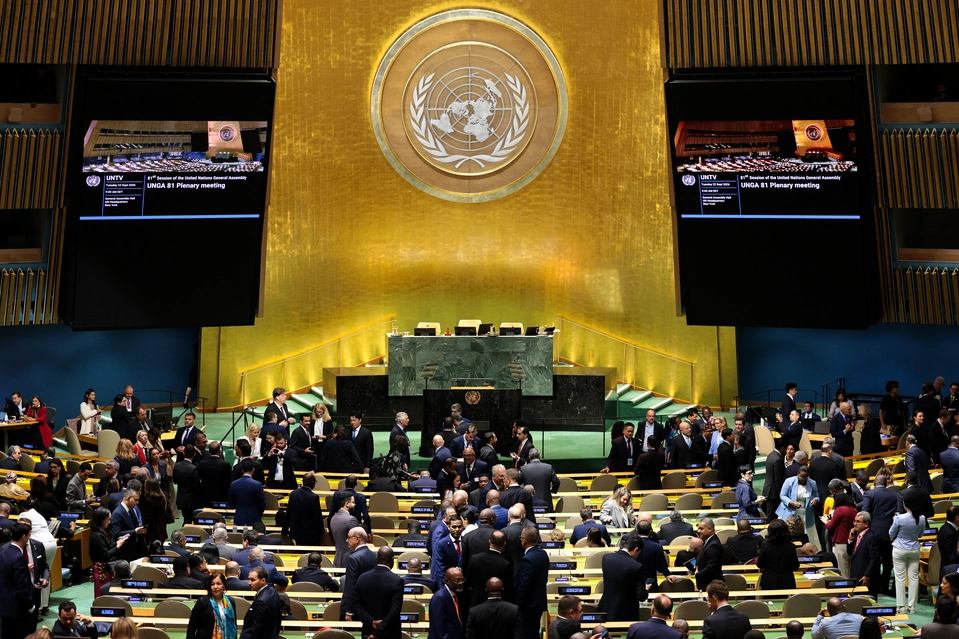
For five years now, at the annual podium of the United Nations General Assembly (UNGA), among the leaders of the world’s countries, no face from Afghanistan has appeared in the stature of a president: not an image of a high-ranking delegation from Afghanistan alongside other government delegations, and not a voice from the country’s highest political office. In a sense, the UNGA is a mirror of the will and presence of the world’s nations, a place where the people of every country turn their eyes to New York to see how their leaders speak about their country, their people and their national interests. For Afghanistan, however, this stage has stood empty for five years. This absence is not merely a ceremonial void; it raises more serious questions about the standing of Afghanistan and its current regime in the international system.
The root of this prolonged absence lies in the conduct of the Taliban regime. Over the past five years, the Taliban have in many cases not responded positively to the demands and concerns of the international community. The imposition of sweeping restrictions on the lives of women and girls, the exclusion of a large part of society from participation in power, and the distancing from demands raised by the international community have deepened the gap between Kabul and the world. The Taliban want to be accepted internationally as the only legitimate government of Afghanistan, but at the same time they show no flexibility on a significant portion of the requirements and demands raised for more normal engagement with the world. This contradiction is one of the major obstacles to normalizing Afghanistan’s relations with the international community.
This situation is also questionable from a diplomatic perspective. Taliban officials have repeatedly spoken of “active diplomacy” and of the world’s attention to Afghanistan, but they have forgotten that diplomacy is not limited to regional trips, bilateral meetings, and attendance at some marginal and showcase gatherings. At the most important annual podium of the United Nations (UN), where heads of state and senior government officials speak about global issues and the national interests of their countries, Afghanistan’s seat is empty. At least in terms of image and diplomatic influence, this absence cannot be overlooked. If the goal of diplomacy is effective presence, carrying a country’s voice to the world and defending national interests in international forums, then Afghanistan’s absence from such a stage raises a serious question about the Taliban’s diplomatic achievements. Certainly, the empty place of a country at the world’s most important annual political podium cannot be filled by repeating the phrase “active diplomacy.”
The matter becomes more serious when we see that others speak about Afghanistan while the voice of its highest political official is not heard on this stage. When Afghanistan has no effective political presence in such an arena, others put forward their own views on its crises, its future and related issues, and they gain a greater role in shaping the international narrative about it. Of course, this does not mean that decisions concerning Afghanistan will necessarily be made without Afghanistan’s presence; however, the absence of political representation at a high level creates more room for others to speak about Afghanistan and to influence discussions about its future.
From this perspective, the continuation of this situation cannot be viewed as entirely separate from the Taliban’s exclusionary and confrontational approach. A regime that seeks international acceptance and engagement, yet shows no flexibility on a significant portion of the international community’s political and legal demands, in effect makes it harder for Afghanistan to have a more normal and effective presence on the international stage. The cost of this absence is not borne by the Taliban alone; Afghanistan and its people pay for it as well.
This reality becomes even more bitter for the Taliban when we compare Afghanistan with Syria. Ahmad al-Sharaa, the president of Syria, attended the annual session of the UNGA and even generated notable moments on its sidelines. The media interviewed him, and government delegations met and held talks with him, even though in some respects al-Sharaa’s record is darker than that of the Taliban: membership in the Islamic State (IS) and Al-Qaeda.
This comparison is worth reflecting on because it shows that the record of a political actor, however dark and controversial, is not necessarily the end of the road for diplomatic engagement. Policies can change, positions can change, and governments can open new paths to reduce their distance from the world. Yet after five years and one month, the Taliban have still not managed to bring Afghanistan to a position where the highest political official of their regime appears alongside the leaders of other countries at the main podium of the UNGA.
The final question, however, is how long this situation will continue. Given the persistence of the Taliban’s policies and positions, the prospect of a swift end to Afghanistan’s political isolation remains unclear. As long as the Taliban show no flexibility on a significant portion of the international community’s demands, do not take inclusive political participation seriously, and do not take fundamental steps to build mutual trust with the world, the distance between Afghanistan and the international community may continue.
But the weight of this isolation falls most heavily on the shoulders of the people of Afghanistan. The Taliban hold power and the instruments of government, yet it is the ordinary citizen of Afghanistan who feels the consequences of reduced international engagement, shrinking economic and diplomatic opportunities, and persistent global mistrust in daily life.
Ultimately, Afghanistan’s empty place at the annual podium of the UNGA is not merely the empty place of a speaker; it is the empty place of a voice, and the empty place of Afghanistan’s political representation on one of the most important stages of world diplomacy. And if this absence continues, the question will not only be why the Taliban are not present in New York; the larger question is why Afghanistan must continue to pay the price of a policy whose outcome is a longer distance between this country and the world.
You can read the Persian version of this report here: