Afghanistan is on the cusp of a new game. On one side, the activities of anti-Taliban fronts have expanded, and on the other, new regional maneuvers centered on Afghanistan are taking shape. Inside the country, the National Resistance Front (NRF), the Freedom Front, the Republic Front, and the United Front have been focusing very systematically and deliberately on launching guerrilla attacks against the Taliban. However, other developments are also unfolding across the region that require closer monitoring and analysis.
Recently, Saudi Arabia’s Delta Oil Company signed an oil contract with the Taliban. The broker of this contract was Zalmay Khalilzad, even though he does not operate in an official capacity on behalf of the United States government. Saudi and American activity in western Afghanistan, in cooperation with the Taliban, is not solely focused on oil and gas extraction. The matter also concerns geography, influence, and the creation of a new economic and potentially security ring adjacent to Iran.
There are also reports emerging from Iran that the Quds Force of the Islamic Revolutionary Guard Corps (IRGC) has established a military camp for the Fatemiyoun Brigade in Sistan-Baluchestan province. If this development is placed alongside the events unfolding in western Afghanistan, it becomes clear that both sides are in the process of measuring and reinforcing their security depth on either side of the border.
On this side of the equation, the Taliban are suppressing the Khatam al-Nabiyyin complex and the Supreme Commission of Shia Muslims of Afghanistan, even though these movements and institutions once served as the Islamic Republic of Iran’s communication network with the Taliban. Yet they were suddenly targeted for suppression. This change in Taliban behavior must be understood within the context of regional developments, not in isolation from them. Although the Islamic Republic of Iran has not withheld any form of cooperation with the terrorist group the Taliban, in the end, the influence of Qatari and Saudi actors over the Taliban has always surpassed that of the Iranians.
If we seek a simple answer to these complex developments, we can conclude that the terrorist group the Taliban, on the advice of Khalilzad and ethnic secular networks outside Afghanistan, have concluded that in the ongoing conflict between America and Iran (in which Saudi Arabia is indirectly involved), the Taliban should remain aligned with Riyadh and Washington.
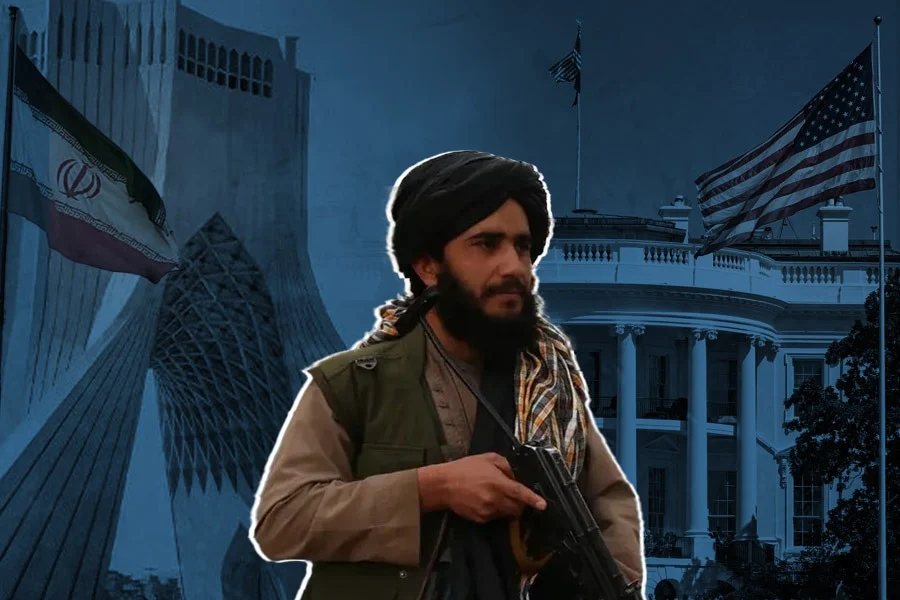
This is precisely where the issue of the Taliban as America’s “silent pawn” gains significance. The Taliban may appear to be at odds with America on the surface, but this apparent disagreement should not blind us to the shared interests that have formed between the two sides in certain arenas. After withdrawing its forces from Afghanistan, America no longer needs to send soldiers back to advance all of its objectives. If the Taliban control the geography of Afghanistan, restrict the activities of America’s and Iran’s adversaries, keep the door open for economic activity by America’s allies, and at the same time prevent the complete collapse of the ruling structure, America can pursue some of its goals through this very structure without a direct military presence.
The Doha Agreement can also be examined within this framework. The agreement effectively paved the way for the withdrawal of American forces and transformed the Taliban from a warring force into the primary party in negotiations over Afghanistan’s future. America withdrew from Afghanistan, but its connections and levers of influence did not fully exit with it. Therefore, the Doha Agreement can be understood not merely as an accord to end the war between America and the Taliban, but rather as the beginning of a phase in which the Taliban could take control of domestic power and America could retain other tools for maintaining its influence without a direct military presence.
The matter of the forty million dollars per week flowing into the country as humanitarian aid and support for Afghanistan’s needs can also be understood within this framework. This money is officially classified as humanitarian aid on the surface, and one cannot directly consider all of it as payment to the Taliban. However, the reality is that such a financial flow in a country where power, economy, and security are all under Taliban control cannot be entirely separate from political calculations. The Taliban benefit from the continuation of this financial flow, and America, by maintaining it, can prevent the complete economic collapse of Afghanistan while retaining a lever of influence at the same time.
Of course, the term “silent pawn” does not mean that the Taliban follow America’s directives at every moment. Rather, it means that the Taliban can serve as a structure that, without America’s direct presence, advances some of America’s and the West’s objectives in the region. A great power does not always need to be present on the field itself. Sometimes it is sufficient for a structure to exist on the field that serves the interests of that power.
Some elements of Saudi intelligence forces or even combat units are reportedly set to be repositioned in western Afghanistan, near Iran’s eastern borders, under the guise of economic activity. The Taliban, in formally acknowledging this practical support for the side opposing Iran in this conflict, proceeded to dismantle institutions and remove individuals with close ties to Iran.
If Saudi Arabia’s economic presence in western Afghanistan gradually transforms into security, intelligence, and protective networks, it can no longer be regarded as merely an economic project. In such geopolitical games, capital enters first, then infrastructure is built, the security of that infrastructure subsequently becomes paramount, and ultimately a network of individuals, movements, and connections takes shape in a given region. The more significant components of such plans are naturally never written into economic contracts.
America’s primary strategy in such a scenario could be to use Afghanistan to exert pressure on Iran from the east, pressure that does not necessarily take the form of direct war. America, on one hand, pursues economic and energy pressure on Iran and, on the other, can use Afghanistan’s geography to complete the pressure ring from the east. Saudi Arabia can also play an economic and regional role in this plan. Investing in energy, creating new transit routes and trade channels, and moving closer to Iran’s borders can all be part of this strategic alignment.
Besieging Iran is not accomplished solely by closing borders. Today, a siege can be economic, energy-based, commercial, political, and security-driven. If new economic and energy routes are built in Afghanistan that exclude Iran, while the capital and influence of Iran’s rival countries simultaneously increase near its eastern borders, this can become an important link in the land siege of Iran.
In this context, the matter of oil and energy transfer and transit also gains importance. Creating rival routes around Iran and altering the energy dependencies of regional countries can be a component of the economic pressure. The objective is not necessarily to have Afghanistan directly block Iran’s oil export routes, but rather to create a competing economic and energy environment surrounding Iran so that Tehran gradually loses part of its geographical and economic advantage.
The Islamic Republic of Iran has sensed the threat emanating from the Taliban. A new game is therefore taking shape. The complexity of this game lies in the fact that Pakistan still appears to have fundamental problems with the Taliban on the surface, but in this new game, Pakistan’s allies are supporting the Taliban.
Iran, under such circumstances, cannot simply allow Afghanistan to become a base of influence for Saudi Arabia and the West near its borders. For this reason, the more the presence of Iran’s rivals in Afghanistan grows, the greater Tehran’s efforts will become to preserve its influence networks and build security depth to the east. This is exactly the point at which the presence of the Fatemiyoun Brigade in Sistan-Baluchestan becomes significant, since Tehran does not want to be left without deterrence tools in the face of the changing security alignment to its east.
In effect, two games are unfolding simultaneously. One side seeks to use Afghanistan to move closer to Iran’s borders and exert economic and security pressure, while the other side is trying to neutralize this very pressure from within the region. Afghanistan sits in the middle of this game, and the Taliban hold both the geography and the structure of power.
The hidden agendas of these countries are also visible precisely at this juncture. No country announces that it is pursuing an economic project to besiege its rival. No contract is written stating that the purpose of an investment is to build intelligence depth or alter the security balance. But when capital, energy, geographical position, and security developments converge simultaneously in one location, the interests operating behind the scenes can be identified from the direction these developments are moving.
For America, Afghanistan can serve as a pressure arena against Iran and at the same time as a tool for containing China, Russia, and other regional rivals, without America having to bear the cost of a direct military presence again. For Saudi Arabia, a presence in western Afghanistan can expand its economic and political influence, and if developed further, can transform into a strategically important position near Iran. For the Taliban, this game represents an opportunity to secure money, capital, and foreign support while maintaining power. For Iran, the issue is preventing the formation of a hostile ring to its east. For Pakistan, the issue is maintaining influence in Afghanistan under circumstances where it is itself entangled with the Taliban over security concerns and the provocation of the Pakistani Taliban (Tehrik-i-Taliban Pakistan, or TTP).
The bitterest part of this game is that Afghanistan is not the ultimate goal for any of these powers. Afghanistan is geography. It has oil and gas, it has borders, it has transit routes, it has armed groups, and most importantly it is situated at a point that can affect Iran, Central Asia, Pakistan, and China. It is precisely this positioning that makes Afghanistan valuable to the great powers and once again puts the people of Afghanistan at risk of being turned into instruments of others’ rivalries.
Therefore, what is happening in western Afghanistan today should not be seen merely as an oil contract, and what is happening in eastern Iran and among networks close to Iran should not be regarded as merely a military repositioning. These developments can be pieces of a much larger game, a game in which economics replaces bullets, capital replaces armies, and political and intelligence influence replaces an official military presence.
Ultimately, Afghanistan appears to have entered a phase in which internal conflict intertwines with regional rivalry and economic warfare. Anti-Taliban fronts inside the country have become more active, while at the same time Saudi Arabia is drawing closer to western Afghanistan through capital and energy investment. Khalilzad appears alongside the Taliban in the process of this contract; the flow of foreign funds continues, and the Taliban, at the same time, are intensifying pressure on certain networks and institutions with close ties to Iran.
If we place these developments side by side, a clearer picture emerges. America, after its military withdrawal, has not completely abandoned Afghanistan; rather, the form of its influence has changed. The Taliban can, in this situation, serve as America’s silent pawn and even function as an indirect proxy group, a structure that holds power in Afghanistan and can advance some of America’s objectives in the region without requiring America’s direct presence. The Doha Agreement was the beginning of this phase, and the continued flow of funds is one of the tools for maintaining stability and influence within this structure.
On the other side, Saudi Arabia can complete the economic ring of this policy in western Afghanistan. An economic presence near Iran’s borders, if extended to energy routes, trade, and security frameworks, can become part of Iran’s land siege, a siege that begins in Afghanistan and whose aim is not merely military pressure, but rather the weakening of Tehran’s economic, energy, and regional influence position.
Iran, too, senses this danger and is seeking to strengthen its security tools and influence networks in order to prevent the formation of such a ring to its east. As a result, Afghanistan can become one of the main arenas of Iran’s indirect confrontation with America and its regional allies.
What is visible in the media is an oil contract, humanitarian aid, Taliban tensions with Shia institutions, and security developments. But behind these surface-level events, the larger issue concerns geography and control of influence routes. America seeks to tighten pressure on Iran from multiple directions. Saudi Arabia can reinforce part of this pressure through Afghanistan. The Taliban can serve as the executive instrument of this presence. And Iran, in order to prevent being besieged, will strengthen its security depth to the east.
In such a game, Afghanistan is once again at risk of becoming a battlefield for others’ wars, with one crucial difference: the future war will not necessarily begin with tanks and soldiers. It may begin with an oil contract, an investment deal, a flow of money, an energy transit route, an intelligence network, and a gradual shift in the political balance. And if this process continues in this direction, Afghanistan will not only be a field of great power rivalry, but can also become one of the most important pressure links in the broader strategy against Iran.
You can read the Persian version of this analysis article here:
افغانستان میدان جنگ تازه؛ ایران و امریکا و بازتعریف نقش طالبان در معادلات منطقهای