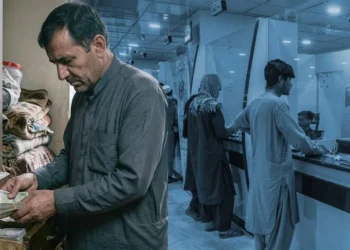

Several families, expressing serious concern over the worsening poverty and unemployment in the country, say that if their family members were not abroad, they would be facing hunger and famine. According to them, the money that citizens of the country send from abroad keeps a large portion of the national economy running. They emphasize that if this money had not flowed into the country, Afghanistan would have fallen into famine under Taliban rule. These families say that the money their family members send from outside the country covers a significant part of their daily expenses. At the same time, they are calling for job opportunities to be created for young people.
Qasem, the father of an eight-member family, says that his son in Germany financially supports his family in Afghanistan by sending money. According to him, this money is spent on daily expenses and house rent, and if his son does not send money every month, the family faces serious difficulty meeting basic needs and even providing food.
This man says: “I am unemployed myself. One of my sons was working, but now he has lost his job too. Another son is in Germany and sends money that covers daily expenses and house rent. Life goes on with the money he sends. If a month passes and the money is delayed, we will have nothing to eat. There is no work in the country. If I work one day, I remain jobless for several days after.”
Zakia (pseudonym), a mother of five children who has lost her husband and is also unemployed, says that her mother-in-law’s nephew pays the family’s monthly house rent and living expenses. She says that to pay her children’s school fees, she cuts back on other household expenses, and due to financial hardship, she has transferred two of her children from a private school to a public one. According to her, her three youngest daughters are still studying at a private school.
Zakia adds: “Life was good before the Taliban came. I worked at a bank and earned a salary of 30,000. My husband was a money changer. The year the Taliban came, thieves killed my husband right at our doorstep. I was left with five orphans. My oldest child was 12 years old. At first they cut my salary, and now they have dismissed me from my job.”
Ramzia, another mother, says that all of her family’s living expenses are covered by her daughter, who has emigrated to Germany. She adds that after her husband was killed, she was left with four orphaned children. She says: “At first, my husband’s brothers covered my and my children’s expenses. After some time passed, they also stopped helping. I was working myself to death until I was dismissed from my job because of Taliban restrictions. Now my daughter sends all of my expenses.”
Ramzia adds that she is worried about her daughter being deported from Germany, and if that happens, her family will face serious problems. She says: “I am worried. Germany is also deporting migrants. If my daughter is deported too, what will I do? In Afghanistan, women are not allowed to work, and there are no job opportunities either. My children are young and cannot work.”
Shahnaz (pseudonym) says that her son sends money for the family from abroad, and they use this money to pay house rent and other living expenses. She says: “The money my son sends is spent only on house rent, electricity and water. My son, who is in Afghanistan,n has been unemployed for a long time. We want job opportunities to be created for young people.”
Omid (pseudonym), a resident of Kabul, says that the economy of a large portion of families depends, in one way or another, on having a family member abroad. According to him, the economic situation of the people, especially the economic situation of families, is far more dire than it appears on the surface.
He adds: “Given the difficult economic conditions and livelihood crisis in Afghanistan, if this opportunity did not exist, we would now be witnessing dangerous humanitarian crises resulting from the complete collapse of family economies. Having a family member abroad has helped many families, and even their relatives, avoid such a disaster.”
Meanwhile, Shakib (pseudonym), an economic affairs expert, says that having family members abroad and the regular transfer of money is one of the effective factors preventing the economic collapse of many families under the current conditions.
He adds: “This money not only covers daily expenses, but also prevents the economic crisis from turning into a deeper humanitarian crisis, such as rising debt, the sale of assets and the complete collapse of livelihoods. However, this assistance is mostly supportive and short-term in nature, and it does not replace the creation of sustainable employment and domestic economic growth.”
According to him, under current conditions, about 10 percent of families earn more than half of their income from remittances sent from abroad. This money is mostly used to cover basic needs, including food, house rent, medical expenses, children’s education, and debt repayment.
Shakib says: “At a time when domestic job opportunities are limited, and incomes are low, this money is often the only thing preventing the complete collapse of families’ livelihoods. A sudden cutoff of remittances, particularly due to the deportation of migrants from Pakistan and Iran, could lead to increased debt, food insecurity and a sharp decline in people’s standard of living. Although remittances can create dependency and stagnation in employment, under the current conditions, where unemployment has reached its peak, they play an important role in keeping family economies afloat and maintaining exchange rate stability.”
This comes as poverty and hunger have intensified in Afghanistan over more than five years of Taliban rule.
During this period, numerous reports have been published about the selling of children in various parts of Afghanistan, and in the same period, many underage girls have entered marriage with older men due to poverty.
You can read the Persian version of this report here:
تشدید فقر و گرسنهگی؛ زندهگی بسیاری از خانوادهها وابسته به حواله مهاجران است