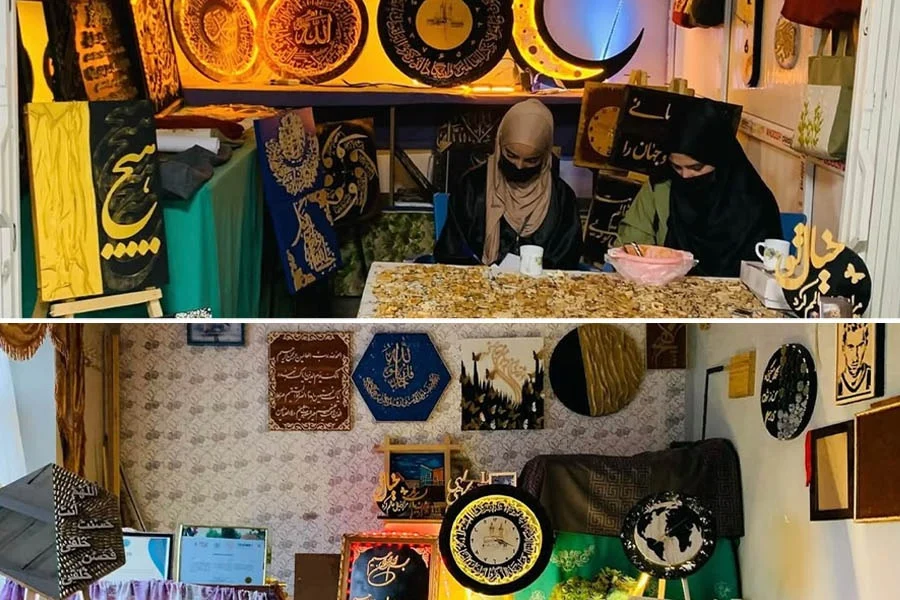
The sound of a blade on wood fills part of Arya Sediqi’s day in a corner of a house in Kabul. Her hands move over the wood, shaping lines and patterns that did not exist moments ago.
Arya is 23 years old and studied up to grade 12 at school. She wanted to continue her education, but that path was cut off when the Taliban closed the doors of education to girls.
This young woman, who was deprived of education, says that at the time she decided to start work she was interested in and could earn an income from, so that she would not remain idle. She now works with four other people in her home workshop and hopes to one day have a large workshop where more girls can work.
Arya says: “When the universities were closed, there was no way to continue. All educational paths were closed. The only open path was to at least find some work for myself to keep myself busy.”
She began woodworking about three years ago. At first, business was not her goal. Arya wanted to make items for the home, things that were both practical and handmade.
Arya says: “At that time, I only wanted to make things that could be used for myself and our home. The first piece I made was inspired by Rumi’s famous notion of ‘Nothing,’ and it gave me a very good feeling.”
Arya’s interest in woodwork grew. She trained under a master craftsman and made her first panels in collaboration with him. Over time, lattice woodwork turned from a hobby into a profession that now forms an important part of her life.
Alongside lattice woodwork, Arya is now also active in wood carving and decoration. She says the income from this work is enough for her daily expenses, and part of it is spent on developing the work and helping her family.
She adds: “The income from this work is enough for my daily expenses, and we spend part of it on buying tools and developing the work, and sometimes we also help the family.”
However, Arya says restrictions on women’s presence at art exhibitions have deprived women artists of the opportunity to present their works and expand the market. She adds: “Large exhibitions are held, and even guests from outside the country attend them, but women are not allowed to participate in these exhibitions.”
She says that despite people’s interest in art and handicrafts, economic problems have reduced the purchasing power for handmade works. She adds: “Our people currently like artists and handmade works, but unfortunately, their economic situation does not allow them to purchase some handmade items.”
Even so, Arya’s market has not remained limited to Afghanistan, and she has so far sent her works abroad as well.
Despite the restrictions, Arya has no intention of giving up her work. For the next five years, she dreams of having a large, independent workshop outside the home, a place where more girls can work and earn an income.
She says: “I would like to have a very good, large workshop where many girls work. A large workshop, a shop, where we can buy a great many tools for our work.”
To reach this goal, Arya is also seeking practical support from institutions and individuals who support artists. She says: “Our request to the supporters of artists is that they be real supporters. So far, we have not seen any support from them.”
You can read the Persian version of this report here:
آریا؛ بازمانده آموزش که رؤیای کارگاه بزرگ را در چوب میتراشد