The discussion of a roadmap for Afghanistan’s future has become a shared language across political circles, the diaspora, and intellectual forums. Each group seeks to present its own vision of what lies ahead: a future shaped by a constitution, political participation, women’s rights, justice, peace, and a new order. A society living under the weight of poverty, repression, migration, and the absence of any horizon needs a picture of the future. Yet the central question remains: do these roadmaps actually connect with people’s lives, or do they linger at the level of elite discourse?
Many political proposals describe the destination more clearly than the path. They speak of a transitional government, a constitution, elections, and the architecture of power, but say far less about how this transition reaches the village, the school, the land, healthcare, employment, the impoverished family, the girl denied education, and the young person without a future. Afghanistan does not suffer only from the absence of political agreement; it also suffers from the rupture between politics and daily life.
Before turning to the Afghanistan Transition Roadmap (ATR), one point must be made clear. Every roadmap, before it becomes a list of projects, carries a political philosophy. The central question is not only which programmes should be carried out; the deeper question is how power is defined, limited, distributed, and held to account. Afghanistan’s crisis is not merely a crisis of governments. It is a crisis in the relationship between people and power. When power is concentrated at the centre, collective interests are sacrificed to personal and networked interests, and people are pushed away from decision-making. Politics becomes a source of corruption, fear, and mistrust.
From this perspective, any serious roadmap must rest on several political principles: human dignity, justice, citizenship rights, the distribution of power, accountability, public participation, equality before the law, and the priority of public interest over group and personal interest. The aim of politics should not be merely to capture the state. The aim must be to build a system in which power is freed from monopoly, and governance is placed in the service of welfare, education, security, justice, and development.
It is from this vantage point that one can examine the ATR, a document that seeks to understand Afghanistan’s transition not only as a transfer of power, but as a rebuilding of social bonds, public services, education, land justice, healthcare, livelihoods, women’s participation, and accountable institutions. By its own definition, the ATR is a people-centred roadmap for rebuilding Afghanistan. It is a plan that connects villages, mid-sized towns, and cities through education, land justice, productive livelihoods, healthcare, religious institutions that uphold human dignity, women’s participation, and accountable public institutions.
The strength of the ATR lies precisely in this shift of perspective. The document does not claim that Afghanistan’s problem rests only at the apex of power. On the contrary, it locates the crisis in the concentration of power, the collapse of trust, the weakness of public services, illiteracy, insecurity over land, rural poverty, the marginalisation of women, and the unfinished work of institution-building. From this view, a political transition cannot bring stability, justice, or peace without repairing the foundations of social life. Legitimacy, too, is built not only through elite agreement but through people’s experience in the school, the clinic, the farm, the market, and the local council.
Even so, a serious critical question remains: can the ATR move from conceptual language to an operational mechanism? Is the idea of “connection” merely a beautiful metaphor, or can it become a workable programme for the child out of school, the girl deprived of education, the landless farmer, the poor family, the under-resourced teacher, and the jobless youth? Without a clear answer, this roadmap risks meeting the fate of other documents that diagnose the problem correctly but fail to change the lives of the poorest.
This is where the role of education becomes prominent, not by reducing the ATR to an education project, but by recognising education as one of the central pillars of transition. Moving from “survival” to “capability” is not possible without literacy, skills, healthcare, land security, and access to markets. Education here is not merely a social service; it is also a tool for forming citizens, raising political awareness, and ensuring oversight of power. If the document treats education as the foundation of citizenship and trust, the conversation around transition moves closer from political slogan to real life. But if education remains only one item among dozens of others, and is not translated into curriculum, teachers, language of instruction, access for girls, digital and offline learning, adult literacy, and links to work and production, it too will become merely a pleasant word.
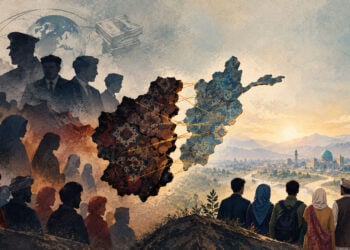
The ATR’s proposal to link village, town, and city also deserves attention. Afghanistan has suffered not only from a crisis of the state, but from a crisis of distance: the distance between the village and the city, the school and the workplace, the farmer and the market, women and institutions, youth and the future, and the people and the state. The concept of a mid-sized town can narrow this distance. It can serve as a space between the village and the large city, bringing health services, secondary education, markets, storage and processing facilities, technical training, and legal services closer to the people. But this idea must not remain only on paper. It must begin with small, measurable, and adjustable pilots.
Another criticism is that, in the 2026 to 2030 phase, the ATR focuses largely on advocacy, knowledge production, diaspora mobilisation, media work, academic engagement in the Netherlands and other European and Asian countries, and preparation for the future, rather than on direct implementation inside Afghanistan. This choice is realistic. But if the ATR remains confined to conferences, articles, and diaspora conversations, it may reproduce the very distance it seeks to overcome.
This limitation should not be hidden. The ATR’s honesty lies precisely in not claiming an immediate rescue. Still, to avoid being restricted to elite language, it must find ways to connect with the reality of ordinary people. One such path is to create online forums and surveys for direct dialogue with marginalised communities. These should not ask people about grand slogans, but about their daily realities: debt, brokerage, fear, coercion, land, water, the absence of any avenue for grievance, rumour, the misuse of aid, and exclusion from education. Such consultations must, of course, be conducted with attention to security, the anonymity of respondents, and the avoidance of any risk to people inside the country. The aim is to identify the real problems in the lives of the eighty per cent of society that is deprived, and from there to build small but practical levers of change. Such surveys, alongside offline education, a land rights package, civic literacy, and pilot projects for mid-sized towns, do not yet amount to political implementation. But they bring the ATR closer to operational readiness and to a direct relationship with the broader population.
A more practical critique concerns the question of funding. The ATR is intellectually compelling, but every serious plan has a cost. No roadmap is realised through moral and political language alone. Transition requires a budget, and that budget must be part of the thinking from the outset. The experience of the past twenty years showed that foreign money, when not coupled with national ownership, transparency, domestic production, and accountability, can produce dependency, corruption, and a project-driven state. The ATR must therefore think across three financial layers: small resources for the intellectual and media phase; development funds for limited pilots; and, in the long term, the transparent use of Afghanistan’s own resources.
Once the question of budget arises, the political economy of transition must also be addressed. This means asking where the financial resources of Afghanistan’s future will come from, and how they will be protected from corruption, raw-material exports, and capture as spoils. At this point, the question of mines becomes important. Afghanistan is poor in public revenue but rich in natural resources. If these resources are extracted without transparency, they become a resource curse. But if managed within a framework of a national fund, independent oversight, transparent contracts, local shares, environmental standards, and investment in education and infrastructure, they can become part of the financial answer to the transition. The central question is not “Do mines bring money?” but rather “What kind of political and legal order can guarantee that mining revenue does not end up in the pockets of power networks, but is turned into schools, clinics, water, land, skills, and jobs for the people?”
One principle must be clear in this debate: mines must not be reduced to the export of raw materials. Raw-material exports, at best, produce short-term income, but in the long term, they keep the country trapped in the position of a dependent, low-capacity economy. If copper, iron, or any other resource leaves Afghanistan only in raw form, the bulk of its value is created outside the country. Afghanistan’s share, in that case, is limited to selling off its soil, environmental destruction, low-paid labour, and political rent.
For this reason, if the ATR seeks to turn natural resources into part of the transition economy, it must focus on the value chain: responsible extraction, primary processing inside the country, at least semi-processing in industrial centres in major cities, the training of skilled labour, local service companies, the transfer of skills, energy and transport infrastructure, and, in later stages, a move toward downstream industries. Mining contributes to development only when it shifts from “exporting stones” to “creating added value.” Raw-material exports will not fund a roadmap. They will only reproduce poverty in new clothing.
In the end, the ATR deserves a sympathetic critique. Sympathetic, because it does not reduce Afghanistan’s problem to a mere transfer of power, and pays attention to the links between village, school, land, market, healthcare, women, citizenship, and accountable institutions. Critical, because it must still make clearer how this connection is built, how it remains free of diaspora elitism, how it engages with people inside the country, how it moves past beautiful language that is far from the family table, and how it covers its own costs.
Afghanistan does not suffer from a shortage of documents, ideas, or plans. It suffers from a shortage of mechanisms that turn documents and plans into bread, education, justice, healthcare, work, and dignity. A roadmap that does not reach the school is incomplete. A politics that is not connected to land, work, healthcare, and the family table is rootless. An economy that only sells raw materials does not build a future. And a transition that does not create citizens may only change the name of power, not the relationship between the people and power.
You can read the Persian version of this analysis here: