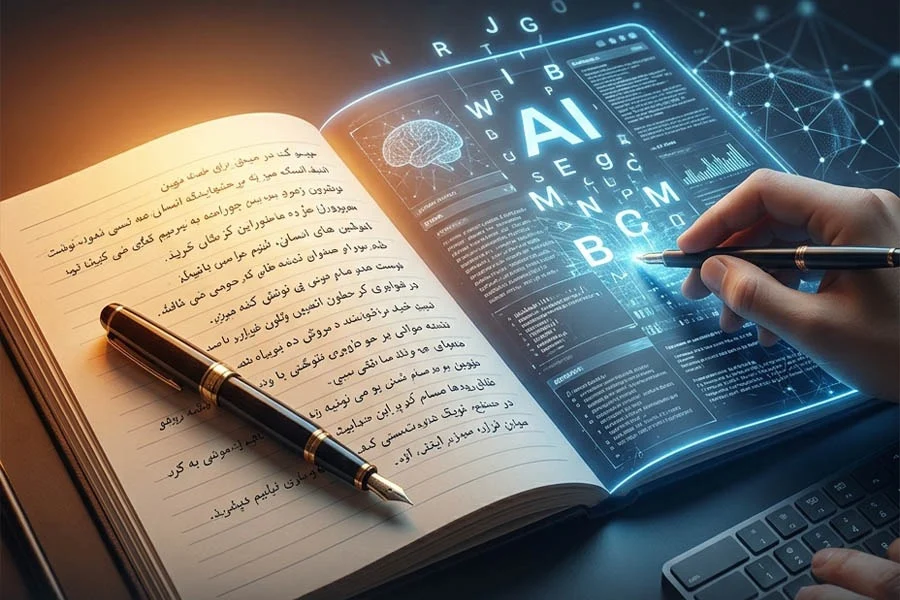
Today, many people turn to artificial intelligence to write articles, prepare reports, draft educational materials, and even compose short texts. The tool can produce an orderly, fluent text in a short time, even one that a reader could barely distinguish from something written by a human. The use of AI in writing has raised questions about the role of the writer and our understanding of authorship. Does using this tool change the human’s standing as a writer? Should we revisit our definition of authorship?
To understand this issue, we must first accept that the age of artificial intelligence differs from the era before it. This difference is not limited to the tools we use. It can also change the way we think, the way we do our work, and our outlook on a wide range of concepts.
We experienced the world before the spread of artificial intelligence, and today we live in a world where this technology has become part of our daily lives. From education and research to programming, design, and content production, we use AI tools across many fields. The ability of these tools to perform tasks that previously demanded more knowledge, skill, and time has led us to reexamine many past methods.
Writing is no exception to this change. Today, with the help of artificial intelligence, we can write articles, prepare reports, organize our thoughts, and even draw on it to write a book. As a result, the ways of producing written work have become more varied, and we can no longer hold the same past views of the writer and the written work while ignoring these new circumstances.
As the ways of writing have changed, different views have also emerged about the standing of the writer. Some believe that a person who produces a text with artificial intelligence and publishes it under their own name is not its author. Others, by contrast, regard the use of this tool as a form of assistance in the writing process and believe that using artificial intelligence alone does not erase the human’s role as a writer. These differing views show that the spread of artificial intelligence compels us to reconsider our understanding of authorship and the place of humans in the process of creating a work.
Of course, we should recognize that this change does not concern only the writer. The reader also faces a new reality and must adapt their outlook to it. But what do these changes mean for the writer, and how can the reader approach texts in these new circumstances? To answer these questions, we must first examine how artificial intelligence changes our understanding of authorship.
How does artificial intelligence change our understanding of authorship?
Setting artificial intelligence aside, when we speak of a writer, we usually have in mind a person who thinks about a subject, researches it, puts their thoughts on paper, and prepares the final work by reviewing and revising the text. Of course, in the process of producing a work, the researcher may be one person, the writer another, and the editor a third. Today, however, in the age of artificial intelligence, we have a tool that can not only correct sentences but also research a subject, suggest arguments, and even produce a complete text.
The important difference between these two situations is that artificial intelligence is not merely a means of carrying out one specific task. It places at our disposal a set of capabilities that we can use to enhance and expand our own skills.
This expansion of capabilities is what leads us to reexamine the concept of authorship. This reexamination does not concern only the role of humans and artificial intelligence in producing a text. It also relates to how artificial intelligence increases our writing abilities and gives us new possibilities. In this context, we should not forget that artificial intelligence, for all its skills and capabilities, is not a human being. It is a technology that humans can use to expand their own abilities. This technology and its capabilities are also what change our understanding of human abilities and of the ways a work is created.
Along the same lines, some people think that artificial intelligence reduces the value of authorship. They even imagine that with artificial intelligence, anyone can write about any subject, but this is not the case. If a writer lacks sufficient ability and does not have a command of the subject they are writing about, artificial intelligence can produce, in a short time, a text that differs little from the text produced for any other user. But a writer who has creativity of their own and, alongside it, learns the skill of working with artificial intelligence can use the tool’s capabilities in a different way and can even challenge them. In such writing, one can also see traces of the writer’s dialogue with artificial intelligence and recognize that the writer does not settle for the tool’s answers alone. Instead, with thought, creativity, and personal abilities, the writer opens a new path for creation.
For this reason, to understand authorship in the present circumstances, we must see what opportunities these possibilities create for the writer and how a human can, alongside using them, also cultivate their own personal abilities.
How should a writer cope with new capabilities in the age of artificial intelligence?
Given the possibilities that artificial intelligence has placed at our disposal, in my view, the writer should accept the new circumstances and get to know the capabilities of this tool. Using artificial intelligence to organize thoughts, examine arguments, refine sentences, and improve the structure of a text can make the writing process easier. In a world where such possibilities are available, familiarity with them can be part of a writer’s skill set.
Of course, we should bear in mind that the importance of these possibilities lies not only in making the writing process easier. With these new capabilities, a writer can create works that they previously might not have been able to create. They can broaden the horizons of their thought and creation, find new ways to express their ideas, and bring more possibilities into the writing process. In this way, the creative use of artificial intelligence can open new horizons for the writer.
Nevertheless, drawing on the possibilities of artificial intelligence is not the only path ahead of the writer. Alongside it, they can pursue another path: cultivating personal abilities and relying on life experiences, human feelings and emotions, their own particular view of the world, and their distinctive way of expression. Every person has experiences shaped by their living conditions, personal encounters, and understanding of the world. These experiences can lay the groundwork for works that spring from the writer’s particular feelings, emotions, outlook, and expression.
A writer can develop their abilities to the point where, relying on them, they create works that challenge the capabilities of artificial intelligence, that is, works for which AI algorithms, at least under current conditions, cannot easily produce similar examples.
From this perspective, using artificial intelligence and cultivating personal abilities are not two opposing paths. The writer neither has to set this tool aside nor should hand the entire writing process over to it. They can benefit from the new possibilities and, at the same time, cultivate the capacity for independent thinking, knowledge of the subject, and their own manner of expression. In this way, a writer can both use the capabilities of artificial intelligence and preserve their own color and identity in their writing.
Here I should point out that the change in the ways of writing is not limited to the writer, and the reader also faces new circumstances. As the ways of producing a work expand, the way readers approach texts also changes. For this reason, we must consider how the reader in the age of artificial intelligence can face these changes and adapt their outlook to the new realities.
How should the reader approach texts in the age of artificial intelligence?
Today, two texts may be very similar in appearance and style of expression, yet one may be the product of a human’s direct research and writing, while the other was produced with extensive help from artificial intelligence. A reader cannot always tell the difference between the two simply by reading the final text.
In such circumstances, should we ask every writer to send us all the stages of their writing, their notes, and their drafts? In my view, such an expectation is not realistic. A writer has no obligation to hand the entire process of their work over to every reader. On the other hand, the final text does not always reveal how it was produced. Therefore, we cannot expect readers to have full knowledge of how a piece of writing came into being in every case.
So how should the reader deal with this situation? In my view, we must accept that with the spread of artificial intelligence, we live in a different world, and to understand present circumstances, we cannot rely solely on past perceptions. This technology has changed our understanding of various concepts, and authorship is no exception. In such a situation, we as readers must increase our AI literacy so that we can better understand the new circumstances.
Increasing this awareness does not mean that the reader must necessarily know how every text was produced or be able to determine the share of the human and of artificial intelligence in it. That is not always possible. What matters is accepting the reality that the ways of producing texts have changed, and that past perceptions and standards alone are not sufficient for understanding all aspects of these works.
Of course, adapting one’s outlook to the new circumstances does not mean abandoning judgment about a text. A reader can still examine the content of a work, its arguments, and the credibility of its evidence and sources. But they must distinguish between what they can understand from the text and what they do not know about its process of production.
Ultimately, how should our view of authorship change?
Throughout history, new tools have repeatedly changed the way humans do their work. Artificial intelligence has brought about a similar transformation, with the difference that this time the technology has entered domains that we previously considered more dependent on human thought and creativity. For this reason, understanding authorship in the age of artificial intelligence requires a fresh examination of our perceptions of the writer and the value of works.
Today, humans can use the possibilities of artificial intelligence to expand their abilities and find new ways of creating. At the same time, life experiences, independent thinking, and personal creativity can still play a role in shaping works. How we use these possibilities, and the place we assign to them in the writing process, affects our view of authorship.
In my view, accepting the reality of artificial intelligence does not mean ignoring human abilities. This technology has placed new possibilities at our disposal, but how we use them and how we cultivate our own abilities depends on our own outlook and choices.
You can read the Persian version of this article here: