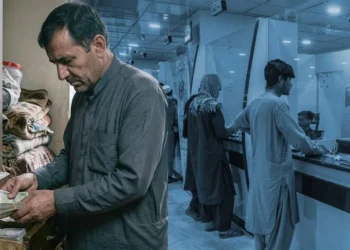
Several Kabul residents and investors say that their trust in the country’s banking system has declined in recent times. They add that concerns about the security of deposits, the stability of banks, and access to their money are among the main factors behind this decline in trust. According to them, because of these concerns, they avoid keeping large sums of money in banks and instead keep part of their capital with money changers or in business activities. They further add that economic instability and a lack of confidence in the future have made people more cautious about depositing their money in banks.
These residents and investors tell the Hasht-e Subh Daily that the experience of banking restrictions after the fall of the previous government reduced their trust in banks and made them more cautious about depositing large sums. They emphasize that continued distrust of the banking system could negatively affect investment, business activities, and the circulation of money within the country’s formal financial system. These individuals call on the Taliban to reform the banking system, improve services, and increase financial transparency to pave the way for the return of public and investor trust in banks.
Sediqa, a Kabul resident, says that because of the unsettled political situation and the experience of banking restrictions following the fall of the previous government, she can no longer trust banks the way she once did. She adds that as soon as her salary is deposited, she withdraws it from her bank account so she does not face, once again, the kind of problems she experienced in accessing her money after the fall of the previous government.
Sediqa says: “Public trust declined after the fall of the government and the problems related to the withdrawal cap, because banks were unable to fully pay out people’s deposits. I myself do not have much trust in banks, and I do not use banking services unless I am forced to. If I did not have a safe place to keep my money, I still would not be able to deposit it in a bank with full confidence.”
Shaker, another Kabul resident, says that in the past people relied more on banks to safeguard their savings, but now, because of declining household incomes, many people are unable to make deposits at all. He adds that although theft and insecurity have increased recently, distrust of banks has meant that people no longer keep their money in banks the way they used to. According to Shaker, banks’ questions about income levels and the source of funds have also led people who cannot prove the origin of their assets to keep their money with money changers instead.
Shaker says: “In the past we had money and we kept it in the bank, but now the salary we earn does not last until the end of the month, and there is nothing left over to deposit. During the republic era, people kept their money in banks because of the ease of banking services, but after the fall of the government, they faced serious banking problems for about two years, and their trust in banks declined. Banks’ questions about income levels and the source of money have led several people who cannot prove the origin of their money to keep their assets with money changers.”
Shah Agha, one of the country’s investors, says that the lack of political and economic stability has made it impossible for him to keep large sums of money in banks, and that despite the insecurity of keeping cash at home, he is still forced to keep part of his capital outside the banking system. He adds that the experience of restricted access to deposits after the fall of the government reduced trust in banks among him and a number of other investors.
Shah Agha says: “In the months after the fall of the republic, many people who had kept their money in banks were unable to fully access their deposits even when they needed the money, and this situation reduced public trust. I personally do not have much trust in banks, because it is still unclear what would happen to our capital if the situation became unstable again, and whether we would be able to access our money or not. For this reason, I prefer not to keep large amounts of money in banks, and I manage part of my capital through business activities and with money changers instead.”
However, some other Kabul residents say they still trust banks and keep their money in these institutions for greater security.
Sayed Ali Behjat, another Kabul resident, says that despite concerns about the possible freezing of deposits and restricted access to money, his trust in Afghanistan’s banks stands at about 80 percent. In his view, keeping money in banks is a better option than keeping it in informal places, and the circulation of deposits within the banking system can help support economic activity and the movement of money in the country.
Sayed Ali Behjat says: “My trust in Afghanistan’s banks is around 80 percent, because the country’s political systems have always been changing, and there is a possibility that at certain points people’s money could be frozen or their access to their deposits restricted. Even so, I keep my money in the bank, because transferring it from one bank to another involves a lot of trouble, and I believe that keeping money in a bank is safer than keeping it elsewhere. Banks can use people’s deposits to circulate money within the country’s economic cycle, and capital should be used in economic and business activities rather than remaining idle.”
Meanwhile, several private bank employees say that ordinary people’s trust in banks has increased somewhat in recent times, but that large companies and investors still approach the banking system with caution. According to them, building the trust of large companies takes time, and these companies need a track record of transactions and assurance of transparency in financial activities before beginning to work with banks.
Ebadullah, an employee of a private bank, says: “Ordinary people usually do not have large amounts of capital. Those who receive remittances open accounts, receive an amount of around 10,000 to 15,000 Afghanis, and after a while withdraw their money from the account. But large companies and major investors are much harder to win over, and building their trust requires repeated visits and transactions before they are confident in the process. Over the past two years, we have managed to attract around 50 to 60 customers, but many large companies still work mostly with money exchange businesses and do not choose banks for transferring or holding their money.”
Meanwhile, several economic experts say that the decline in public trust in the banking system has negative consequences for the circulation of money, investment, and the country’s economic growth. They add that the continuation of this situation could reduce banks’ ability to attract deposits and provide financing to productive and commercial sectors. In their view, the lack of economic and political stability, liquidity problems, weak banking services, and concerns about access to deposits are among the main factors behind the decline in public trust in banks.
Qutbuddin Yaqoubi, an economic affairs expert, says that public trust in the banking system is vital for the country’s economic growth, and that a decline in this trust could create difficulties for banks’ operations and for investment. He adds that the banking crisis, difficulty in accessing deposits, weak banking services, economic problems, and low financial literacy are among the main factors behind the decline of public trust in Afghanistan’s banking system. According to Yaqoubi, restoring public trust requires oversight of banks, greater transparency, protection of public deposits, bank accountability, and the development of Islamic banking and electronic payments.
Yaqoubi says: “Public trust in banks is vital for economic growth. When people keep their money in banks, banks can use these resources in productive, commercial, and investment sectors and help create job opportunities. But when people, for various reasons, do not trust banks and keep their money in cash instead, problems such as the deterioration of banknotes and liquidity shortages arise, and banks’ activities become limited as well.”
These complaints about declining public and investor trust in banks come as Afghanistan’s banking system has faced widespread challenges in recent years. The World Bank has said in a report that Afghanistan’s banks have lost about 25 percent of their total deposits since 2020, a situation the institution described as concerning for Afghanistan’s small banking industry. According to statistics from the Afghanistan Banks Association, 12 private banks currently operate in the country alongside the central bank.
You can read the Persian version of this report here: