Findings of this report show that after the Foundation for International Community Assistance (FINCA) in Afghanistan halted its operations following the Taliban takeover, the fate of the loans and assets of the institution’s customers has been left shrouded in uncertainty. Documents, customer accounts, and sources indicate that the Mutahid Development Finance Institution (MDFI) has introduced itself as the body responsible for collecting the loans of former customers of the Foundation for International Community Assistance (FINCA) Afghanistan. According to the sources, individuals involved in collecting FINCA Afghanistan’s loans have introduced themselves with titles such as “Qari” and “Amarati” and have said they aim to collect the funds of “Bayt al-Mal” (the public treasury), and that they have done this by putting pressure on customers. According to the findings of this report, the financial institution FINCA Afghanistan, which previously operated under the support of FINCA International, halted its activities in Afghanistan after the Taliban takeover. FINCA International has said that after the Taliban takeover, due to international sanctions and the loss of effective control over FINCA Afghanistan, it was no longer able to manage and oversee the institution’s activities. As a result, at the end of 2021, FINCA Afghanistan was removed from this organization’s consolidated financial statements and its activities were classified as “discontinued operations.” The institution provided small loans to impoverished people, small business owners, and needy families, and had 23 branches in different parts of Afghanistan.
Sources claim that after halting its activities in Afghanistan, the organization destroyed all documents relating to its customers and declared the remaining loans of customers forgiven and closed. According to the information obtained, the organization’s employees have also completed their final settlement procedures.
Sources claim that in one branch of the institution alone, there were more than 100 million Afghanis in capital and circulating funds. According to the sources, after FINCA Afghanistan halted its activities, another institution called “Mutahid Development Finance Institution” introduced itself as responsible for FINCA-related affairs and is collecting loans from the institution’s former customers.
Sources add that the majority of FINCA Afghanistan’s customers were poor people who had received loans to buy a few head of livestock or to start small businesses, and who are still struggling with economic hardship. However, according to the sources, the second institution, in coordination with the Taliban, is collecting these loans from customers through pressure and force.
The institution’s customers claim that their loans were forgiven by FINCA Afghanistan, which removed Afghanistan from its financial circle, but it is unclear on what basis the second institution is collecting its loans.
Customers claim that MDFI employees have introduced themselves as people affiliated with the Taliban and say that this money is “Bayt al-Mal” and must be collected. According to them, collecting these sums under the name of the Taliban has raised concerns about the possible misappropriation of these assets. They also say that, under an understanding with MDFI, these individuals receive about 30 percent of the collected amounts as a fee.
Customers say it must be made clear, when money is collected in the name of “Bayt al-Mal,” under what authorization it is transferred to specific bank accounts, including accounts at the “First MicroFinance Bank” (FMFB), and under what mechanism these funds are held and spent.
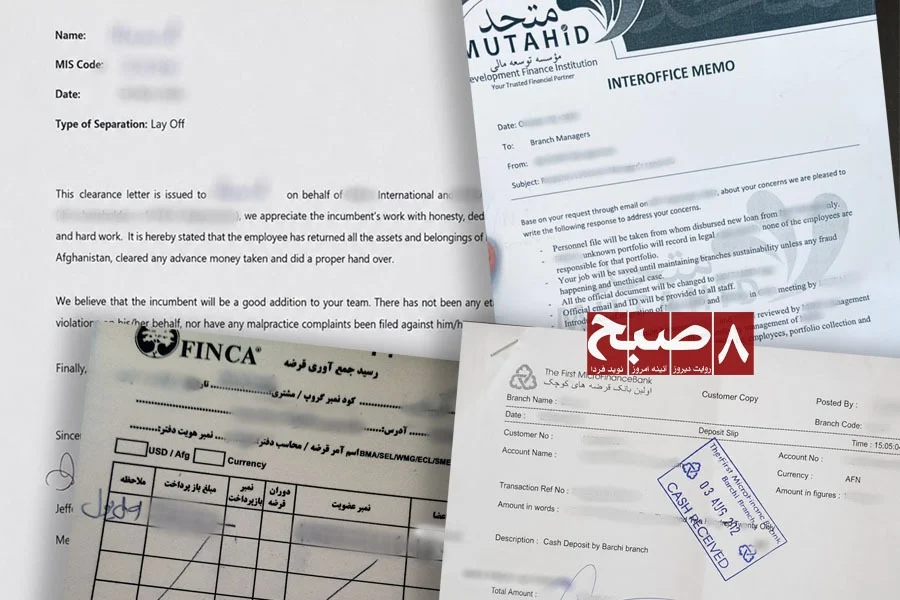
This letter was issued in the name of a former employee of FINCA Afghanistan. The person’s name has been removed from the report. The letter was issued to this employee on November 20, 2022, with the signature of one of FINCA Afghanistan’s senior officials.
The letter states: “This settlement letter has been issued on behalf of FINCA International and FINCA Coop (shareholders of FINCA Afghanistan) for [name of individual removed]. We appreciate this employee’s cooperation and performance, marked by honesty, commitment, and hard work. It is hereby confirmed that this employee has handed over all assets and equipment belonging to FINCA Afghanistan, has settled all advance payments and interim amounts received, and has properly completed the handover of duties (Handover).
At the bottom of the letter, Jeffery Smith, a member and representative of the board of directors of FINCA Afghanistan, has signed it.
Claims of missing customer identification documents
Some FINCA Afghanistan customers claim that after learning that the institution had halted its activities in Afghanistan, they went to retrieve their documents, but found that the papers and documents they had deposited with FINCA when receiving their loans are not in the possession of MDFI.
MDFI has changed the receipt slips for collecting money, which were previously issued in the name of FINCA Afghanistan, and now issues these receipts in its own name, even though FINCA Afghanistan was previously part of the FINCA International network.
Previously, FINCA Afghanistan collected the payments of its former customers in the bank account number 021104010006101. But now, the collection of loans from people is carried out under the title “Bayt al-Mal” and in the name of the “Islamic Emirate” by individuals hired by MDFI. These individuals introduce themselves with titles such as “Qari Sahib,” “Amarati,” and “Mujahideen” and collect money from FINCA’s former customers. According to FINCA’s former customers, this process has created serious questions and concerns about how these assets are managed and the possibility of their misappropriation.
Also, according to slips made available to the Hasht-e Subh Daily, MDFI deposits the amounts collected from people at the “Microfinance Bank,” a private bank. Customers stress that if this money belongs to “Bayt al-Mal,” it must be made clear why it is being collected and held in a private bank, at a time when the central bank and other state banks operate under Taliban control.
Documents show that FMFB has also collected the loans of one of FINCA Afghanistan’s customers. In a document issued by the bank’s Dasht-e Barchi branch on August 3, 2022, it can be seen that an amount of 135,220 Afghanis was received from one of FINCA Afghanistan’s customers. In this document, the account name is recorded as “MISFA FINCA Loan Collection,” and the document type is listed as “Deposit Slip.” The transaction description states that this amount was deposited in cash by the Barchi branch and that the total fee was zero Afghanis.
Some customers claim that the people hired to collect the debts pressure or threaten them, citing their relationships or acquaintance with some Taliban fighters, to make them pay the amounts related to FINCA loans.
Signing of a document between FINCA and MDFI
On the other hand, another document shows that a document was signed between Mutahid Development Finance Institution (MDFI) and some FINCA Afghanistan employees, according to which the assets of FINCA’s customers are held in a specific account, and FINCA employees in Afghanistan bear no administrative, financial, or legal responsibility for this money.
Sources say that the memorandum of understanding between MDFI and FINCA employees states that all of FINCA’s money remains in one account and none of FINCA’s employees bear any responsibility for it. According to the sources, the question is how several employees who lacked the authority to transfer FINCA’s money were able to sign this memorandum with MDFI.
This memorandum between MDFI and FINCA Afghanistan employees was signed on October 3, 2022. The letter states: “Regarding your request through the email dated September 29, 2022, about the concerns and questions raised, we are pleased to provide the following answers to address your concerns: The files of those who received their new loans only from MDFI will be taken over.”
The letter says that FINCA’s loan portfolio will be recorded under code 2645 and that none of the employees will be responsible for that portfolio of loans. The text of the letter warns: “FINCA’s loan portfolio will be registered under legal code 2645 and none of the employees will be responsible for it. Your job will be retained as long as the sustainability of the branch is maintained, unless a case of fraud or unethical conduct occurs.”
According to this memorandum, all official documents will be changed to the MDFI logo, and an official email and identification card will be provided to all employees. The memorandum also states that the matter of merging FINCA Afghanistan’s assets with MDFI or transferring them to it will be raised and presented in a meeting by the institution’s legal department.
Another section of the letter states: “All provisions of the agreement between the Microfinance Investment Support Facility for Afghanistan (MISFA) and MDFI have been reviewed by the management of this institution, and its content will be shared with you in full by MDFI management. MDFI will be responsible for legal matters, including issues related to employees, loan collection, and other required matters. The structure of the departments and offices will also be based on the MDFI structure. MDFI management respects all employees, greatly values their efforts to improve Afghanistan’s economic situation, and welcomes any suggestions from employees.”
According to the sources, despite the signing of this document, the funds of FINCA’s customers are still being collected by employees hired by MDFI. Also, according to available information, in some cases this process has been accompanied by pressure and threats against customers and employees.
At the same time, the sources stress that the findings show no legal document or evidence has been issued or implemented for the transfer of FINCA Afghanistan customers’ funds by FINCA International to MDFI.
What do FINCA International’s reports say?
In a report (the 2021 consolidated financial statements), FINCA International said that after the Taliban takeover in Afghanistan, it was no longer able to manage FINCA Afghanistan’s operations and to oversee and effectively control its activities as before. For this reason, on December 31, 2021, FINCA Afghanistan was removed from the organization’s consolidated financial statements and its activities were placed under Discontinued Operations.
According to economic experts, the removal of Afghanistan from the consolidated financial statements due to the loss of control does not mean the forgiveness of loans. Also, the classification of Afghanistan’s activities as “discontinued operations” does not specify to which institution customers’ receivables were transferred after FINCA’s exit or who had the legal right to collect them.
Meanwhile, in its 2022 report, the organization also said that the Taliban takeover and the subsequent imposition of international sanctions effectively brought to a complete halt and restricted the ability of FINCA Microfinance Holding Company (FMH) to manage its financial interests, benefit from returns, and influence the decisions of FINCA Afghanistan through normal governance channels.
The report states that although FMH remained the legal owner of FINCA Afghanistan, its management formally concluded on December 31, 2021, that it had lost effective control over this branch. According to the report, this decision was made because FINCA could no longer exercise its influence and authority over the branch’s activities as a shareholder, was no longer exposed to its variable returns, and no longer had the possibility of influencing its financial performance through managerial intervention.
Due to this significant event, FINCA Afghanistan was classified for accounting purposes as a discontinued operation (Discontinued Operation). The institution’s financial performance in 2021, up to the time control was lost, has been recorded separately under this title in the comparative columns of the 2022 report so that it is not consolidated with the figures of the active branches.
In Note 29 of the financial statements (Note 29: FINCA Entities), which lists all active branches and subsidiaries under FINCA’s control around the world at the end of the 2022 financial year, the name of Afghanistan has been removed entirely.
Before halting its operational activities in Afghanistan, FINCA Afghanistan was, in 2020, one of the active institutions in the field of microfinance, providing financial services mainly to low-income individuals, small businesses, and customers with limited access to banking services.
A FINCA International document, a Form 990 for 2020 that it submitted to the United States for tax exemption, along with financial and registration documents for the 2020 financial year, shows that FINCA Afghanistan was at that time part of FINCA’s international structure and was connected to FINCA’s international entities through a chain of corporate ownership and control.
Legal structure and ownership
According to information contained in the tax return and public disclosure documents of FINCA International for the 2020 financial year, the local entity named FINCA Afghanistan operated as a commercial company, and its legal personality was registered as a joint-stock commercial company (C Corporation). In this structure, FINCA Afghanistan was directly under the control of FINCA Microfinance Cooperatief U.A. This company played an intermediary role in FINCA’s corporate chain and was itself under the ownership structure of FINCA’s investment entities.
According to the reports, the ownership share related to FINCA in this structure was reported as 65.89 percent. This structure shows that in 2020, FINCA Afghanistan was an independent entity in terms of local operations, but was connected to the international FINCA network in terms of ownership and corporate structure.
According to information reported in FINCA International’s financial documents, FINCA Afghanistan had provided financial services and products to about 21,872 customers and beneficiaries in 2020.
According to this information, the reported revenue related to FINCA Afghanistan in 2020 was about $3.15 million, and the value of its reported assets at the end of that year was about $11.32 million.
You can read the Persian version of this report here:
مشتریان فینکا میان بدهی و ابهام؛ چه کسی پول قرضهها را جمعآوری میکند؟