By Flávia Mantovani, Folha de S.Paulo (Brazil)
Diana Soliz’s story began like those of many other Bolivian immigrants in São Paulo: The unemployed single mother arrived in by bus, without papers, and initially worked and lived inside a sewing workshop. The year was 1996. Soliz was 35 years old, and she put in exhausting hours; her employer did not respect labor rights, and Soliz did not even know that such rights existed for immigrants.
In Bolivia, Soliz had worked as a domestic employee since the age of 14, and she found a few jobs in this field in São Paulo, always without a signed contract. When she needed surgery, her employer refused to give her medical leave. This situation led her to the Domestic Workers’ Union of São Paulo. She attended meetings where she discovered that there were other immigrants in her profession who were being exploited like her.
In 2017, Soliz became the first immigrant to join a union in Brazil—something that was possible only because of the new Migration Law. Since then, she has dedicated herself to raising awareness among domestic workers, immigrants, and Brazilian women about their rights. She was a director of the union for six years and currently serves on the board of the National Federation of Domestic Workers. She is also a substitute council member of the Municipal Council of Immigrants of São Paulo.
In these capacities, Soliz participates in collective negotiations with employer unions; attends public hearings; coordinates conversation circles to listen to the demands of immigrant domestic workers; and promotes awareness campaigns informing immigrants that they have the same rights as Brazilian workers. She also helps organize support groups with labor lawyers, assistance with immigration regularization, and referrals to Portuguese language classes and professional training courses.
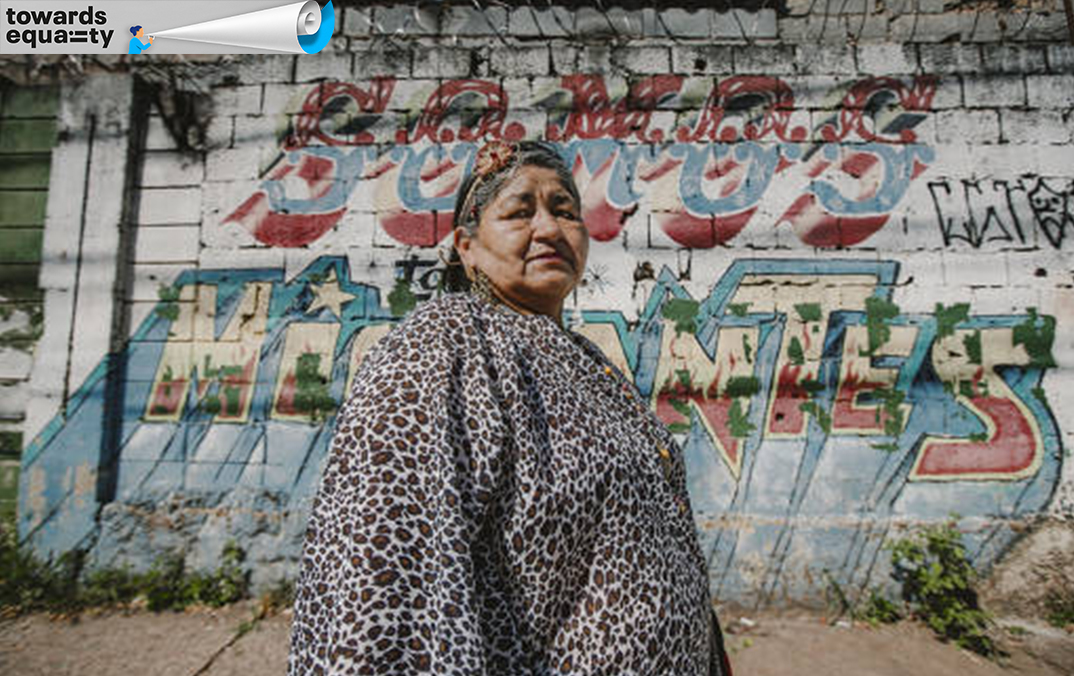
In 2019, a giant photo of Soliz adorned a pillar of the President João Goulart Elevated Highway, the famous Minhocão, in an exhibition by photographer Raquel Brust about diversity in São Paulo. Today, at 62, she is surprised to see how far she has come —once an abused domestic worker, she is now the proud representative of her profession.
Here, in her own words, is her story:
“I arrived in Brazil almost 30 years ago. I was unemployed with a young daughter and had just left the hospital after an accident. My twin sister, who worked as a cook in a sewing workshop in São Paulo, asked if I wanted to come. She sent money, and I decided to go.
I was unsure whether or not to bring my daughter. She was four years old, and I didn’t know what I would find when I arrived, so I ended up leaving her with my mother.
I became the nanny for the sewing workshop owners’ two children. I started at 7 A.M. and had no set end time because they sometimes worked until midnight.
The workshop was in a rented house, and everyone slept and ate there. My sister and I stayed in a small room, and the male workers slept in bunk beds. It was cramped, full of boxes, and there was nowhere to put our clothes. It was very sad. Sometimes we would have Sundays off, but only when there wasn’t much work.
After a while, I met a Brazilian man. We got married, and I decided to bring my daughter here when she was eight years old. I stopped working to take care of her, then when she was a bit older, I became a nanny again.
In 2008, I got a job at the house of a woman who worked at an international bank. I did everything—took care of two boys, cleaned, cooked. She earned a lot of money and lived in a nice house, but she paid me only R$ 400 a month. She did not pay me overtime or give me transportation money. I had no idea what the minimum wage was [it was R$ 415], and I didn’t know that I had the right to have a work permit.
I stayed there for six years, then found out that I needed surgery and would have to be away for two months. Every 15 days, my employer would call me and ask me to come back because she didn’t want to be without a maid, but I couldn’t go back to work, I was recovering.
After I returned, I asked when she would pay me. She replied, ‘Pay you for what? You didn’t work.’ I told her that I had the right to medical leave, and she said, ‘Where did you get that idea? You’re an immigrant.’ She told me to find another job, but I didn’t accept her explanation and went to seek information.
I found out that there was a union, and I went there. They explained to me that I did have rights, and I called my employer to come to the union, but she wouldn’t. She proposed that we ‘resolve this between ourselves.’ She said she would increase my salary by R$ 100 and sign my work permit, but I didn’t accept her offer. If a judge said I was entitled to R$ 50, I would accept those R$ 50, because that was my right. I filed a lawsuit and ended up winning. She had to pay for all those years I worked without a signed contract.
I have been a domestic worker since I was 14. My mother had 16 children, and I was practically raised in an orphanage with two other sisters because my father drank and didn’t provide food for us.
In that orphanage, we had food, a doctor and school. But I was very young, and I missed my mother. I left there at the age of 14 for a job taking care of a child. I was almost abused by the employer’s son and his father. I slept in the corner of the pantry room, using a piece of cardboard as a bed with a sheet on top. At night, they would try to enter, but I locked the door from the inside. I was just a girl.
One day, I ran away to my mother’s house. The employer told her that she sent me away because I had stolen a package of napkins, but my mother didn’t believe it. Later, I found out that this [sexual abuse] had already happened before in that house.
People don’t imagine the risk we run. The employer may treat you well, but sometimes it’s the husband or another man in the family. When I was seven months pregnant, I worked at the house of a writer who was very kind. One day, her husband came on to me when I was making their bed. I pushed him away, went downstairs and wanted to leave, but the employer convinced me to stay until the baby was born.
I swore to myself that my daughter would never be a maid. Not because of the work itself, but because I was afraid that she would be abused, violated. Today she works in a call center.
At the union, I discovered that immigrants are heavily exploited. I didn’t want other people to go through what I went through, so I started attending the meetings. I was the first immigrant to join a union in Brazil. In 2017, they created a Migrant Department and invited me to be director. We organize courses and lectures and help with obtaining documents.
Many Brazilians don’t like it, they think we want everything for free. No, we work, we pay taxes. Immigrants don’t want to be taken care of by the government, immigrants want to work—and most of them work really hard.
We don’t have statistics on immigrants in domestic work in Brazil, but we know that there are many Bolivians, Paraguayans, Haitians, Venezuelans, Angolans, Filipinos and Congolese. Some work just for food or housing. Many come after receiving false information about how much they will earn. They arrive already owing money for the ticket; their passports are withheld, they are prohibited from leaving and threatened with deportation.
An Angolan woman once told me in tears that she was forced to eat on the floor because the employer said she ‘was black and couldn’t eat at the table.’ She slept next to the dog house and was given only leftovers. This hurts me, and it happened just three years ago.
Slavery hasn’t ended, it’s just hidden. There are people who hire immigrants to avoid paying for benefits set forth by labor rights, thinking that immigrants won’t complain. And indeed, many immigrants still aren’t aware of their rights in Brazil.
I’m happy when I can guide someone. When they invited me to the union’s board, I said, ‘But I don’t know anything, I can’t speak, I’ll make mistakes.’ Today, I participate in seminars and roundtable discussions. I travel to Brasilia [Brazil’s capital] regularly. I still can’t believe that, at 62, I’ve made it this far.”