Donald Trump returned to power in the 2024 presidential election under the slogan “Make America Great Again.” In his campaign, he had promised to end endless wars, reduce the cost of living, and return the government’s focus to America’s domestic affairs.
But less than two years later, the start of the United States’ war with Iran confronted those promises with new questions. Beyond its military costs, the conflict also carried economic consequences. Disruption to oil shipments through the Strait of Hormuz and a rise in global energy prices affected the fuel market and made the cost of living once again one of the major issues in America’s political landscape.
In this way, a war being fought beyond America’s borders became a matter tied to the daily lives of the country’s citizens. For some of the voters who had backed Trump on the promise of ending foreign conflicts and improving economic conditions, the gap between campaign slogans and the government’s performance grew increasingly significant.
Among these voters, young people held a special place. This was a generation that had shown signs of a shift in political orientation in the 2024 election and was now measuring the government’s performance against its expectations.
Doubts Among Trump’s Young Voter Base
A Reuters report based on conversations with several male students at St. Anselm College in New Hampshire offers an example of the changing outlook of some of the young people who voted for Trump in 2024. Two years after that election, some of these students no longer supported the president with the same confidence.
In their remarks, concerns about their economic future, student debt, and the difficulty of buying a home were raised alongside criticism of some government policies, particularly the treatment of immigrants. However, their positions were not uniform. Some continued to support Trump, while others had doubts about their earlier choice.
Even so, in 2024 Trump had managed to turn the dissatisfaction of some young people with the economic situation and the performance of the ruling political camp into his electoral capital. But two years later, those same grievances persisted, and this time, in reaction to the performance of his own government, they ended up benefiting his rivals.
Beyond Trump: A Generation with Different Demands
The shift in the outlook of the younger generation cannot be reduced solely to some voters distancing themselves from Trump. A Guardian report based on conversations with young Americans shows that this generation’s demands are not limited to the performance of one president or even one political party.
For some, the government’s immigration policies and its treatment of immigrants are a decisive issue. Others are concerned about war and America’s foreign policy, and another group considers civil rights, climate change, and the future of democracy among the most important issues facing the country.
This difference in priorities shows that Generation Z cannot be regarded as a group with uniform demands and concerns. Economic experience, social standing, and political views can influence this generation’s choices in different ways.
At the same time, opposition to Trump and the Republicans does not necessarily mean trust in the Democrats. Some young critics of the government are also dissatisfied with the Democratic Party’s performance and believe the party has failed to offer a clear answer to problems such as the cost of living, housing, and job prospects.
Therefore, the issue is not only how many young people have distanced themselves from Trump. The more important question is whether the Democrats have been able to fill the void left by lost trust.
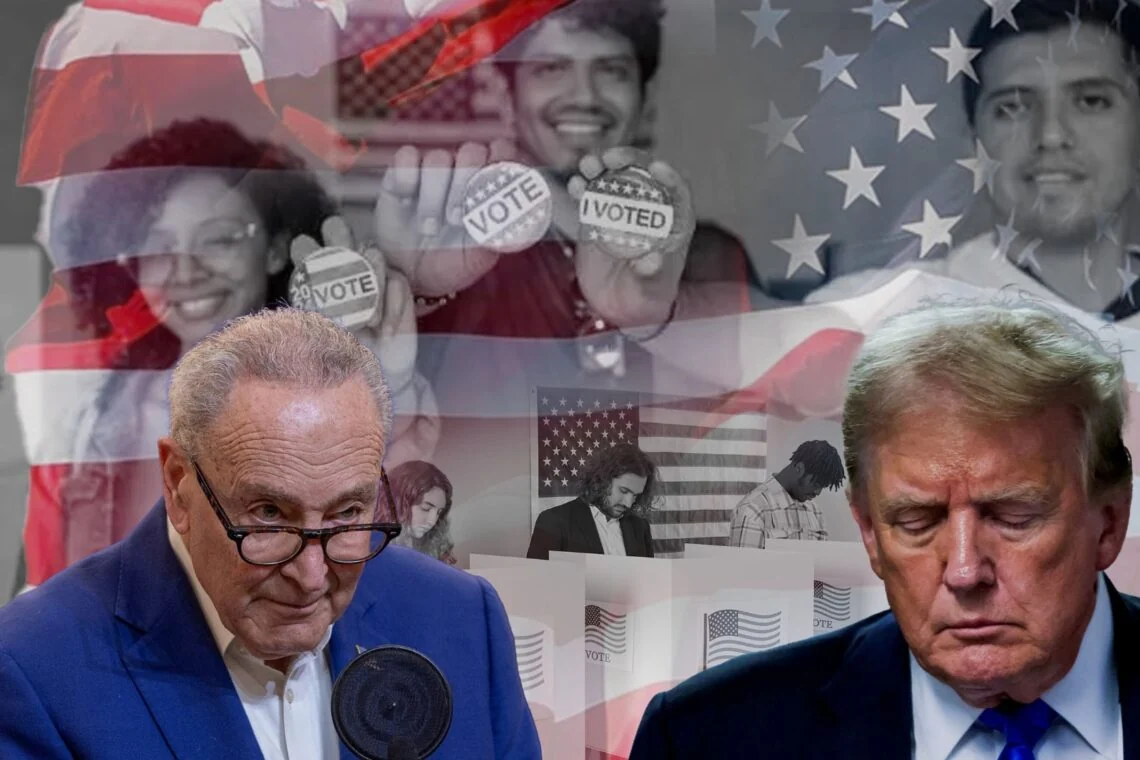
The results of the November 3, 2026 midterm elections offered a new picture of young Americans’ political leanings. According to a preliminary analysis by Tufts University’s Center for Information and Research on Civic Learning and Engagement (CIRCLE), about 66 percent of voters aged 18 to 29 voted for Democratic candidates for the House of Representatives, while the Republicans’ share was 31 percent. This gap of 35 percentage points represents a significant change compared with the 2024 election.
The significance of this result lies not only in the increase in support for the Democrats, but also in the changed behavior of groups that had moved closer to Trump in the previous election. According to CIRCLE data, men under 30, who had leaned more toward Trump in the 2024 presidential election, showed greater support for Democratic candidates in the 2026 midterms.
However, it cannot be concluded from these figures that all the young people who voted for Trump in 2024 have now turned to the Democrats. Presidential and midterm elections are not the same in terms of candidates, turnout, and political conditions. Moreover, this data does not necessarily show a change of mind among the same individuals. The composition of the young people who went to the polls in each election may also have changed.
On the other hand, the economy and employment remain among the most important concerns of this generation. Preliminary CIRCLE data shows that the economy and job opportunities topped young people’s priorities in the 2026 election. This indicates that their political choices cannot be explained solely by support for or opposition to a president.
The return of young people’s support to the Democrats could be a sign of the party’s revival among Generation Z, but it is still too early to draw conclusions about a return of lasting trust.
The Democrats managed to win the support of a large share of young voters in the midterm elections, but this support does not necessarily mean full acceptance of their programs and policies. Some of these votes may be less a product of trust in the Democrats than a reaction to the performance of the Trump administration and dissatisfaction with the status quo.
On the other hand, the Republicans, too, cannot regard young people’s support in the 2024 election as a guarantee for their future. The significant shift in young people’s votes between the two elections shows that this group cannot be considered a fixed base of either party.
You can read the Persian version of this article here:
«نسل زد» و بحران اعتماد؛ ترمپ، دموکراتها و رأیدهندهگان جوان