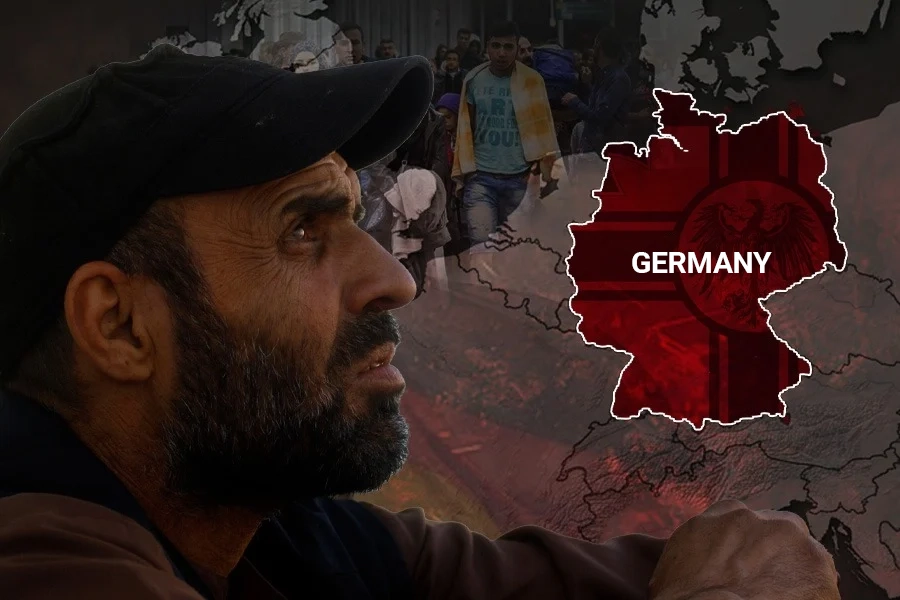
Support for the Alternative for Germany (AfD) party has grown considerably within German society in recent years. The party succeeded in forming one of the largest factions in the German Federal Parliament following the 2025 federal elections. The rise of the far-right party in Germany stems from multiple, complex factors: migration, economic stagnation, economic inequality, rising energy prices, and crimes committed by asylum seekers are among the most critical factors. But the question that arises is this: what connection does the future of Afghanistan’s asylum seekers have with the rise of this party? The answer is that the Alternative for Germany, in its campaign and electoral manifesto, pursues a strict immigration policy and attributes part of German society’s problems to the excessive presence of undocumented asylum seekers. Members of this party have also repeatedly called for the forced deportation of asylum seekers, stricter requirements for granting them residency and citizenship documents, and the imposition of stringent border controls. In all of its political positions, the party shrewdly points to the issues of migration, Germany’s economic stagnation, rising energy prices, and crimes committed by asylum seekers, issues that remain part of German society’s ongoing concerns.
Economic Stagnation
Germany’s automobile manufacturing industry, the most powerful sector of the country’s industries, requires a stable energy supply for its production process. The problem is that since the start of the Russia-Ukraine war, direct gas imports from Russia to Germany have been halted, forcing German companies to procure energy from other sources at exorbitant prices. Rising energy costs, particularly in the automobile manufacturing sector, have placed significant pressure on these companies, leading to a decline in exports. On the other hand, the development of the automobile industry in China and the increase in customs tariffs imposed by the United States on car imports from the European Union have also had an impact.
It is worth noting that automobile manufacturing companies are among the most significant taxpayers in Germany, and for this reason, economic stagnation and declining exports in this industry can affect the country’s economy. The far-right party attributes Germany’s economic stagnation to the policies of the ruling parties in power, which, in its view, provide excessive support to Ukraine against Russia. Conversely, the party does not consider support for Ukraine to be in the interest of Germans. A portion of the citizenry also aligns with the Alternative for Germany’s position on this matter.
Concern Over Falling Behind in Economy and Technology
Another issue that has contributed to the party’s growth is its focus on Germany’s capabilities in the field of artificial intelligence. Members of this party are calling for greater investment in this sector and consistently warn that if Germany overlooks the technological revolution, it could face more serious problems in the long run. Some German citizens also believe their country has fallen behind other nations, including the United States, China, and India, in technological competition. Under such circumstances, it is natural for this to work in favor of populists, drawing part of society toward populist leaders who offer simplistic, short-term solutions to complex problems.
Economic Inequality
Another factor contributing to the growth of the far-right party is the severe economic inequality between eastern and western Germany. For example, in 2025, the average gross annual salary in eastern Germany was 45,000 euros, compared to 58,000 euros in western Germany. Since German reunification, the eastern part of the country has been unable to achieve economic parity with the western part. Academic studies and the Elite Monitor project also show that eastern Germany is significantly underrepresented, relative to its share of the population, in management and key positions, the media, and the military compared to western Germany.
The Migration Issue
There is no doubt that migration is a central component of the far-right party’s core policies. However, what is raised in Germany’s formal and informal discussions regarding migrants is how to integrate them into society and the labor market. Migrants must be able to enter the occupations needed by the German economy through language training and vocational and technical education, thereby meeting the country’s labor requirements.
What fuels the far-right party’s rhetoric is the considerable rate of crimes committed by migrants. In May 2024, in the city of Mannheim in the state of Baden-Württemberg, an Afghan migrant stabbed a police officer to death and wounded five others. Likewise, in February 2025, in the city of Munich, a 24-year-old Afghan man attempted to drive a car into a crowd of people. The occurrence of these crimes has affected public opinion in Germany, and the Alternative for Germany has exploited it for political gain.
The encouraging point for asylum seekers is that Germany’s laws and policies recognize a series of guarantees for the protection of migrants. In Germany, even if a party gains more power, it remains constrained and cannot accomplish much, because there is a constitution, courts, and independent institutions that prevent the unchecked dominance of those in power and guarantee individuals’ rights. Human dignity and equality before the law are among the fundamental principles of Germany’s legal system. On this basis, a change of government or a political party coming to power cannot, by itself, strip migrants of their rights. If a decision violates the law, there remains the possibility of appeal and recourse to the courts.
However, this does not mean that migrants, particularly Afghanistan’s refugees, should not be concerned about the growth of the far-right party. This party holds strict positions on migration, the granting of asylum to migrants, and their deportation. Accordingly, if it gains more power, it could affect Germany’s migration policy. Therefore, concern over the growth of this party is not without cause. At the same time, however, one should not assume that the strengthening of this party would erase migrants’ rights overnight. It must not be forgotten that in Germany, parties operate under the shadow of the constitution and the oversight of the courts and legal institutions.
According to a report by the Federal Office for Migration and Refugees (BAMF) and statistics presented to the German parliament, in the first half of 2026, Afghanistan’s asylum seekers made up 37 percent of the asylum-seeking population in Germany. Afghanistan’s asylum seekers are also concerned about the growth of the far-right party. This concern is focused primarily on stricter restrictions regarding family reunification. However, the main challenge for the future of Afghanistan’s asylum seekers is not merely being accepted into German society, but also becoming part of the skilled workforce that this society needs.
Therefore, the more migrants are able to fill the professional and skills gaps in the German labor market, the greater their chances of integration, because according to research findings commissioned by the Bertelsmann Foundation, Germany needs an annual influx of 288,000 skilled workers. If Afghanistan’s asylum seekers remain excluded from vocational training and entry into specialized, needed occupations for an extended period, the migration issue could continue to be at the center of political disputes between the far-right party and other political currents, and the risk of intensified forced deportations could even increase.
You can read the Persian version of this analysis article here:
عوامل رشد حزب راست افراطی در آلمان و آینده پناهجویان افغانستان