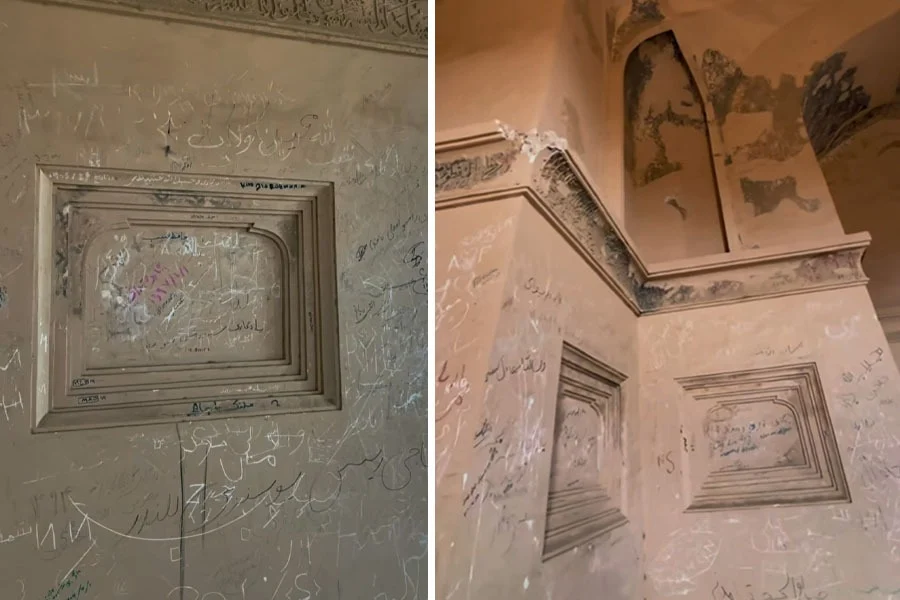
Several residents of Ghazni have criticized the behavior of some tourists toward the historical monuments of the province. They say that some tourists, while visiting historical sites, damage the historical value and authenticity of these monuments by writing souvenir messages and drawing designs on the walls. According to them, the lack of adequate supervision and effective measures by Taliban-controlled departments to prevent such behavior has made damage to the historical monuments possible.
In interviews with the Hasht-e Subh Daily, these residents stress that the Taliban’s Directorate of Information and Culture in Ghazni should prevent damage to the province’s historical monuments by installing warning signs, launching awareness programs, and taking the necessary measures. They also call on tourists to observe the principles of cultural heritage protection when visiting historical sites and to refrain from writing souvenir messages or drawing designs on the walls of these monuments.
Salim, a resident of Ghazni, says that writing messages and painting on the walls of historical monuments damages the value and beauty of these structures. He adds that damage to these monuments can also negatively affect the attraction of tourists. According to him, to prevent damage to these monuments, supervision of historical sites should be increased, and people who damage them should face legal action.
Salim says: “Writing souvenir messages and scribbling on the walls of historical monuments not only damages the beauty of these structures, but also affects their historical and cultural value. Tourists should know that these places are not only for sightseeing and taking photos, but are part of the history and culture of Ghazni. In my view, awareness-raising alone is not enough; serious supervision of historical sites is also needed, and people who damage these monuments should face legal action. If we do not protect our historical heritage today, future generations may lose the chance to see these monuments in their original form and authenticity.”
Rohullah, another resident of Ghazni, says that the absence of warning signs and adequate supervision at historical sites has paved the way for people to write souvenir messages on the walls of these monuments. He stresses that specific measures should be taken to prevent this behavior, and visitors should be made aware of the consequences of damaging historical monuments.
Rohullah says: “Tourists who come to visit the historical monuments of Ghazni expect to see the authentic architecture and historical features of these structures, not the names and writings that others have left on the walls. This behavior not only diminishes the beauty of the monuments, but also distracts visitors from their historical value. People should know that the real souvenir of a historical site is the photos and memories they take with them, not the writings they leave on its walls.”
Hamed, another resident of Ghazni, also criticizes the writing of souvenir messages on the walls of Ghazni’s historical monuments and says that this behavior reflects some visitors’ disregard for the historical value of these monuments. He adds that specific measures should be taken to protect historical monuments and prevent this behavior from continuing.
Hamed says: “It upsets me to see some people scribble on or write souvenir messages on Ghazni’s historical monuments. The historical monuments of Ghazni are part of our identity and history, and they must be preserved for future generations, rather than us damaging them by writing names and messages on their walls. These monuments have great historical value, and any damage to them can diminish their beauty and authenticity. If this behavior continues, future generations may not be able to see these monuments in the same form in which they have been left to us from the past.”
Meanwhile, a number of cultural experts say that writing souvenir messages and scribbling on the walls of historical monuments damages the cultural value and historical authenticity of these structures. They stress that protecting historical heritage is a shared responsibility of the relevant institutions and citizens, and that tourists should refrain from any behavior that damages these monuments when visiting historical sites. In their view, increased supervision, the installation of warning signs, and awareness-raising among tourists can be effective in preventing damage to these monuments.
Kitabkhan Faizi, a cultural expert, says that writing souvenir messages on historical monuments damages the authenticity of these structures and reduces their value. He adds that this problem is not limited to Ghazni and can be seen in other provinces as well.
Mr. Faizi says: “About two months ago, we traveled to Kandahar. On the Zabul-Kandahar route, there is a minaret called Sheikh Durani, on which people have written souvenir messages and damaged this historical monument. Unfortunately, some tourists do not observe the principles of protecting these monuments when visiting historical sites.”
Another cultural expert, who did not want his name mentioned in the report, says that writing souvenir messages on historical monuments is an improper act and damages the authenticity and cultural value of these structures. He adds that the relevant institutions should take the necessary measures to prevent damage to historical monuments and create opportunities for tourists to record their memories in an appropriate way.
The complaint by Ghazni residents about the behavior of some tourists toward historical monuments comes as the Taliban have also faced criticism at various stages of their rule over their treatment of Afghanistan’s cultural heritage. During the Taliban’s first period in power, the giant Buddha statues in Bamiyan were destroyed in March 2001 on the orders of Mullah Omar, the group’s former leader. Also, over the past five years, the group has collected the statues from the Faculty of Fine Arts at Kabul University.
According to the available information on Ghazni’s cultural heritage, nearly 100 historical monuments have been registered in the province. Ghazni residents say that a number of these monuments need reconstruction and restoration. The Ghazni Fortress, the Old City of Ghazni, the Great Mosque, the Bala Hissar, the historical towers, the Palace of Sharifkhan, the Minaret of Bigum, Tapa Sardar, and the Tomb of Masud I are among the historical monuments of the province whose protection is important for preserving the country’s cultural heritage.
You can read the Persian version of this report here:
یادگارینویسی بر دیوارهای تاریخی غزنی؛ بیتفاوتیهایی که میراث فرهنگی را تهدید میکنند