When Afghanistan was at war, it was one of the most important issues in world foreign policy. Suicide attacks, the fall of cities, military operations, international conferences, and, finally, the withdrawal of foreign forces from the country were on top of the world’s news almost every day. Today, however, even though millions of people in Afghanistan are struggling with poverty, hunger, unemployment, sweeping social restrictions and a humanitarian crisis, Afghanistan no longer holds its former place in world news and political calculations. This may be one of the most dangerous changes in Afghanistan’s situation: the crisis has not gone away, but the world’s attention to it has faded. For many countries, Afghanistan is no longer an “urgent crisis.” In other words, the crisis in Afghanistan has shifted from an emergency to a chronic problem, one that everyone knows exists, but that few expect to be resolved anytime soon.
Humanitarian crises usually draw more global attention when a new and dramatic incident occurs. Hunger that repeats every day, children who suffer malnutrition every day, families who live with unemployment every day, and girls who have been kept away from school for years are gradually no longer considered “fresh news” by mainstream journalism. This is the point at which a humanitarian crisis can come close to being normalized. When an emergency continues for a long time, the international community also becomes accustomed to it.
Another important factor is the changing geopolitical environment of the world. After the United States and NATO withdrew from Afghanistan, the attention of the major powers shifted to other crises. The war in Ukraine, the rivalry between the United States and China, the war in Gaza, the Middle East crisis, and growing competition in various regions of the world have taken up a large share of the political and media capacity of Western countries. In these circumstances, Afghanistan no longer has the same geopolitical importance it had during the years of the American military presence. This does not mean that Afghanistan has become unimportant to the world, but rather that the nature of its importance has changed. For the United States, Afghanistan is no longer a battlefield. For Europe, it is no longer a major migration issue on the scale of previous years. And for many countries in the region, it has become more of a security and economic issue than an international crisis requiring urgent intervention. This shift in perspective has important consequences.
One of the major contradictions in Afghanistan’s current situation is that, although the Taliban have still not been officially recognized by many countries, they are in practice engaging with a large part of the international community. Countries hold talks with the Taliban, some embassies and diplomatic missions in Afghanistan remain active, international organizations work in the country,y and humanitarian aid continues. In other words, the world has reached a form of engagement with the Taliban without recognition. This situation also has an unintended consequence: Afghanistan’s political crisis has moved from being “a problem that must be solved immediately” to “a reality that must be managed.” The international community is no longer necessarily waiting for an immediate change in Afghanistan’s political system. Many countries have concluded that they must work with the existing reality, even if they do not consider it desirable. This is precisely where the danger of the crisis becoming normalized grows.
In past years, a large part of the world’s relationship with Afghanistan was carried out through development assistance, economic projects and direct support for the government of Afghanistan. Today, a significant part of this relationship has been limited to humanitarian aid. This difference is very important. Humanitarian aid is essential to save a person from hunger, but on its own it cannot rebuild a country’s economy. Food distribution can prevent the death of a family, but it cannot create a job for that family. Health aid can treat a patient, but it cannot build a sustainable health system. If a country remains in a state of receiving emergency aid for years, a dangerous thing happens: the crisis becomes the model by which society is run. Afghanistan must not become a country for which the world raises money every year to prevent a humanitarian disaster, with no prospect of a way out of this cycle.
Why is the suffering of the people of Afghanistan no longer shocking?
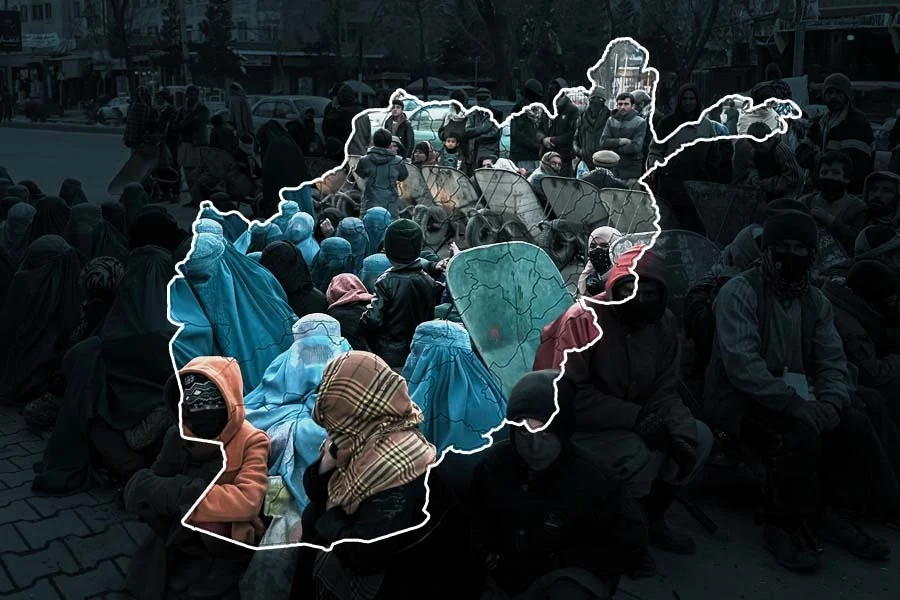
This may be the hardest part of the story. Over the past two decades, the world has repeatedly seen similar images of Afghanistan: hungry children, displaced families, women deprived of basic rights, devastated villages, migrants stranded at borders, and hospitals facing shortages of supplies. The repetition of these images can reduce their impact. What was a shocking catastrophe in the first years of the war may, after two decades, become part of the general perception of Afghanistan. This phenomenon is not limited to the media. Politicians also respond to it. When a crisis continues for a long time, and there is no simple solution to it, the political incentive to address it declines. The crisis in Afghanistan has fallen victim to this very attention fatigue.
Of course, not all of the responsibility lies with the international community. The Taliban, through their own policies, particularly the severe restrictions on women and girls, the curbs on civil and political freedoms,s and the absence of an inclusive government, have made normal engagement with the international community difficult. Western countries cannot easily establish normal political and economic relations with a regime that has deprived a large part of society, especially women and girls, of their basic rights. But the problem is that political pressure on the Taliban does not necessarily mean a reduction in people’s suffering. A regime may be sanctioned, but the cost of sanctions is sometimes borne by people who play no role in that regime’s decisions. For this reason, the international community faces a difficult dilemma: how can it pressure the Taliban without putting further pressure on the people of Afghanistan? To this day, no complete and convincing answer to this question has been found.
Perhaps the greatest danger for Afghanistan is not just the spread of poverty or malnutrition. The greater danger is the normalization of this situation. If the international community concludes that this is simply how Afghanistan is and must remain, the pressure for change will also decline. If girls are deprived of school for years, their deprivation may one day no longer be seen as an urgent crisis. If millions of people live in poverty, poverty can become an ordinary feature of society. If the migration and forced return of millions of people keeps recurring, this too may come to be regarded as part of Afghanistan’s “natural state.” This danger is even more serious than the crisis itself, because as long as a crisis is regarded as a crisis, it is possible to mobilize resources to resolve it. But once the crisis becomes the “normal state of affairs,” the incentive for change disappears.
The international community cannot limit its relationship with Afghanistan to sending food parcels and emergency aid forever. Afghanistan needs an economy, investment, an education system, job opportunities, and a sustainable health system, and above all, it needs a political outlook that can accommodate the different segments of society. Humanitarian aid is necessary, but it is not enough. If the world only thinks about how to get Afghanistan from one winter to the next, it is in effect managing the crisis, not resolving it. Afghanistan may no longer be at the top of the world’s news, but its crisis has not ended. The country has moved from a long war into a multilayered crisis: an economic crisis, a humanitarian crisis, a crisis of political legitimacy, a crisis of women’s rights, a migration crisis, an employment crisis, and a crisis in its relations with the outside world. The problem is that these crises are no longer sudden and explosive; they are slow, prolonged and corrosive. And perhaps this very feature has allowed the world to live with them. But the people of Afghanistan cannot. For a family in Afghanistan with a hungry child, the crisis happens every day. For a girl who has been deprived of school, the crisis is not a news headline but a part of her lost future. For a young man without work, the crisis is not an economic report but the whole outlook of his life.
Therefore, the main question is no longer “why is Afghanistan still in crisis?” The more important question is: “why does the continuation of Afghanistan’s crisis no longer worry the world as much as it used to?” The answer may be that the world has become accustomed to the crisis in Afghanistan. But the world’s growing accustomed to a crisis does not mean the crisis has ended. Sometimes the most dangerous phase of a crisis begins when no one is surprised by its existence anymore.
You can read the Persian version of this analysis here: