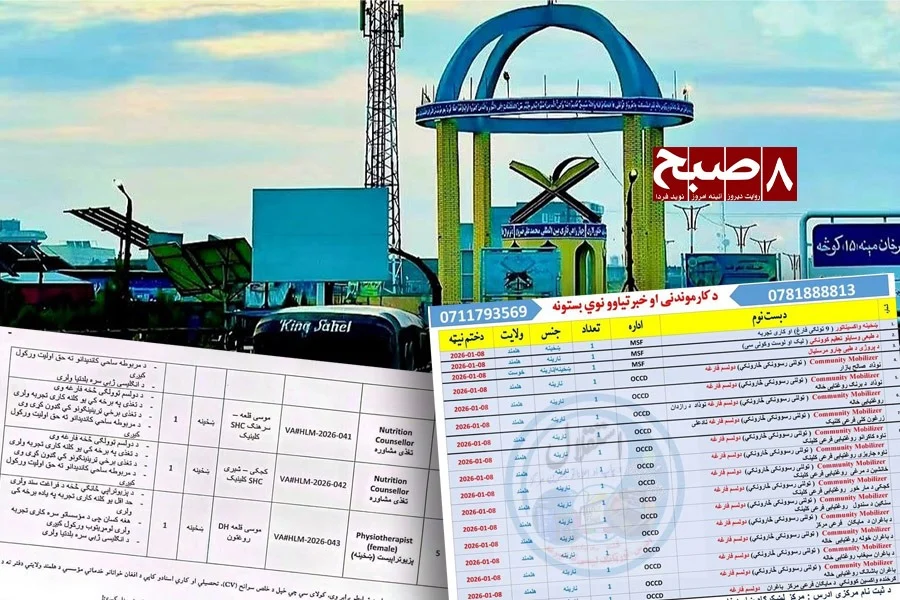
Some residents of Helmand and officials of government institutions under Taliban control in the province say that even finding women who have graduated from twelfth grade for positions designated for women is difficult, and in some cases impossible. They say that some institutions and government bodies under Taliban control repeatedly advertise their vacancies; however, despite easing the hiring requirements, no woman who has graduated from twelfth grade can be found in the province to apply for these positions.
The human resources official of one institution in Helmand says that men have been hired for some positions designated for women. According to him, they were unable to find even a single woman who had graduated from twelfth grade for these positions and were ultimately forced to hire men instead of women.
This human resources official adds that in another instance, the institution had advertised several positions for women; however, after two rounds of advertising, it only managed to find four women who had graduated from twelfth grade.
He says: “All institutions that need female staff struggle to find girls who have studied up to twelfth grade. Some time ago, we advertised positions related to women twice, and the requirements were also very simple; however, unfortunately, we were unable to find girls who had been educated up to twelfth grade.”
Meanwhile, officials of a number of other institutions in Helmand make similar statements, saying that the number of educated women in the province is decreasing day by day. According to them, the Directorate of Public Health, the National Statistics and Information Authority (NSIA), banks and several other institutions under Taliban control that need to hire women cannot find educated women, even twelfth-grade graduates, for the positions in question.
A source in the Helmand Directorate of Public Health, under Taliban control, says that some private institutions in the province have issued educational certificates in midwifery to girls who have not even attended school.
This source says that girls for whom some private institutions have prepared documents in exchange for money are now working in Helmand’s health centers based on work experience. According to this source, in many health centers in Helmand, women work in professional positions even though they are unable to write their own names.
This source says: “The situation in Helmand has become very bad. In the health sector and administrative bodies, professional positions have been taken by unqualified individuals. In health centers, there are many girls who cannot even write their names, yet they work as midwives. Some of these girls have graduated from private centers in Helmand and hold midwifery certificates, but they are unable to write their own names. The reason is that schools have been closed and society is moving in a different direction. In the future, you will also see that, out of necessity, illiterate individuals will work in professional positions.”
Dil Mohammad, a resident of Helmand, says that the ban on girls’ education not only affects the current lives of students, but will also cause a shortage of professional personnel in the province in the future.
He says that if girls are not allowed to continue their education, the shortage of female teachers, health workers, midwives, nurses and other female professional staff will increase in the coming years. According to him, many families in Helmand want their daughters to be educated, but the closure of schools has taken this opportunity away from them.
This Helmand resident adds: “We are now seeing the consequences of this ban with our own eyes. Girls who should be teachers, doctors, midwives and other professional staff today have been left at home. If the doors of girls’ education are not reopened as soon as possible, finding female professional staff will become more difficult in a few years.”
Meanwhile, a young girl from Helmand who was deprived of continuing her education after sixth grade says that the closure of schools has destroyed all her plans for the future.
Haafiza, a tenth-grade student, says that when she was studying in school, she hoped to continue her education up to twelfth grade and then at university, but the ban on girls’ education has left this wish unfulfilled.
This student, deprived of education, says that after the school closed, she spends most of her days at home, and the hardest part of the situation for her is talking with girls her own age about education and the future, while she herself is no longer allowed to go to school.
Haafiza says: “Every morning, when I see girls below sixth grade wearing school uniforms, I wish I could go to school with them too. We have been waiting for years, but we still do not know when we will be allowed to continue our education again. I do not want to lose my education; I want to go back to school and build my future.”
Over the past five years, the Taliban have closed the doors of schools and universities to girls, and have also banned women from work, education, presence in society, and participation in various aspects of social life.
You can read the Persian version of this report here:
ممنوعیت آموزش؛ نهادها: در هلمند زنان فارغ صنف دوازدهم برای استخدام پیدا نمیشوند