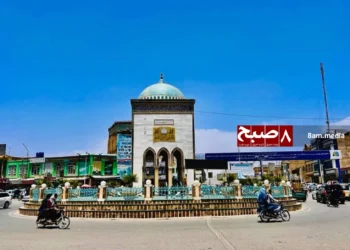

A supervisory document from Afghanistan’s central bank, under Taliban control, on the performance of “New Kabul Bank” (NKB) shows that the bank has made only 28.56 percent progress in implementing its reform program and the enforcement measures set by the central bank, and its performance has been rated “weak.” The report, which covers a follow-up supervisory period from September 30, 2025 to February 28, 2026, reveals weaknesses in liquidity management, the absence of an updated capital plan, a 40 percent concentration of deposits with a single major client, shortcomings in corporate governance, vacancies in several key management positions due to incompetence, unresolved embezzlement case follow-ups, and non-compliance with some banking regulations. According to this assessment, NKB scored 3.33 percent in capital adequacy, 16.11 percent in liquidity, 32 percent in earnings, 46.88 percent in asset quality, and 44.51 percent in management. Da Afghanistan Bank (DAB), the central bank under Taliban control, has also warned that if incomplete documents or inaccurate information are submitted, it can take legal action against the bank or its officials in accordance with the banking law.
A copy of the 66-page report by the DAB task force on the review of NKB’s status shows that the supervisory body identified widespread weaknesses in the bank’s managerial, executive, and operational performance. This oversight period began on March 31, 2026, and continued until May 7, 2026. The report’s findings reveal serious problems in the implementation of the reform program, capital and liquidity management, the corporate governance structure, compliance with banking regulations, and the follow-up process for violations and embezzlement cases at NKB.
According to this document, DAB’s General Directorate of Banking Supervision and Financial Services has sent the first follow-up supervisory report on the implementation of NKB’s reform program, covering the period from September 30, 2025 to February 28, 2026, to the bank’s board. The letter states that bank officials have implemented only about 28 percent of the specified conditions and are required to implement the remaining measures as soon as possible and report the results to DAB.
The report emphasizes that the assessment was based on documents and information provided by bank officials, and responsibility for the accuracy of these documents rests with the bank itself. DAB has warned that if incomplete or false information is provided, legal action could be taken against the bank or its officials in accordance with Articles 93 and 97 of the banking law.
Capital Plan Based on Outdated Information
One of the most significant criticisms raised in the report concerns NKB’s “capital preservation and growth plan.” According to the supervisory team, although this plan was approved by the executive board and the supervisory board, it was prepared based on financial data from different time periods and was not updated after the enforcement measures were issued.
The report states that risk-weighted assets increased from about 906 million Afghanis at the end of 2024 to more than one billion Afghanis by the end of June 2025. It also notes that the bank’s regulatory capital reached about three billion Afghanis, and the capital adequacy ratio was calculated at close to 297 percent, far above the minimum legal requirements.
The report states: “The bank’s risk-weighted assets were reported at about 905.9 million Afghanis as of December 31, 2024, a figure that rose to one billion Afghanis by June 30, 2025. Likewise, the bank’s financial capital stood at over 2.4 billion Afghanis at the end of 2023 and increased to 2.6 billion Afghanis by the end of 2024. Based on the calculations conducted, the bank’s capital adequacy ratio relative to risk-weighted assets reached 296.61 percent as of June 30, 2025, remaining above the regulatory requirement throughout the entire review period. However, the submitted plan does not include updated financial figures following receipt of the enforcement measures, and the bank’s new financial situation has not been fully reflected.”
Nonetheless, DAB has emphasized that the submitted plan lacks an updated analysis of capital adequacy ratios, the capital reliance ratio, the quality of capital components, and future scenarios, and that the bank is required to prepare a comprehensive plan in line with supervisory standards that precisely details the capital adequacy ratios, tier one and tier two capital, regulatory capital, and the capital reliance ratio according to the specified tables.
Declining Deposits and Lack of Outlook
The report shows that NKB has only reviewed the trend in customer deposits up to the end of 2024. According to the report, customer deposits have decreased by about 31 percent compared to 2019, but no forecast or analysis of the deposit situation for 2025 and 2026 has been provided, with only a deposit balance of about 17.8 billion Afghanis mentioned as of the end of June 2025.
At the same time, DAB has expressed concern over the high concentration of the bank’s financial resources. According to the report, by the end of February 2026, the deposits of the Afghan-Chinese Oil and Gas Company alone accounted for about 40 percent of the bank’s total deposits, a situation that, in the supervisory body’s view, violates liquidity regulations and reflects the bank’s severe dependence on a single major depositor.
No Plan for Crisis Conditions
Another part of the report states that NKB has no updated agreement with its shareholders for capital injection in emergency conditions. The bank’s stress test also merely described the general state of Afghanistan’s economy without providing any figures-based analysis to show what impact economic crises would have on the bank’s capital and financial capacity.
The supervisory team also noted that the bank has not yet formed a crisis management committee and has not developed a business continuity plan, risk identification, crisis management, and stakeholder coordination in accordance with supervisory requirements.
The report states: “A review of the bank’s financial reports during the supervisory period shows that NKB has not actively participated in the country’s economic activities, such that during this period, the bank has not carried out any financing or investment. Likewise, the bank has not provided the supervisory team with any updated commitment from its shareholders regarding the provision or injection of capital under emergency conditions.”
Weak Corporate Governance
The report also reveals widespread shortcomings in the bank’s management structure. According to the supervisory team, the bank’s supervisory board lacks members with expertise in legal and information technology fields, a matter that contravenes good governance regulations for banks.
The report states: “According to Article 8 of the Good Governance Regulation, the composition of the bank’s supervisory board must include individuals with professional experience and expertise in legal and information technology fields. However, a review of the educational records and work history of the supervisory board members shows that those included in the board lack relevant education and professional experience in legal and information technology fields.”
The supervisory board also did not form any subcommittees, including an internal audit committee, during the review period, and no meetings of such a committee were held. DAB added that the performance evaluation of executive board members was, contrary to the law, conducted by the chairman of the executive board rather than the supervisory board.
According to the report, the bank also lacked several important policies, including a customer rights protection policy, a policy for protecting customer deposits and assets, and a procedure for handling fraud and abuse cases.
The report emphasizes: “According to paragraph 8 of Article 15 of the Regulation on the Protection of Customer Rights in the Financial Sector, the bank’s supervisory board is required to prepare and approve an internal customer rights protection policy, a sales policy and procedure, a policy and procedure for protecting customer deposits and assets, and a policy and procedure for handling fraud and abuse cases. However, the supervisory team’s findings show that NKB lacked an internal customer rights protection policy during the review period, and the necessary documents regarding the approval and implementation of these policies were not made available to the supervisory team.” According to the report, “NKB lacked a specific policy and procedure for protecting customer deposits and assets during the review period. In addition, the bank lacks a specific policy and procedure for handling cases of fraud, deception, and abuse.”
Vacant Key Positions and Incomplete Implementation of the Strategic Plan
DAB stated in the report that NKB has also failed to implement its strategic plan. Among other things, plans to establish correspondent banking relationships with foreign banks, investment, service development, the activation of four inactive branches, and the purchase of ATMs have not been carried out.
The report states that the Know Your Customer (KYC) form must be reviewed and renewed in accordance with paragraph 5 of Article 13 of the Regulation on Organizing Activities and Preventing Money Laundering. However, due to the absence of a specialized member on the supervisory task force to review matters related to anti-money laundering, full assurance could not be obtained regarding the extent of the bank’s compliance with this requirement.
Additionally, two key positions, deputy chief executive officer and head of credit, remained vacant during the supervisory period, and contrary to the banking law, the bank’s management structure was not complete.
The report states: “The bank’s executive board is required, in accordance with paragraph 1 of Article 56 of the banking law, to regulate the number of its members. Taking into account the bank’s organizational structure for 2026, this structure was approved by the bank’s supervisory board on December 27, 2025. The members of the executive board include the chief executive officer, the deputy chief executive officer, the chief financial officer, the head of credit, and the chief operating officer. However, during the supervisory period, the position of deputy chief executive officer, whose occupant resigned on February 16, 2026, and the position of head of credit both remained vacant.”
The report also shows that the general directorates of services and procurement continue to operate under the chief operating officer, whereas they should be managed directly under the executive board.
The report further states: “During the supervisory period, the bank generally acted in violation of the requirements of Article 5 of its personnel policy, such that of the 26 employees promoted to higher positions, 25 were promoted through recommendation and only one through open competition. Examples of such promotions include the promotion of the treasurer of the Ghor central branch to deputy of the Ghor branch, the manager of the Loy Jirga branch to treasurer of the Loy Jirga branch, and an employee from the general card management department to deputy of the Kandahar police command branch.”
Embezzlement, Unresolved Accounts, and Foreign Exchange Losses
According to the document, an embezzlement case involving 75,872 dollars by three bank employees, which occurred between 2017 and 2019, has still not been resolved. As of the preparation of the report, only about 19,800 dollars had been recovered, and bank officials attributed the delay to the ongoing court proceedings within Taliban institutions.
The report also states that more than 36,000 US dollars of the bank’s assets held at CSC Bank in Lebanon remain unresolved, and it emphasizes that there is no reliable documentation regarding the possibility of recovering this amount.
Another part of the report states that the bank incurred losses of about 38.45 million Afghanis during the supervisory period due to exchange rate fluctuations but did not take effective measures to manage this risk.
The report states: “As of February 28, 2026, the bank had four inactive branches in government locations, including the parliament building, the Kandahar police headquarters, a branch located within the compound of the Kandahar Directorate of Education, and the Kandahar 3rd Brigade. However, the bank lacks a specific plan regarding the activation or deactivation of these branches.”
Administrative and Banking Violations
The supervisory team’s findings show that NKB relocated 18 of its branches in recent years without observing the legal deadline and without prior notification to DAB. The bank also relied mainly on direct appointment rather than open competition for staff promotions, which contravenes the bank’s human resources policy.
The report states that bank officials are required, in accordance with Article 41 of the banking law, to strictly refrain from arbitrarily relocating branches from one place to another. If relocation is necessary, the bank must notify DAB in writing 30 days in advance. However, the bank arbitrarily relocated 18 of its branches from one location to another between 2022 and 2024.
Additionally, during the supervisory period, one of the bank’s urban branches in Kabul, which was previously located in the Amanzada commercial market near the Alauddin intersection, was relocated to the Kabul Complex commercial market on Darulaman Road in Kabul, near the Russian embassy. Notification of this branch relocation was only sent to DAB 30 days after the new property lease was signed.
Other issues mentioned in the report include the absence of a standard archive for document retention, the collection of fees from some inactive accounts contrary to DAB’s directive, incomplete implementation of the minimum balance system, failure to update Know Your Customer (KYC) information, and failure to use all approved identification documents for account opening.
The report states that bank officials have not transferred documents related to branches located within military garrisons to the central archive or provincial branches. Likewise, bank officials have not taken any effective practical steps toward creating a standard archive that would ensure the safekeeping and security of documents. This absence of a standard archive seriously exposes the bank to financial, operational, and legal risks.
The central bank under Taliban control stated that, based on the reviews conducted, the current situation shows that Kabul Bank’s documents are stored in a non-standard manner at two separate locations in the Shahr-e Naw area, one near the Hajj and Endowments Directorate and the other in the Arzan Qeymat area. According to the bank, both locations lack the necessary conditions for the safe storage of documents as well as timely access to them.
In its final summary, DAB assessed NKB’s status based on five key indicators. According to this assessment, the bank’s capital adequacy stood at 3.33 percent, rated “very weak”; asset quality at 46.88 percent and management at 44.51 percent, both rated “good”; earnings at 32 percent, rated “weak”; and liquidity at 16.11 percent, rated “very weak.”
DAB calculated the overall rate of NKB’s compliance with the reform conditions and enforcement measures at 28.56 percent and, based on this result, rated the bank’s overall performance in implementing the reform program as “weak.” The report also notes that NKB had announced the implementation of certain conditions, including clauses 10.5 and 10.7 of the reform program, but DAB’s reviews found that one of these conditions had not yet been implemented in the bank’s system, and no documentation was provided showing the implementation of the other.
DAB concluded by calling on NKB officials to implement all remaining conditions as soon as possible, update their reform programs, and submit a documented report of the measures taken for further review.
You can read the Persian version of this investigative report here:
کابلبانک؛ از ضعف مدیریتی و بحران نقدینگی تا ناکامی در اصلاحات بانکی