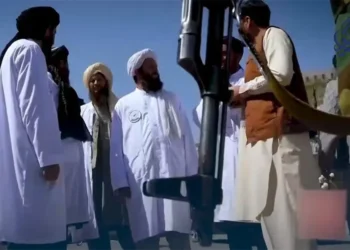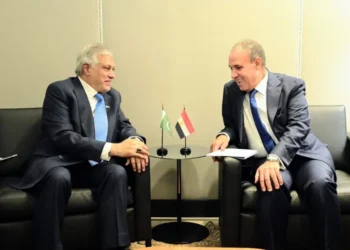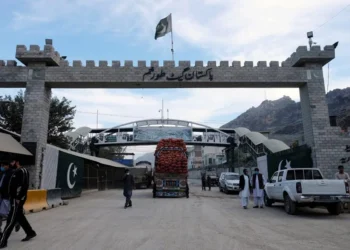
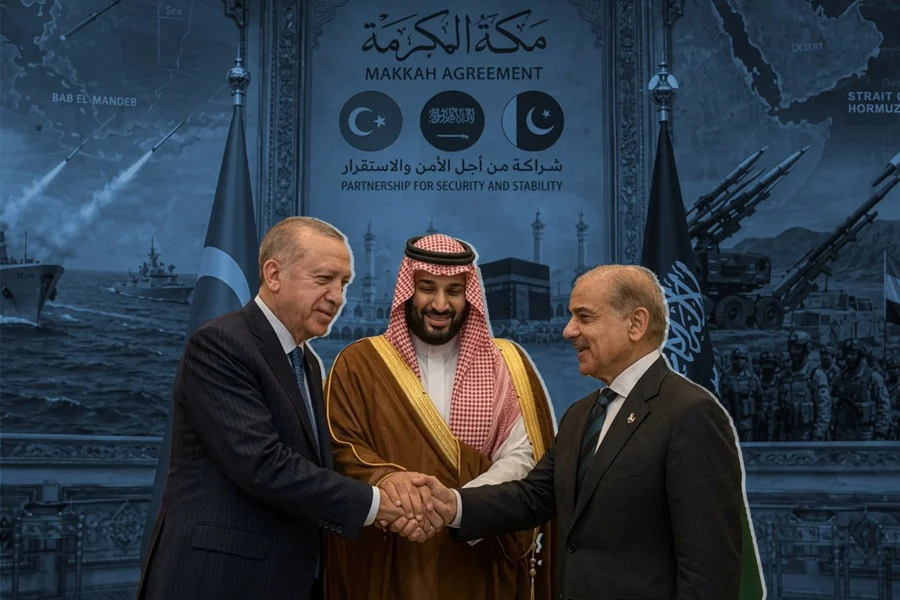
If we view the current confrontation between Pakistan and the Taliban solely through the lens of Tehrik-i-Taliban Pakistan (TTP), we miss the most important development. The bigger issue is that one of Pakistan’s long-standing calculations about Afghanistan may be unravelling. The structure that was meant to create “strategic depth” on Pakistan’s western border and limit India’s influence has now, as the TTP threat intensifies, given New Delhi more room to return to the Afghanistan equation. The question, therefore, is no longer just how Pakistan will rein in the Taliban. It is how long Islamabad will continue to see a balance with the Taliban at its center as serving its interests.
This question is being raised in a different regional environment. In August 2026, Pakistan, Saudi Arabia and Turkey signed the “Mecca Joint Defense Agreement,” moving security cooperation among the three countries into a more institutionalized phase. On the other side, India and Israel upgraded their relations in February of this year to a “Special Strategic Partnership,” and their defense, security, cyber, and technological cooperation has expanded. At the same time, the rift between the Taliban and Pakistan has deepened as Kabul has moved closer to New Delhi. These relationships do not yet amount to two symmetrical alliances with a joint command, but they place the Afghanistan crisis in an environment where multiple regional rivalries could become linked.
For opponents of the Taliban, this is where the significance of the development lies. If Pakistan continues to treat the problem purely as one of correcting Taliban behavior, the opponents can at best be one of several levers of pressure. But if Islamabad concludes that the problem lies in the very balance that has turned the Taliban into the dominant, unrivaled force in Afghanistan, a different space emerges. The gap between these two positions, pressuring the Taliban to change their behavior versus moving toward changing the balance of power in Afghanistan, is the central axis of this discussion.
When the Logic of a Strategy Works Against Itself
Pakistan’s crisis with the Taliban can be seen as Islamabad’s collision with one of the contradictions of its own long-standing strategy in Afghanistan. For years, Pakistan benefited from an environment in which the official border had not managed to fully separate ethnic and tribal ties, religious networks, and the geography of war. That same cross-border continuity once gave the Taliban of Afghanistan depth and the means to survive, but now that same structure has made it difficult for Islamabad to separate the Taliban from the TTP.
The Durand Line deepens this contradiction. The Taliban of Afghanistan and the TTP are two separate organizations, but they operate on both sides of a border whose legitimacy has long been disputed and which, in Pashtun political memory, is tied to the claim of Pashtunistan and the “Lar o Bar” narrative. When years of shared warfare, tribal ties and ideological affinity are added to this background, Pakistan’s problem is no longer merely convincing the Taliban leadership to restrain a foreign group. In practice, Islamabad is demanding the severing of a network within which part of the Taliban’s own power took shape.
This is where the limits of Pakistani pressure become clear. Even if the Taliban leadership understands the cost of confrontation with Islamabad, fully meeting Pakistan’s demand on the TTP could set it against part of the very social and wartime environment that formed alongside the Taliban over the years. The issue, therefore, is not necessarily just the will of the Taliban leadership; it may be its capacity to sever a network that is difficult to break without internal cost.
This limit has produced a cycle of mutual escalation. The Taliban’s inability or unwillingness to break with the TTP has increased Pakistani pressure, and as that pressure has grown, the Taliban have moved closer to India, a closeness that increases their room for maneuver against Islamabad. India uses this rift to expand its influence, a development that in turn heightens Pakistan’s security sensitivity and intensifies pressure on the Taliban. As a result, the very pressure meant to rein in the Taliban can push them further toward India and strengthen the very outcome that Pakistan’s historical strategy in Afghanistan was designed to prevent.
At this point, the decisive question is no longer how badly relations between the Taliban and Pakistan have deteriorated. It is how long Islamabad will consider this contradiction solvable within the framework of “correcting Taliban behavior,” and from what point it may begin to see the problem in the very balance of power it once helped create.
The Hypothesis of a Larger Alignment
At this point, the hypothesis of a larger regional alignment becomes important, though not because the existence of two cohesive blocs has been proven in advance. The Mecca agreement is now an official reality, and on the other side, the India-Israel strategic partnership also has an established structure. But the existence of these two relationships does not in itself prove that one was created to counter the other.
Hasan Khan, head of Zhwandoon TV, regards these developments as part of a larger alignment. In his view, Israel, in cooperation with India, is trying to use the Taliban and an escalation of TTP activity to entangle Pakistan in an internal crisis, limiting this country’s ability to provide military support to Saudi Arabia. In this reading, Pakistan, Saudi Arabia and Turkey stand on one side, and the Taliban, India and Israel on the other.
The analytical value of this hypothesis does not necessarily depend on proving a secret alliance. Actors do not always need to be members of a single command to produce a shared outcome. India can seek to increase its influence in Afghanistan, the Taliban can seek to reduce their dependence on Pakistan, the TTP can pursue its own goals inside Pakistan, and Israel can pursue its own independent interests in its strategic partnership with India. Yet the direction of these interests, even without a common command center, can increase pressure on Pakistan on several fronts.
From this perspective, the more useful question is not whether the Taliban, India and Israel have formally formed an “alliance.” It is whether the convergence of their interests can change Pakistan’s security environment in such a way that Islamabad no longer sees the TTP, the Taliban and India’s growing influence in Afghanistan as three separate problems, but defines them as components of one interconnected security problem. A change in threat perception matters because states do not necessarily respond to the actual, single source of a threat; they respond to the picture their security apparatus builds from the set of threats.
Within this framework, Israel’s possible role should be weighed with greater caution. The defense, technological and security cooperation between India and Israel is extensive and well documented, and India’s closeness to the Taliban has also increased New Delhi’s access to the Afghan environment. In theory, India could be a link through which outside resources, knowledge or capabilities find their way into Afghanistan. But until there is independent evidence of such a transfer to the Taliban or the TTP, turning this possibility into a claim of an operational Israel-India-Taliban mechanism goes beyond the bounds of documented analysis.
This limit on evidence, however, does not change the main thesis. For Islamabad’s calculation to change, Pakistan does not need to prove the existence of a joint operations room among its enemies. It is enough for the country’s security apparatus to conclude that the consequences of the various actors’ behavior are accumulating in one direction: the TTP is increasing internal pressure, the Taliban are unable or unwilling to remove it to the level Pakistan expects, and India is exploiting the resulting rift to increase its influence in Afghanistan. In that case, the problem for Pakistan is no longer a single source of threat; it is the cumulative effect.
From Changing Behavior to Changing the Balance
If Pakistan sees these developments as components of an interconnected threat, the next issue is no longer identifying the threat but the type of response it chooses to contain it. The military confrontation with the Taliban, coupled with the increased activity of opposition fronts in northeastern Afghanistan, has made the question more pressing: to what extent is Pakistan’s pressure designed to change Taliban behavior, and at what point could it turn into an effort to change the balance of power inside Afghanistan?
Here a distinction must be made between “fact” and “claim.” Armed activity by Taliban opponents has increased in parts of the northeast, and the Taliban accuse Pakistan of supporting their opponents. Islamabad rejects this accusation, and the available independent evidence is still not sufficient to establish an organized Pakistani program. From the standpoint of policy analysis, however, the important question is not only whether there is current support; it is, if Pakistan turns to using the opponents as leverage, what level of power for them would be compatible with Islamabad’s goals.
Supporting armed opponents does not necessarily mean a decision to overthrow the Taliban. There is a great distance between limited assistance to increase pressure, building the capacity for a sustained presence in part of Afghanistan’s territory, changing the balance of power, and a full regime-change project. For Pakistan, even creating some level of internal balance could serve a strategic function without a commitment to regime change.
If the opposition fronts move from scattered attacks to a sustained presence in parts of Afghanistan, the Taliban’s geographic and military monopoly will face a challenge. The Taliban will have to shift part of their forces, resources, and security focus to internal fronts, and the cost of continuing the confrontation with Pakistan will rise. In such a scenario, Islamabad’s goal is not necessarily the fall of the Taliban; changing the balance inside Afghanistan could itself be a tool for changing Taliban behavior.
Pakistan could then keep two tracks open at the same time: negotiation and direct pressure to secure verifiable action against the TTP, and alongside it, an internal lever that raises the cost of rejecting Pakistan’s security demands. Therefore, the decisive question is not simply whether Pakistan supports the Taliban’s opponents or not. The more important matter is, if it does, what level of power Pakistan wants them to have.
Is the goal merely to increase military pressure? Should the opponents be able to take control of part of the territory and break the Taliban’s monopoly? Is such a capacity meant to be a lever to compel the Taliban to carry out, in practice and in a verifiable way, the commitments Pakistan expects regarding the TTP? Or could it, at a later stage, become the foundation for the formation of a political alternative to the Taliban?
These levels must not be confused with one another. A foreign power may strengthen the Taliban’s opponents enough that they can pressure Kabul, but not necessarily enough to replace the Taliban. This distinction is of fundamental importance for the Taliban’s opponents.
Opportunity or Proxy Role?
If the regional environment is changing, the Taliban’s opponents face an opportunity and a risk at the same time. The opportunity is that the Taliban would no longer be the only actor through which regional countries are forced to view Afghanistan’s future. The more the cost of the Taliban rises for Pakistan, the greater Islamabad’s incentive to have other options.
But the risk begins at the same point. The interests of Pakistan and the Taliban’s opponents may overlap at some juncture, but they are not identical. Pakistan pursues its own security and interests above all else. If Islamabad’s goal is merely to create enough pressure to change Taliban behavior, Pakistan’s need for the opponents may diminish just when the Taliban become willing to make concessions.
The Taliban’s opponents, therefore, should not mistake the possible support of a foreign power for that power’s commitment to their ultimate goals. Afghanistan’s experience has shown that when a domestic force builds its entire calculation on foreign support, it may be left without backing at the moment the patron’s interests change.
In such a situation, the first task for the Taliban’s opponents is to turn the regional opportunity into real weight in Afghanistan’s domestic equation. A sustained presence inside the country and a social and political base can challenge the Taliban’s monopoly and turn the opponents from a force outside the equation into one of its parties. But changing the balance must not necessarily remain limited to the expansion of war. If the goal is to break the monopoly on power, this same balance can ultimately be achieved through a political path as well, including through negotiations leading to genuine participation of various forces in an inclusive structure backed by credible international guarantees.
From this perspective, pressure and dialogue are not necessarily contradictory paths. Increasing the weight of the opponents can raise their bargaining power, while keeping the door to negotiation open preserves the possibility of turning a change in the balance into a political agreement. For Pakistan too, if the primary goal is to contain security threats and prevent an uncontrollable force from monopolizing Afghanistan, a guaranteed political balance could at some point serve the same function that pressure for changing the balance on the ground is pursuing.
For the Taliban’s opponents, the meaning of this development is that an increase in military weight must be accompanied by an increase in political weight. An effective presence inside the country and the breaking of the Taliban’s geographic monopoly can make them part of the balance of power; but to turn this position into a lasting achievement, an inclusive political framework must take shape at the same time in opposition to the Taliban’s monopolistic structure, one that can bring together Afghanistan’s various political, ethnic and social forces and, if the ground for a political solution is prepared, enter the equation with a defined weight and program. In this way, resistance and politics will not be separate paths: increased weight on the ground builds political power, and political cohesion and a program turn that power into the capacity of an alternative that can be offered for Afghanistan’s future.
Opposing the Taliban alone is not a program of governance. A serious alternative must have clear answers on the type of political system, the distribution of power, the participation of ethnic and social groups, women’s rights, fundamental freedoms, the economy, and Afghanistan’s relations with its neighbors.
This same logic matters in the foreign policy of the opponents as well. Taking advantage of the opportunity arising from the change in Pakistan’s calculation must not turn into strategic dependence on Islamabad. Pakistan can be one of the parties of engagement, but to preserve the independence of their decision-making, the opponents need more balanced regional and international relations. The more diverse their sources of support and political contacts, the lower the likelihood that they will be removed from the equation when one country’s calculations change again.
Do Not Confuse Opportunity with Proxy Status
For the Taliban’s opponents, the value of the current development does not lie in the possibility that Pakistan may need them; the real importance is that, for the first time, Pakistan’s need to preserve the Taliban’s monopoly over Afghanistan may diminish. These two do not mean the same thing. The first could turn the opponents into a tool of temporary pressure for Islamabad, but the second could create a wider space for changing the balance of power in Afghanistan. Therefore, the decisive issue for the opponents is not their degree of closeness to Pakistan, but their ability to turn the rift created in regional calculations into independent political and domestic weight.
The decisive shift occurs when Pakistan’s goal moves from compelling the Taliban to change their behavior to accepting the necessity of changing the balance of power in Afghanistan. The sign of this transition will not merely be the intensity of attacks or the harshness of Islamabad’s positions; the more important criterion is whether Pakistan allows political and field capacities independent of the Taliban to develop as a lasting part of the Afghanistan equation. In that case, the issue will no longer be merely containing the TTP or pressuring Kabul, but the Taliban’s monopoly on power itself will become a variable in the regional calculation.
For the Taliban’s opponents, an effective policy must be built on this distinction. They cannot determine the timing and limits of a change in Pakistan’s calculation, but they can determine the capacity with which they enter this space if it opens. If the change in the regional balance only leads to greater dependence on a foreign patron, the new opportunity will be merely another form of proxy status; but if this space leads to an increase in their independent weight inside the country, political cohesion and the ability to offer an inclusive alternative, the change in Pakistan’s calculation could move from a development in relations between two countries to a variable in Afghanistan’s political future.
You can read the Persian version of this analysis article here:
توافق مکه در برابر طالبان، هند و اسراییل؛ آیا صفبندی تازهای در حال شکلگیری است؟