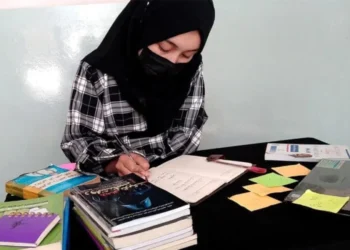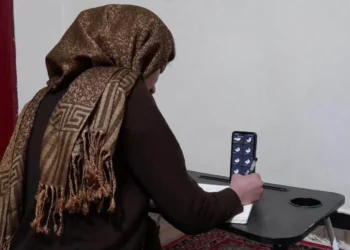
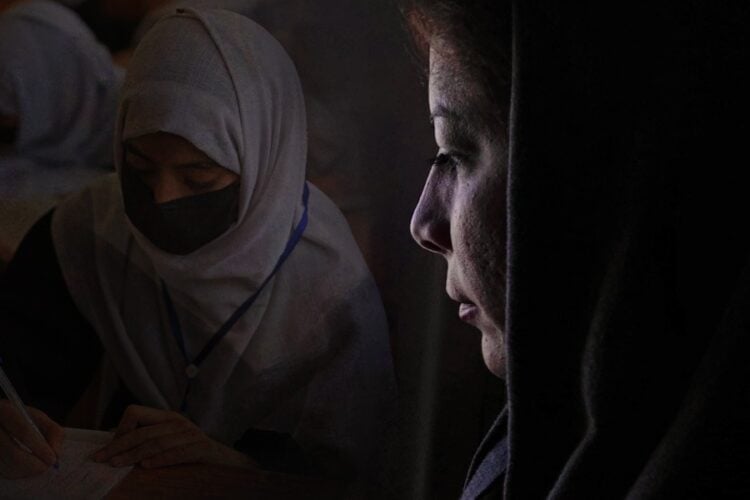
I see Mozhda with her young daughter, Paria, resting peacefully in her arms. Mozhda ’s hands are wrapped around her daughter’s small body, and from time to time, she gently looks at her face. There is a mixture of calm and regret in her eyes, as if, while looking at her child, she is also searching for a part of herself in the past; a woman who once lived with her books, made plans for her future, and believed that one day she would sit in a university classroom and, wearing a graduation gown, celebrate the end of years of study and hard work.
When Mozhda talks about her past, her voice is calm, but behind that calmness lies deep regret. Paria is still in her arms as Mozhda gently strokes her daughter’s hair and recalls the days when she spent two full years preparing for the university entrance exam. She says, “I studied for the university entrance exam for two years. I studied together with my brother. We both worked hard to succeed in the fields we wanted. I was a top student at school and always thought that university would begin a new chapter in my life after school.”
For Mozhda, the university entrance exam was not simply an exam. It was a gateway to a future she had imagined for years. She pictured herself in a university classroom, surrounded by books, professors, and classmates. She dreamed of becoming a lawyer and wanted to build a place for herself through her knowledge and abilities.
But Afghanistan took a different path just as Mozhda was getting closer than ever to her future. With the Taliban’s return to power, everything changed. Mozhda did not even get the chance to sit for the exam for which she had studied for two years. The books that had once represented her future gradually remained in a corner of the house, and the plans she had made for her life were brought to a halt by the restrictions.
Later, when universities were also closed to girls, Mozhda had lost more than just the opportunity to take an exam. She felt that a part of her future had been taken away from her. She says, “When universities were closed, I realized that the future I had imagined for myself would no longer be possible so easily. Everything had changed. I had studied for two years so I could go to university, but I could not even take the entrance exam. Then the universities were closed too. It was as if all the paths I had seen ahead of me had suddenly been closed.”
Mozhda grew up in a well-off family. Her family was financially comfortable, and a lack of resources was not an obstacle to her education. If money had been the only problem, perhaps Mozhda ’s story would have been different today. She had even decided to continue her education abroad. She wanted to find a way to continue studying and pursue elsewhere the dream that had been taken away from her in Afghanistan. But this time, another obstacle stood in her way: her family’s traditional views. Mozhda ’s family did not agree to let her go abroad to continue her education. In a family where major decisions about girls’ lives are still influenced by traditional beliefs, Mozhda ’s wishes could not overcome her family’s decision. She says, “I wanted to leave and study. I had the opportunity to do so. But my family did not allow me. They thought that a girl should not leave her family alone to continue her education. No matter what I said or how much I tried to convince them, it did not work.” For Mozhda, that “it did not work” was more than just a phrase. Behind it was a future that was slowly slipping away.
Her family asked her to put aside her dreams of education, university, and becoming a lawyer and instead enter another stage of life, one that for many girls is still presented as the natural path before they are ready for it: marriage. Mozhda eventually married a man from a wealthy family. She does not speak negatively about her husband. On the contrary, when she talks about her married life, she says that she loves her husband and is satisfied with her life. But being satisfied with married life does not mean that the regret over the life she wanted has disappeared.
Perhaps this is the most difficult part of Mozhda’s story: a woman can love her husband, be satisfied with her life, be the mother of a beloved child, and at the same time continue to miss the woman she once was and the future she wanted.
While kissing her daughter’s face, Mozhda says, “I love my husband and I am not unhappy with my life, but I think it was not yet time for me to get married. I still dreamed of studying. I wanted to pursue my dreams, fly, and build something for myself. I did not want to become a mother so soon.” Mozhda’s voice becomes quieter at this point. She does not want to deny motherhood. Paria is precious to her. She holds her child, looks at her, and talks about the future she wants to build for her daughter. But between her words, the regret over the experiences she never had can clearly be heard. Mozhda says, “I love my child very much. Being a mother is valuable to me, but I regret the things I was unable to experience.”
Things that may seem ordinary to many have become difficult-to-reach dreams for Mozhda: sitting in a classroom, having professors, studying in her field of interest, attending a graduation ceremony, wearing a graduation gown, taking photos with classmates, and eventually having a career she earned for herself. She once considered all of this part of her future, but now she speaks of them as opportunities she never got to experience. “Sometimes I think that if those things had not happened, perhaps I would have graduated from university by now. Perhaps I would have become a lawyer. Perhaps I would be working and building the life I had imagined for myself.”
Mozhda pauses before continuing: “My brother finished his studies. He was able to achieve what he wanted. But I remained where I was, with a dream that is still in my heart.” This may be the simplest yet most painful part of Mozhda’s life: her brother completed his education, but Mozhda ’s dream did not end. It was simply put on hold.
Mozhda looks at her daughter. Paria is calm in her mother’s arms, unaware that years ago her mother had struggled for a future similar to the one she now wants for her. Mozhda says, “I do not want Paria to one day say, ‘I wish I had studied, I wish I had gone, I wish they had allowed me.’ I do not want being a girl to become a limitation for her.” For Mozhda , Paria is not only a child. She is another opportunity for the dreams Mozhda was unable to achieve.
Mozhda wants her daughter to be able to follow whatever path she chooses for her future. She wants that if Paria decides one day to become a doctor, lawyer, professor, or pursue any other dream, no one will stand in her way because she is a girl. Mozhda says, “I want my daughter to achieve all her dreams. I do not want someone to tell her one day that she cannot do something because she is a girl. Even if achieving her dreams means that she has to be away from me, I still want her to have the freedom to make her own choice.” These words, spoken by a mother holding her child, carry a deep meaning. Mozhda says that even if one day achieving Paria’s dreams means being separated from her mother, she is willing to accept that separation because she does not want her daughter to experience the same limitations, she experienced out of fear of being apart. She does not want a mother’s love to become a high wall standing in the way of her daughter’s future.
Perhaps this is where Mozhda ’s story becomes more than a personal account. Her story is not only about a girl who was unable to take the university entrance exam or attend university. It is the story of a generation of girls who found themselves caught between dreams and restrictions; girls who could have become students, lawyers, doctors, professors, and more, but whose major life decisions were made not by themselves, but by others.
Yet Mozhda still carries that girl inside her: the same girl who studied for the university entrance exam for two years, studied with her brother, and looked toward the future with excitement. Life may have taken her somewhere she never imagined in those days, but that dream has not completely disappeared. Even now, when she talks about becoming a lawyer, there is still excitement in her words, an excitement that has not faded over the years. Perhaps it is not as strong as it once was, but it is still there, like a light beneath the ashes.
Mozhda is now a mother. She holds Paria, cares for her, and thinks about her future. But alongside all her responsibilities as a mother, a part of her is still that top student at school, the girl who opened her books and studied for a better tomorrow. She says, “I cannot bring back the past. I cannot relive the years I lost. I cannot find the university seat I never got to sit in. But I can make sure that if my daughter wants to sit in that seat, she can.”
Paria is still in her mother’s arms. Mozhda looks at her quietly and perhaps sees in the child’s face the future she was unable to experience. A future in which being a girl is not a reason for saying “no,” an obstacle to moving forward, or an excuse to give up on one’s dreams.
Mozhda ’s story did not end with marriage. It did not end with motherhood, nor did it end when the doors of universities were closed. Her story is still continuing, in her eyes, in her regrets, and in the dreams, she now wants to keep alive for her daughter.
Mozhda was unable to fly, but she still believes in flying. Perhaps her greatest wish today can be summed up in one sentence: her daughter should never have to ask for permission to pursue her dreams simply because she is a girl. She wants Paria to reach the place she could not. For Mozhda , perhaps this is the last opportunity to ensure that the dream taken from her will not be taken from her daughter.