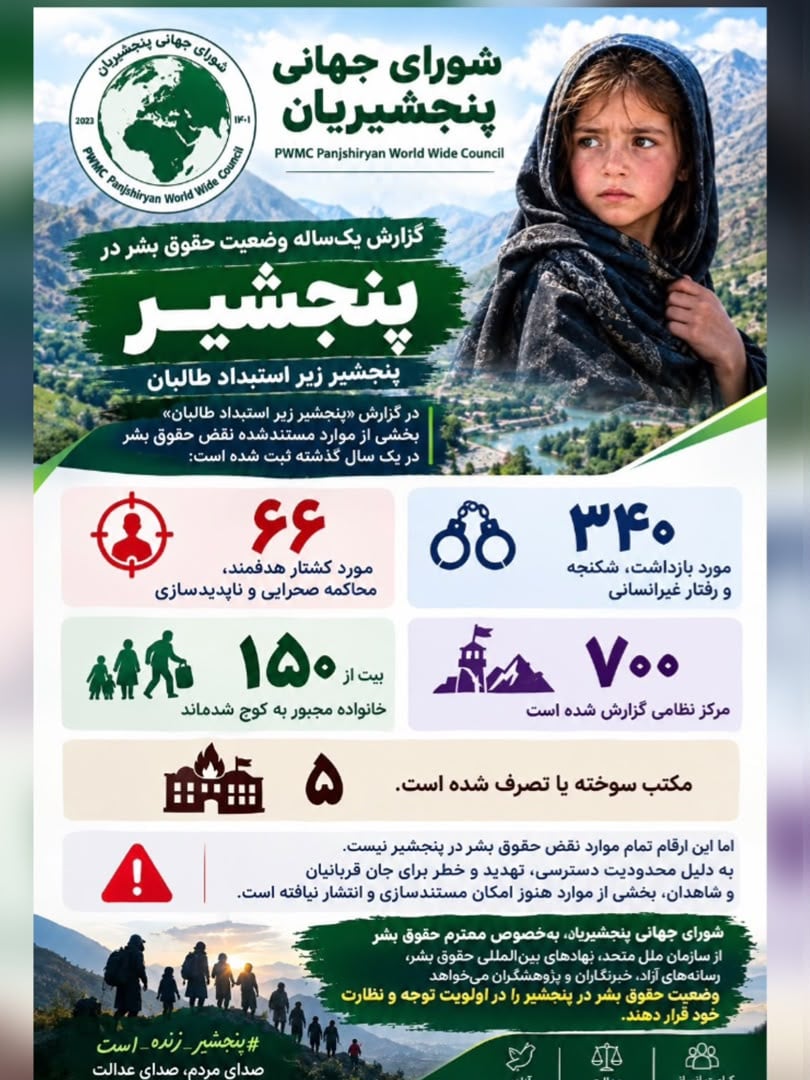
The Panjshir World Council, in an investigative report, said it has documented 66 cases of human rights violations in the province.
The council said on Friday, October 2, that the documented violations included killings, extrajudicial trials, torture, enforced disappearances, and people being run over by vehicles.
The Panjshir World Council said around 340 residents of Panjshir had also faced humiliation, threats, detention, torture or enforced disappearance in various cases.
The report said, “Around 340 residents of Panjshir, including in cases apparently linked to their ethnicity, language, identity and, in particular, being from Panjshir, have been subjected to humiliation, threats, detention, torture or enforced disappearance.”
According to the council, in some cases, the bodies of individuals were found in ruins, hospitals or near their homes, while the fate of others remains unknown.
The report said former security forces members and some former civilians and military personnel had been detained on allegations of membership in the National Resistance Front and held in private detention facilities.
The council reported that around 400 residents of Panjshir had been detained in Bagram prison and said it had received reports of arbitrary detention, extortion and demands for money in exchange for their release.
The Panjshir World Council also reported the forced displacement of more than 150 indigenous families following security, economic, military or property-related pressure.
The report said that in some areas, people’s homes and lands had been vacated or seized and subsequently used to accommodate Taliban forces or individuals affiliated with them.
The council also reported widespread restrictions on women and girls in education, employment, access to healthcare and social participation.
According to the report, the Taliban have imposed additional restrictions this year, including limiting the use of smartphones, restricting movement after 8 p.m., restricting access to seasonal pastures and preventing livestock from grazing in mountainous areas.
The Panjshir World Council said a number of educational and religious centers in the province have come under Taliban control.
According to the report, around 1,100 children and young people were present at two centers, about 400 of whom participated in programs related to “jihadist” education.
The report also expressed concern over restrictions on the Persian language, cultural and identity changes, the use of Panjshir’s name for propaganda purposes, and forced statements by residents.
The council also reported the extraction of around 66 types of minerals, damage to some private properties, and concerns over natural resources, livelihoods and unequal access to public services.
The Panjshir World Council stressed that some of the claims, including those related to demographic changes and international crimes, require investigation and verification by independent and competent judicial authorities.
The council emphasized that these figures do not represent all cases of human rights violations in Panjshir and said that due to limited access, threats and risks to the lives of victims and witnesses, some cases have not yet been documented or published.