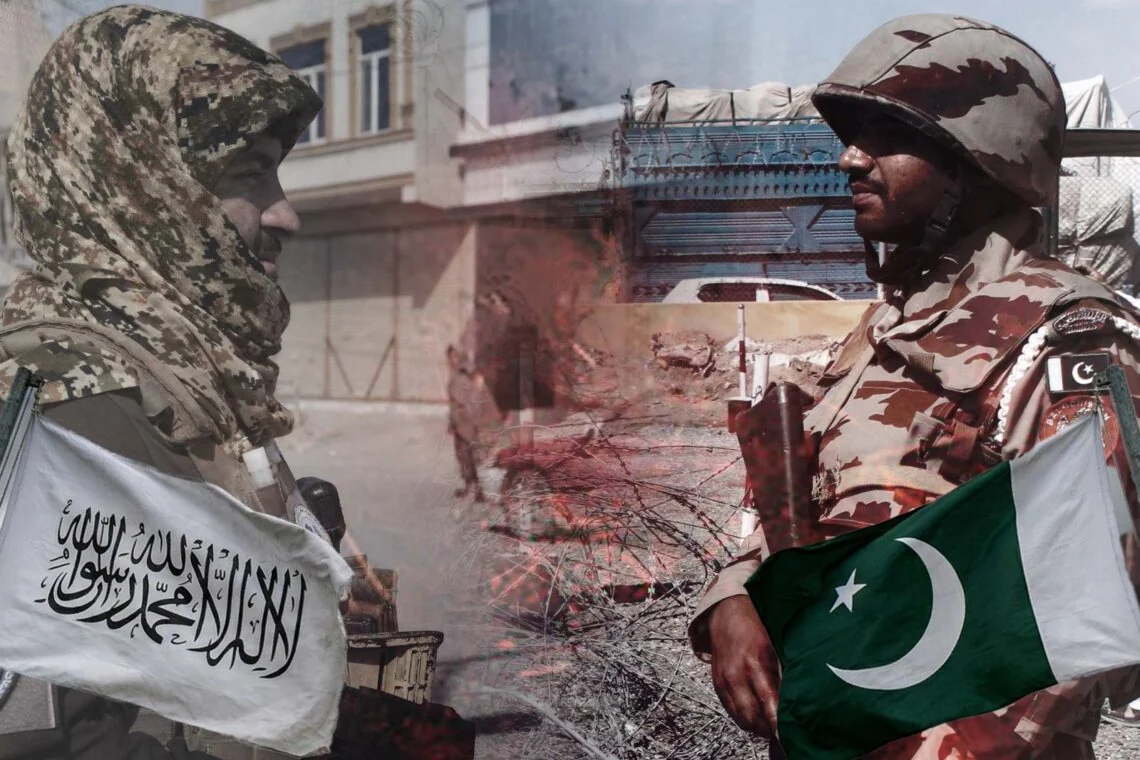
The confrontation between the Taliban and Pakistan has raised important questions about the nature of this conflict, Islamabad’s strategic objectives, and the future of relations between the two sides. Is this confrontation real and driven by a clash of interests, or is it part of a complex intelligence and political game to manage developments in Afghanistan and the region? After three decades of investing in the Taliban, is Pakistan now seeking to contain them, or does it want to once again draw on its historical pattern of managing and redirecting jihadist forces?
To understand this conflict, it is not enough to look only at border clashes, airstrikes, and harsh political posturing. The relationship between the Taliban and Pakistan has a long and complicated history in which security cooperation, mutual dependencies, regional rivalries, and unmet expectations all coexist. For this reason, the current confrontation can be examined from three different angles: a genuine clash of interests, a managed confrontation aimed at containing the Taliban’s opponents, and the continuation of a historical pattern in Pakistan’s security strategy.
The gap between Pakistan’s expectations and the Taliban’s conduct
One view worth considering is that the confrontation between the Taliban and Pakistan is real and rooted in Islamabad’s unrealistic expectations of the Taliban. Pakistan assumed that the Taliban’s return to power would pave the way for achieving its strategic, security, and economic goals in Afghanistan. After the Taliban were re-established in power, however, it became clear that not all of these expectations could be met.
Pakistan’s most important expectation was that the Taliban of Afghanistan would sever ties with Tehrik-e-Taliban Pakistan (TTP) and participate effectively in weakening and containing the group’s activities. Islamabad expected the Taliban, after returning to power, to act in support of Pakistan’s security and to prevent the activities of groups that threaten the country’s internal security.
However, Pakistan’s expectations were not limited to security matters. In foreign policy, Islamabad wanted a significant reduction in relations between Kabul and New Delhi and to prevent the expansion of India’s political, economic, and security influence in Afghanistan. Pakistan also expected to hold decisive influence over the Taliban’s diplomatic orientation and to prevent the emergence of an independent foreign policy that would conflict with its strategic interests.
In the economic sphere, Pakistan sought trade and customs concessions, including exemption from customs tariffs for the export and transit of Pakistani goods to Central Asia. Establishing a permanent and reliable corridor through Afghanistan to access the markets, resources, and economic opportunities of the Central Asian countries was another part of these calculations.
Alongside these goals, Islamabad was probably hoping that the Taliban’s return to power would help rebuild Pakistan’s image in Afghan public opinion and reduce the historical negative sentiment toward the country. Containing Pashtun nationalist movements, weakening cross-border claims, and reducing the political and security sensitivities tied to the Durand Line and the ethnic bonds on both sides of the border were also among Pakistan’s expectations.
Beyond all of this, Pakistan probably expected to hold extensive and unrivaled influence within the Taliban’s power structure and to play a decisive role in the security, intelligence, military, and economic institutions of their regime.
On this basis, the Taliban’s inability or unwillingness to meet these expectations has gradually deepened the rift between the two sides.
Pakistani airstrikes on targets in Kabul, Kandahar, and other parts of Afghanistan, Islamabad’s critical positions against the Taliban at regional and international meetings, its hosting of figures and groups opposed to the Taliban, and the intensification of the propaganda and media war in Pakistan are signs that may point to the genuine nature of this confrontation.
From this perspective, the current conflict is the result of a clash between Pakistan’s strategic expectations and the Taliban’s actual conduct, a situation that has pushed the relationship between the two old allies into a phase of distrust and confrontation.
Is Pakistan seeking to manage the Taliban and their opponents?
In contrast to the first view, there is another possibility: the current confrontation may be staged and managed, a scenario whose main goal is not to topple the Taliban but to contain their opponents and manage the political environment in Afghanistan and the region.
After nearly three decades of political, security, and intelligence investment in the Taliban, Pakistan has achieved one of its key strategic goals, namely the establishment of a friendly regime in Kabul. From this perspective, it does not seem logical that Rawalpindi would easily abandon all of its past investments.
Instead, it may be trying, by displaying opposition to the Taliban, both to redefine its relationship with the group and to bring the groups opposing them under its own monitoring and influence.
Establishing contacts with the Taliban’s opponents and hosting them in Islamabad could provide an opportunity to better understand the nature, capacity, composition, motives, goals, and seriousness of the opposition groups. Such an approach allows Pakistan to closely monitor the political movements of the Taliban’s opponents, instead of facing an unknown and unpredictable opposition.
This policy could also serve another regional goal: keeping the Taliban’s opponents away from their traditional allies, especially countries that have had political, security, or military relations with anti-Taliban groups in the past.
In such a situation, Islamabad could make itself one of the main channels of communication with the Taliban’s opponents and prevent the formation of independent regional coalitions. In this way, Pakistan would maintain its connection with the Taliban while also holding influence over their opponents.
Displaying opposition to the Taliban may also leave India and other regional actors uncertain. If New Delhi concludes that Pakistan itself has come into confrontation with the Taliban, it may face more complicated calculations about the necessity, timing, and manner of its diplomatic and strategic moves toward Kabul.
One of the most important possible consequences of such a scenario, however, is the “Pakistanization of the Taliban problem,” meaning that the Taliban issue would shift from a broad political, human rights, and international crisis to a largely bilateral dispute between Afghanistan and Pakistan.
In that case, the attention of the international community might focus less on the nature of the Taliban regime, the political future of Afghanistan, and the need to change the status quo, and more on the border and security disputes between Kabul and Islamabad. Such a trend could reduce international pressure for fundamental change in Afghanistan.
The ambiguity surrounding the objectives and exact results of the airstrikes, the absence of independent and verifiable information on casualties and damage, the concentration of a significant portion of the clashes in border areas, and the extensive media propaganda are among the factors that can be considered when examining this hypothesis.
On the other hand, according to this view, Pakistan’s support for the Taliban’s opponents so far has been largely limited to meetings, political contacts, and media positioning, and no practical or decisive support for them has been observed. The lack of sufficient evidence of an open and coherent strategy to overthrow the Taliban regime also strengthens the question of whether Islamabad truly wants regime change in the Taliban or simply wants to manage their behavior.
Of course, these signs alone do not prove that the confrontation is staged, but they can serve as a basis for examining Pakistan’s possible goals beyond the visible disputes between the two sides.
The Pakistani army and the historical pattern of using jihadist forces
For a deeper understanding of the current confrontation, attention must also be paid to Pakistan’s security structure, the founding rationale of its army, and its historical strategy of using jihadist groups.
Since Pakistan’s founding, rivalry and enmity with India have been among the most important factors shaping the country’s security and defense policy. India is eight to nine times larger than Pakistan in terms of population, geographic size, economic capacity, and human resources. This imbalance has always been one of the main concerns of Islamabad’s military and security strategists.
Based on this analysis, Pakistan’s security institutions have concluded at various points in history that relying on conventional military power alone cannot create the necessary balance against India. For this reason, the use of religious identity, ideological mobilization, and support for jihadist networks became one of the tools of the country’s security policy.
Within the framework of this strategy, strengthening the narrative of a civilizational and religious confrontation between India and Pakistan and increasing the capacity for religious mobilization, especially in border and peripheral regions, gained importance. The aim was for Pakistan, in the event of a wide-scale war with India, to have access not only to its regular army but also to the capacity of ideologically mobilized forces.
However, this policy faced a fundamental contradiction. The armed ideological networks that were meant to be instruments of Pakistan’s power against external threats could become a threat to the country’s political structure, state institutions, and even the Pakistani army itself.
Within this framework, one can speak of a pattern known as “Build Them Up, Then Tear Them Down.”
The logic of this analytical model is that jihadist forces must always be engaged in a mission, conflict, or external objective, so that their military and ideological energy is discharged outside Pakistan’s borders rather than threatening the country’s internal structure.
In such a view, the type of political system governing Afghanistan is not of decisive importance; what matters is the continuation of conflict and keeping jihadist forces occupied outside Pakistan. In this way, Islamabad can preserve the capacity of these networks as a tool of regional influence while reducing the risk of their return to the domestic arena.
Afghanistan: the stage for a repeating historical cycle?
The developments of recent decades in Afghanistan can also be examined within the framework of this pattern.
During the Cold War, Pakistan became one of the main bases for supporting, organizing, and backing the Afghan mujahideen factions. Its support for the mujahideen played a prominent role in the overthrow of the government of Dr. Najibullah.
After the mujahideen government came to power, the Taliban emerged as a new force against the new order. The support of Pakistan’s security structures for this group was one of the important factors in the expansion of Taliban power and ultimately the fall of the Islamic State of Afghanistan.
After 2001, Pakistan officially joined the international counterterrorism coalition and maintained its official relations with the Islamic Republic of Afghanistan. Nevertheless, the presence of Taliban leaders and networks on Pakistani soil and the country’s support for them were always among the most important sources of distrust between Kabul and Islamabad.
During this period, Pakistan maintained official relations with the Afghan republic on one hand, and on the other, provided the ground for the continued activity and rebuilding of the Taliban, a movement that ultimately returned to power in Afghanistan in 2021.
The question now is whether Rawalpindi is once again seeking to repeat the same pattern. After the Taliban’s return to power, is Pakistan trying to contain the Taliban by strengthening rival groups, applying security pressure, and managing political opposition, or is it laying the groundwork for the formation of a different political order?
If this hypothesis is correct, the current confrontation would be part of a historical cycle in which armed groups are first strengthened as instruments of influence and then, as conditions and interests change, come under pressure or are replaced by other forces.
Is Pakistan seeking to change the Taliban’s behavior, or to change the Taliban themselves?
The current confrontation between the Taliban and Pakistan cannot be interpreted solely based on official statements or the intensity of military clashes. This conflict may be the result of a genuine clash of interests, may be pursued as part of a managed confrontation, or may reflect the historical pattern of Pakistan’s security policy of using jihadist forces and then containing them.
These interpretations do not necessarily negate one another. The security disputes between the Taliban and Pakistan may be real, yet Islamabad may at the same time try to use these very disputes to increase pressure on the Taliban, identify their opponents, and strengthen its regional influence. Likewise, the fact that the confrontation is real does not necessarily mean Pakistan has decided to overthrow the Taliban regime.
From this perspective, the distinction between changing the behavior of the Taliban and changing the Taliban themselves becomes fundamentally important. If Islamabad’s goal is merely to compel the Taliban to accept Pakistan’s security, economic, and regional demands, the current pressures could be a tool for redefining the relationship between the two sides. But if Pakistan has concluded that the Taliban are no longer able or willing to serve its strategic interests, the possibility of supporting other political options could also enter the country’s future calculations.
Ultimately, what will clarify the nature of this confrontation is not the intensity of political slogans and the media war, but Pakistan’s actual conduct: the extent and type of pressure on the Taliban, the level of support for their opponents, and how Islamabad engages with India and other regional powers.
You can read the Persian version of this article here: