
Several citizens of Afghanistan are expressing serious concern over the rising prices of potatoes and other food items. They say that on the one hand, prices have increased, and on the other hand, the employment situation of the people is extremely poor, to the extent that many families cannot even provide a single meal for their children. According to them, with the intensification of the war and the closure of Pakistan’s borders, prices are rising day by day. Based on statements from residents of several provinces, the price of potatoes varies in each province. Currently, the price of one seer of potatoes in Kabul is about 400 afghanis, in Badakhshan and Takhar between 350 and 400 afghanis, in Mazar-e-Sharif 300 afghanis, in Herat 420 afghanis, and in Ghor, based on a five-kilogram measure, between 170 and 250 afghanis.
Following the increase in joint U.S. and Israeli attacks against Iran and the continued closure of the country’s crossings with Pakistan, the prices of food and basic goods are rising day by day. Many citizens of Afghanistan say that they have removed rice, meat, and other nutritious foods from their meals. According to them, potatoes have also now been removed from the tables of low-income families due to rising prices, and the process of eliminating food items one after another continues. They stress that if the current situation persists, a famine crisis will not be far off.
Many citizens of Afghanistan are expressing concern over the rising prices of food items, especially potatoes. They emphasize that the increasing trend in potato prices, amid unemployment and growing poverty, has alarmed people who relied on potatoes as their only meal.
Mahsa (pseudonym), a resident of Kabul, says that, despite a strong need, she has refrained from buying potatoes due to the price increase and instead purchased eggplant at 40 afghanis per kilogram. According to her, the price of potatoes in Kabul markets has reached 400 afghanis per seer, and due to widespread unemployment and poverty, people have even lost the food they previously prepared with potatoes.
This Kabul resident adds: “Potatoes, which are the food of low-income people and can be used to cook a variety of dishes, have now reached the price of meat. Where are people supposed to find this much money? If standard cold storage facilities were built and farmers were supported, such regional developments would not affect the country’s economy in this way; but unfortunately, no one is paying attention.”
Mahsa emphasizes: “The Taliban, instead of solving people’s problems, are only adding to them and accept whatever is demanded of the people of Afghanistan. If the situation continues like this, the prices of other food items will also increase, and life will become difficult for everyone. I myself work and have an income, but I still cannot prepare a proper meal; now, how can someone with little income live?”
A resident of Herat also says that currently the price of one kilogram of potatoes has reached 60 afghanis. According to him, this means one seer of potatoes is 420 afghanis, and due to widespread unemployment and poverty, people are unable to provide even their simplest meals. He adds that, along with these challenges, the war between Iran and the United States and the closure of the border with Pakistan have also contributed to rising prices, and if this situation continues, prices will rise further and hunger will reach its peak.
This Herat resident adds: “In Herat, prices have reached their peak and people, due to economic problems and unemployment, cannot afford food and their daily necessities. Everyone raises prices as they wish, and in the meantime, poor people become the victims. Even the price of one kilogram of potatoes has reached 60 afghanis. Although some families can afford to buy food, many families go to bed hungry at night.”
A resident of Mazar-e-Sharif, the center of Balkh province, says that on the one hand, prices have increased, and on the other hand, the employment situation of the people is very poor. According to him, the price of one kilogram of potatoes has reached 300 afghanis, and while potatoes were the only food for low-income people, this food item has now also been removed from their tables.
Two residents of Fayzabad, the center of Badakhshan province, also say that the price of potatoes in this city has risen to between 350 and 400 afghanis. According to them, with the continuation of the current situation, people’s concerns have increased, and the price of potatoes will likely rise further. They emphasize that, despite having agricultural land in Badakhshan, due to the lack of cold storage facilities and standard farming, people are not even able to supply their own potatoes.
Additionally, a resident of Firozkoh, the center of Ghor province, says that the price of five kilograms of potatoes is 170 afghanis, while another resident of the same city states that the price for the same amount of potatoes is 250 afghanis.
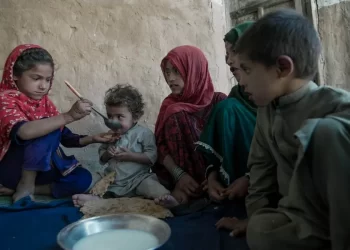
The World Food Programme (WFP) has announced that with the start of 2026, Afghanistan is simultaneously facing three crises, including intensified conflict on the Pakistan-Afghanistan border, the consequences of the conflict in Iran, and an unprecedented hunger crisis. According to the organization, one-third of Afghanistan’s population, or 17.4 million people, now require urgent food assistance. The report states that child malnutrition has increased sharply, and it is likely that 3.7 million children will need treatment in the current year alone.
You can read the Persian version of this report here:
کچالو هم از سفره مردم رفت؛ سایه گرسنهگی بر افغانستان پهنتر میشود