This campaign is now accompanied by artists, politicians, and thousands of social media users. Currently, the hashtag of this campaign has been shared more than seven and a half million times on Twitter. The supporters of this campaign want the international institutions and organizations active in the areas of human rights to recognize the so-called “Hazara Genocide in Afghanistan” and to identify and prosecute its perpetrators.
Thousands of Afghan citizens held a protest march on Saturday, October 8, in different cities of the world in response to what is called genocide in Afghanistan. These marchers published a joint resolution. In this resolution, it is emphasized that the United Nations and the international community should recognize the “Hazara Genocide in Afghanistan”. In this resolution, the United States of America and the European Union are still asked to take necessary and urgent steps to protect the Hazaras. Among other things included in this resolution; The establishment of a fact-finding commission to identify the perpetrators of the bloody attacks against the Hazara citizens of Afghanistan and to reach this issue by the International Criminal Court are the parts that specifically to be noted.
Social media users, especially the Hazara population of Afghanistan, also emphasize that the purpose of launching this campaign and the marches that have been launched in America, Europe, Australia, and Asia is to recognize the “Genocide of the Hazaras” by international organizations, especially the International Criminal Court. According to the protesters, they want to draw the attention of the countries of the world to stop these killings. They carry this march to convey their message to the world and create empathy and sympathy among different human groups.
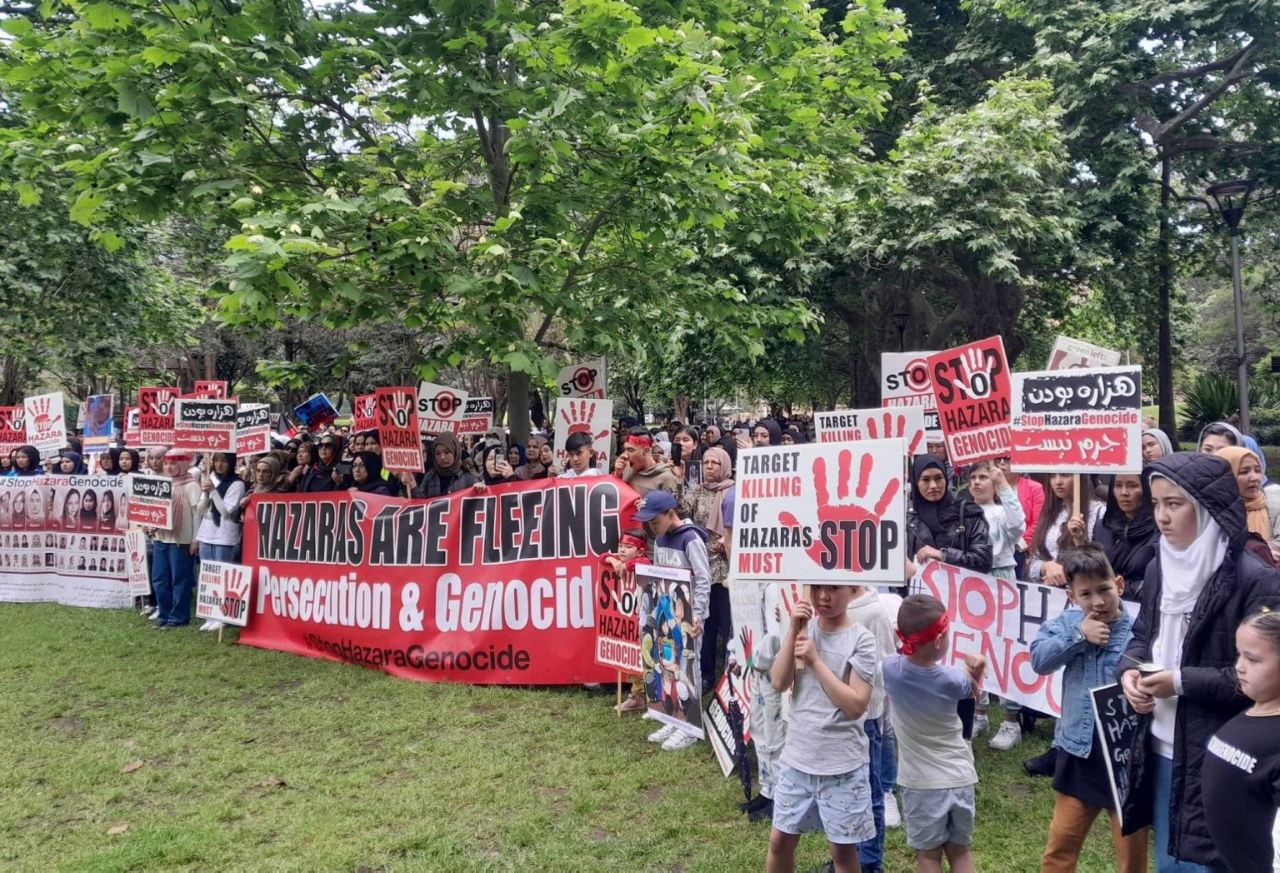
The social media users have published a list related to the “#StopHazaraGenocide” campaign, which shows that demonstrations were held in more than 96 cities in different countries of the world yesterday. In several cities around the world where demonstrations have been held so far, protesters have taken to the streets with the slogan “Stop Hazara Genocide”. Videotapes published on social networks show that hundreds of protesters have come to the streets in Washington DC, Sydney, Berlin, Makassar, Rome, Paris, and other cities of the world.
Farhad Darya, Wajiha Rastagar, and Dawood Sarkhosh are of the well-known artists of the country, have also announced their support for this campaign. Farhad Darya has called the protest march against the so-called “Hazara Genocide in Afghanistan”, “The largest, most widespread, and most popular gatherings and protests” to stop the genocide of the Hazaras in Afghanistan. Also, Wajiha Rastagar, by posting a videotape on social media, said: “Dear compatriots, let’s raise our voices in protest against the genocide of our Hazara brothers and sisters, as well as the young generation of the Kaj Educational Training Center, each of whom are our daughters and sons.”
In addition to the citizens and a number of Afghan artists, some political figures from host countries have also participated with the marchers and gave speeches in Australia, Chris Boyne, a member of parliament and the country’s energy minister, attended the Sydney protestors and said: “It is true that the Hazara people have suffered from successive wars, they have been massacred one after another. Consecutive killings, consecutive years.” In his speech to the protestors, referring to the suicide attack at the Kaj Educational Training Center in the west of Kabul the capital, which left more than 50 dead and nearly 90 wounded, he emphasized: “This is not only a crime committed against the Hazaras and the youth but the perpetrators must be punished.” The attack that took place on September 30 in a crowded place of youth, shows the fact that the world has not come together like us here to call to stop such barbaric attacks.”
However, Diane Coleman, a member of the Cumberland City Council and a professor at the University (Western Sydney University), who has joined the “#StopHazaraGenodice” in the crowd of protesters, wrote on her Facebook page: “I am honored to be associated with the Hazara community of Sydney today. This demonstration was part of the global protest against the bombing of a school in Kabul, which was held in 70 countries.” She added: “Everyone has the right to freedom, equality, and justice, and stop the genocide of the Hazaras.”
Protest against the “Hazara Genocide” which is said to have been held in more than 90 cities in different countries of the world, yesterday in different cities of America, Canada, Australia, Germany, Belgium, France, Italy, Norway, Poland, Sweden, Switzerland, Finland, Indonesia, Turkey, Austria, New Zealand, Brazil, and Pakistan have followed with protest rallies. Protesters have demanded to stop the “Hazara Genocide” and to have it recognized by international institutions.
However, the images that are circulating on social media show a number of Afghan citizens have joined this campaign, and they are holding placards of “Stop Hazara Genocide”. They are from the stoneworks factories in Isfahan, Iran, and a number of university students in this country.
Also, on Saturday, October 8, a number of Afghan citizens living in Islamabad, the capital of Pakistan, joined the “#StopHazaraGenocide” campaign with a protest rally and demanded the recognition of the genocide of the Hazaras with the slogans of “Justice! Justice! Hazaras have the right to live!”, with these campaigns they have turned to international human rights institutions and countries of the world to protect the Hazaras.
What are the Examples of Genocide?
Meanwhile, Mirza Raf’at, an expert in legal affairs, speaking to the Hasht-e Subh Daily says that the mass killing of Hazaras in Afghanistan is a clear example of “genocide”. According to him, any action and intention that leads to the destruction and physical removal of a part or the whole group of a particular nation or religion is a clear example of genocide. Mr. Raf’at adds: “The systematic and targeted killing of Hazaras and the attack on their educational and religious centers in Afghanistan is done to destroy this particular ethnic group. Extermination of the Hazaras is planned and implemented, which are clear examples of genocide.”
This expert on legal issues states that the recognition of the “Hazara Genocide” by the International Criminal Court (ICC) and international human rights institutions brings requirements and obligations for the countries of the world to work for the realization of justice.
According to him, the protestors have a long and difficult road to the recognition of this action by the world, but he emphasizes that documents and grounds for the investigation of international institutions in Afghanistan should be facilitated, and also by enlightening the minds of the public in the world, by doing so, it is possible to come close to this human desire, which is to honor the blood of humans and realize justice throughout the world.
Mr. Raf’at points out that with the recognition of the “Hazara Genocide”, it may not be possible to establish justice at present, but the path and steps to establish justice after the war, are measured and taken, and its perpetrators are also prosecuted by the International Criminal Court (ICC) in addition to a specific government. He considers it beneficial to fulfill this request to protect civilians who are at risk of genocide and to prevent such crimes from being committed again.
However, the scope of these protests is expanding. So far, dozens of domestic and international figures, including politicians, artists, and writers, have joined the campaign to end violence in Afghanistan, especially against the Hazaras, and shared the hashtag “#StopHazaraGenocide” on Twitter.
These protestors in various marches consider the continuation of attacks on educational, sports, cultural centers, mosques, and shelters of the Hazaras as examples of genocide, which has been going on for several years. These protestors mention the attack on Mauoud Educational Center in the Dasht-e Barchi area of Kabul city, in which 48 students were killed and 67 others were injured. According to them, during the past few years, mosques have been attacked in the west of Kabul. They mention the attack on the Baqir al-Uloom Mosque on November 1, 2016, which left 27 dead and 67 wounded. 39 people were killed and 45 were injured in another attack in the Imam-e Zaman Mosque in the Pul-e Khoshk area of the Dasht-e Barchi area of Kabul the capital.
“Maiwand Sports Club”, which is a civilian and private place, was targeted by a suicide attack on September 5, 2018, as a result of which 30 people were killed and 50 others were injured. In the following year, on August 19, 2019, a wedding hall called “Shahr-e Dubai” in the west of Kabul was targeted by a suicide attack, as a result of which 80 people died and nearly 200 others were injured. A cultural center called “Tabian” was also targeted by a suicide attack in the Dasht-e Barchi area, in which dozens of people were killed.
The 100-bed government hospital in the Dasht-e Barchi area was also attacked by a group of armed attackers on September 13, 2020, which resulted in 24 deaths and 16 injuries, including women in labor and babies. On October 24, 2020, Kausar Danesh Educational Center was targeted by a suicide attack, according to official statistics, in which dozens of people were killed and injured. Similarly, in another attack on Al-Zahra Mosque in 2017, 50 people were killed and 8 others were injured. In 2014, during the month of Ramadan, 14 people were shot by the Taliban for being Hazaras on the Ghor-Kabul highway. There have been many such attacks in different areas of Afghanistan against the Hazaras, who are mainly Shiites by religion. These attacks are called by the users of social networks clear examples of “Hazara Genocide”.
However, the main question is whether the “Hazara genocide” will be recognized. Dr. Gregory H. Stanton, the researcher and founding president and chairman of Genocide Watch, says that international communities and human rights organizations will not recognize the “Hazara genocide”; Because according to him, its recognition brings heavy responsibilities for them. He believes that the Hazaras have been massacred continuously since 1890 and the reason is religious. Apart from him, human rights organizations including the United Nations and the International Criminal Court have not yet responded to these requests and protests. It remains to be seen whether the result of these protests will be the recognition of the “Hazara Genocide” or not.
Amin Kawa-Senior Reporter and Analyst, Hasht-e Subh Daily