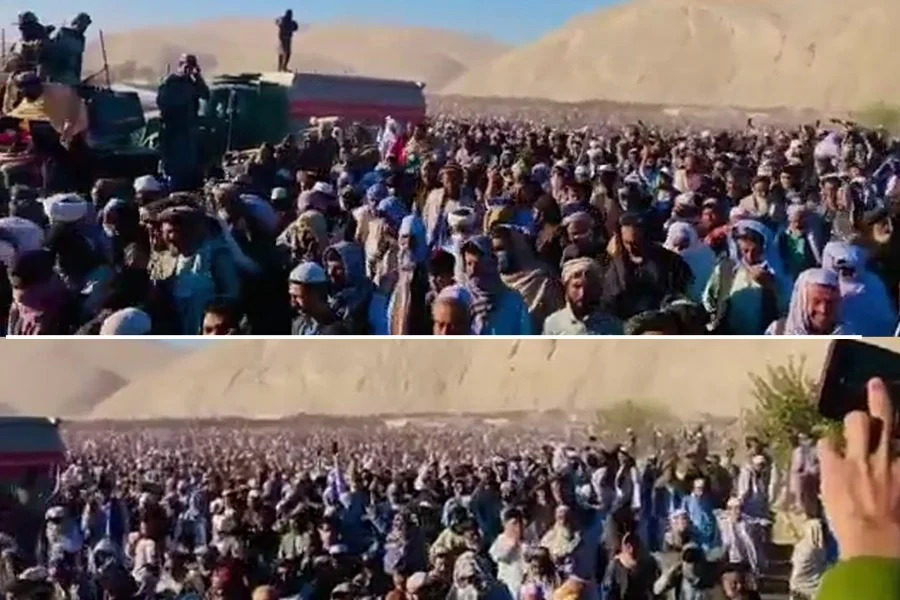
The Tablighi Jamaat has stepped up its activities in recent days by holding preaching events in northern Afghanistan. Footage from the group’s gatherings in Takhar and then in Sarpul province shows that thousands of residents from nearby and distant areas have attended. This comes as the Taliban have banned all forms of public gatherings, yet they have supported the Tablighi Jamaat’s events and provided security for them. Meanwhile, Mohammad Moheq, a researcher of religious affairs, says the Tablighi Jamaat and the approach it has adopted have one positive aspect: it is not a movement oriented toward power and does not fall under the umbrella of political Islam. However, Mr. Moheq criticized the spread of religious gatherings and displays in Afghanistan, saying that restrictions on scholarly, cultural and social activities have paved the way for what he calls “false and inflated religiosity.” In his view, promoting such “ridiculous” displays distances society from its fundamental issues instead of strengthening morality and spirituality, and reduces religiosity to the level of folk pastimes such as “dog fighting” and “cock fighting.” On the other hand, a number of the country’s citizens say that encouraging this trend draws people away from their family and social responsibilities. According to them, many members of the Tablighi Jamaat remain out of contact with their families for months, while their children live in poverty and are deprived of a father’s affection.
In the most recent case, a major Tablighi Jamaat event was held last Thursday in Sarpul province. Images and videos of the event published on social media show a large turnout of people who attended the gathering.
The organizers described the purpose of these events as “reminding people of the values of faith and prayer, purifying the self, and calling Muslims to act on Islamic teachings.” They say these gatherings offer Muslims an opportunity to come together and strengthen affection among themselves, so that they can benefit from the words of scholars to improve their individual and collective lives.
Meanwhile, Professor Mohammad Moheq, a researcher of religious affairs, says the Tablighi Jamaat and the approach it has adopted have one positive aspect: it is not a movement oriented toward power and does not fall under the umbrella of political Islam. He says that since its founding, the core principle of the Tablighi Jamaat has been to stay out of politics and not to contaminate religion with politics. In this respect, compared with groups such as Hizb ut-Tahrir, the Muslim Brotherhood, jihadi Salafis and other movements, it can be regarded as a positive movement. In addition, the Tablighi Jamaat also tries to preach and promote certain ethics and virtues.
Mr. Moheq adds: “If we consider this situation in the current context of Afghanistan and present circumstances, these displays and gatherings that we see are not a promising phenomenon. Even without the Tablighi Jamaat, because space for scholarly, cultural and artistic work and for the activities society needs has been restricted or closed in Afghan society, a vacuum has emerged, and this vacuum is being filled by apparently religious movements. Even if the Tablighi Jamaat did not exist, more religious goods than society in Afghanistan needs today are being produced, reproduced and distributed. In principle, material, spiritual and cultural goods should be produced and distributed in proportion to the needs of their audiences. Otherwise, it can create a crisis.”
The researcher of religious affairs says: “In such a situation, the Tablighi Jamaat adds to this market, and as seen in the media and on social media, thousands of people gather for a very simple religious matter that even children know and that even illiterate people are aware of. Meanwhile, there is nothing new that could increase the religious awareness and scholarly level of society. This is not a religious act. Rather, it is a ridiculous spectacle and a lowering of religion to the level of folklore games and popular entertainment such as goat-pulling. In the Taliban environment, the practice of religion in Afghanistan has been reduced to the level of stone fighting, bear fighting, goat-pulling, quail fighting, and the like.” According to him, in such a situation, any fame-seeking and directionless individual or group finds the opportunity to use the name and sanctity of religion to create a social standing for themselves, gain an audience, and drag unemployed and destitute people from one scene to another.
Professor Moheq adds: “All of this directs the energy of society into useless and futile entertainment in the name of religion, rather than into productivity, economic growth, industrial improvement, entrepreneurship, averting dangers, reducing poverty and deprivation, discrimination and injustice, and strengthening the material and spiritual foundations of society so that people’s rights can be better secured. For this reason, the phenomenon of religiosity has come to resemble what is called a ‘bubble’ in economics. Sometimes we witness a housing bubble. A bubble means unwarranted inflation and an artificial rise in the price of something, that is, something being valued beyond its real worth. The bubble of religiosity, or false but inflated religiosity, is growing by the moment and has, in a way, swallowed the identity of society. The day this bubble bursts, it will bring a moral, scholarly, and cultural catastrophe, because this type of religiosity does not help in the slightest with the growth of the lofty morality and religious spirituality that religions intend. On the contrary, it promotes hypocrisy and other vile acts in the name of religion and makes people neglect and drift away from fundamental issues.”
On the other hand, some social media users have also criticized the holding of these events, asking: “Reform of which condition of Muslims? Which of this country’s ills are they curing?” They then answered themselves, saying that these events are nothing but demagoguery, a waste of time and a waste of money.
Nasir Ahmad Omari, one user, wrote: “Outwardly they behave well toward strangers, but they do not treat people well in their own homes. We saw it with our own eyes.”
Khwaja Basir Ahmad Siddiqi, another user, asked: “I saw some of them who cannot even read the Quran and Hadith properly. So how do they preach?”
Abdullah Shirzad, another user, wrote: “Isn’t this an Islamic country? Why are they holding a preaching movement here? It is all due to unemployment, and many people take part in it for a morsel of bread.”
Niaz Razeqi, a Facebook user, wrote: “One should acquire knowledge. Nothing is gained from storytelling.”
Mohammad, a Facebook user, wrote: “What benefit do their gatherings bring to the country? They block the roads around the venue and impose restrictions on residents because of security measures. Let them do a good deed instead: collect money and build a water well or carry out other charity work whose benefit reaches the people. This is neither service to religion nor promotion of a more tolerant and better face of religion.”
Fazl al-Din wrote: “It is a good deed, but I wish this group would also take action one day for the cleanliness of the city. Let each of them plant a sapling or water a sapling in their area. In one year, thousands of saplings would be planted, and it would also help the environment.”
Taliban-controlled media have also confirmed that the event was held in Sayyadabad district of Sarpul province and that the group’s fighters were responsible for providing its security.
You can read the Persian version of this report here:
از بیکاری تا تجمعهای دینی؛ آیا «جماعت تبلیغ» خلأ جامعه را با نمایش پر میکند؟