


Introduction
The existence of jurisprudential and sectarian differences among Muslims cannot be denied, and they have persisted from the era of the Companions of the Prophet to the present day. The multiplicity of opinions and theories on points of jurisprudence, theological debates, differing views on the names and attributes of God, whether the Holy Quran is created or uncreated, and more all point to the presence of diverse perspectives among Muslims. Throughout history, these differences have led to the formation of various jurisprudential, theological, and political currents and schools in Islamic societies.
Each Islamic current, depending on its particular approach and discourse and its treatment of opponents, has been classified as either “moderate” or “rationalist” on the one hand, or “radical” or “extremist” on the other. This stems from the fact that the language and literature of religious dialogue have not been uniform throughout history, and different Islamic currents have pursued different approaches depending on how they used words and terms when facing their opponents.
Currents that regard the understanding of religion as exclusive to themselves and consider themselves holders of the correct and final reading of religion have, in many cases, adopted a harsher approach toward their opponents. One of the most important linguistic and conceptual tools used throughout history against intra-religious opponents has been the use of terms such as “takfir” (declaring someone an unbeliever), “tafsiq” (declaring someone a transgressor), and “tabdi” (declaring someone a heretic). Besides these three terms, other words and expressions are also used.
Given the widespread use and importance of these three terms in intra-religious disputes, here I try to address the question of why radical Islamic currents use terms such as takfir, tafsiq, and innovation-making. How do these terms become tools for negating the credibility and the religious and social standing of opponents?
What Is Delegitimization?
The word “legitimate” is Arabic and derives from the root “sharia.” It is used in the sense of permissible and lawful, and in accordance with the rulings and commands of God, and it also carries the concept of general acceptability or public approval. Here, legitimacy means having the standing and the right to express opinions and draw inferences, and the permission to discuss issues and issue religious edicts. In an Islamic society, all Muslims have the right, in line with their capacity and expertise, to comment on religious subsidiary matters, to narrate traditions and edicts, and to express their views. Apart from the natural order of things, this legitimacy comes from sharia itself and from the divine command.
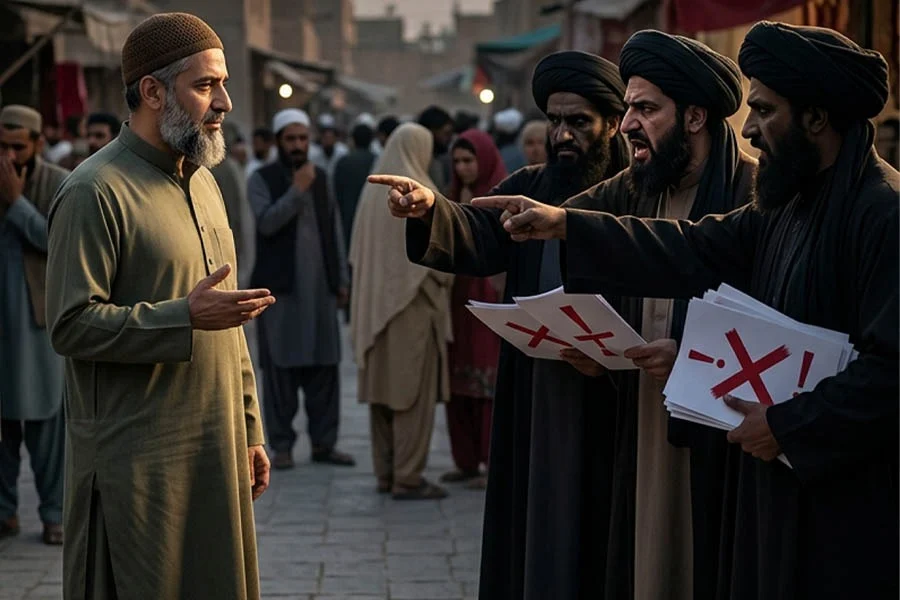
Delegitimization, formed by adding the suffix “-ization” to the word legitimacy, means taking this right away from a faction, group, sect, or individual. In the simplest definition, delegitimization is a process through which a faction, group, sect, or individual is portrayed as deprived of, and stripped of, credibility, rightfulness, acceptability, or the competence to be present and express opinions in a given field.
The terms takfir, tafsiq, and tabdi are among the religious terms that radical currents have used more than any others to strip their opponents of legitimacy. Traces of this discourse can be seen abundantly in the instrumental use of these terms by the scholars of the People of Hadith in the past and by Salafi currents in the present era.
1) Takfir: The Harshest Tool of Delegitimization
Takfir, as a term, means attributing unbelief to a Muslim individual and ruling that he has left Islam (attributing unbelief to a Muslim). Imam al-Ghazali says: “Takfir is a legal ruling, because the ruling of unbelief means making a person’s property lawful to seize, shedding his blood, and ruling that he will dwell eternally in the fire of hell (Ghazali: 87).” This act can, however, be expressed in different language and words. For instance, Abdullah, the son of Ahmad ibn Hanbal, reports: “It was narrated from Ishaq ibn Mansur al-Kawsaj that he said: I asked Ahmad ibn Hanbal: Is a person rewarded for being hostile to Abu Hanifa and his companions? He said: Yes, by God (Hanbal Shaybani: 137).” In a sense, what is meant here is the takfir of Imam Abu Hanifa and his companions. Similarly, Abu Ismail al-Harawi says about Abu al-Hasan al-Ash’ari, citing the Sheikh of Sijistan, Yahya ibn Ammar: “I saw the pulpit of Yahya ibn Ammar, on which he stood many times, declaring the Ash’arites unbelievers and then cursing them, and testifying that Abu al-Hasan al-Ash’ari was a heretic. I also saw Umar ibn Ibrahim and his own teachers (doing the same) (Ansari Harawi: 411).”
When a Muslim is accused of unbelief, religious discrediting takes place; his competence to express opinions and make arguments is revoked, and he loses the opportunity to present views as a Muslim in the Islamic community.
2) Tafsiq: Removing the Opponent from the Circle of Moral Credibility
Tafsiq derives from the word “fisq”: “Fisq is disobedience, abandoning the command of God Almighty, and departing from obedience to Him”; that is, disobedience, abandoning the command of God Almighty, and leaving the circle of obedience to Him. Tafsiq means attributing disobedience and departure from the divine command to a person or group, and ruling that they are among the wrongdoers.
In religious terminology, fisq does not mean leaving the Muslim community; however, some people use this word in a broader sense that also includes unbelief. In common usage, the term fisq and the attribution of the label “fasiq” to individuals are used for moral discrediting. When you introduce a scholar or a Muslim as a fasiq, you are in effect questioning his moral character and razing his social credibility to the ground. As a result, society treats his views and opinions lightly, and the legal and religious standing from which he speaks as a Muslim is restricted within the framework of the unwritten rules of the Islamic community.
3) Tabdi: Attributing Innovation to the Opponent
Tabdi means attributing innovation in religion to a person. Innovation refers to novelty in religion that did not exist before, and that contradicts the tradition, beliefs, and conduct of the religious predecessors. In defining innovation, Ibn Taymiyyah says: “Whatever of beliefs and acts of worship contradicts the Book, the Sunna, and the consensus of the predecessors of the community (Ibn Taymiyyah: 198).”
The term “innovator” is also, in many cases, used alongside the terms unbelief and transgression to discredit people and to question the credibility and soundness of their views. Under this definition, when a religious scholar, preacher, or exegete is accused of innovation, his competence to comment on religious matters is called into question, because it is assumed that his beliefs and actions contradict the Book, the Sunna, and the consensus of the community’s predecessors. In this way, his expression, interpretation, thought, and opinion are delegitimized.
From Critiquing an Opinion to Delegitimizing the Opponent
Islam, as a phenomenon with a specific text, has always required interpretation throughout history and in the wake of social, cultural, economic, and political events. For this reason, intra-religious currents have formed separate alignments in re-reading the text. Each, taking into account the cultural and social environment and emerging economic and political phenomena, has engaged in independent reasoning, innovation, and reinterpretation in various dimensions in response to mental and practical dilemmas. Naturally, as intellectual rivalries take shape, actors come to need to critique and examine one another’s views in terms of thought and approach to issues.
Critique of interpretive approaches and of the views of the schools is a measured undertaking that has played, and continues to play, a valuable role in the dynamism of religious schools and thought. But critique in general has its own value-based and ethical frameworks and should not turn into heated polemics or end in the destruction of personalities. Ordinarily, the critique of an interpretation or opinion should be directed at the reasoning and content of that view; that is, the critic must show what reasoning-based problems the interpretation or understanding in question faces.
For example, a distinction must be drawn between these two statements: 1. This opinion or interpretation is not compatible with such-and-such a religious principle. 2. So-and-so, who has given this opinion, is a transgressor, an innovator, or a deviant.
In the first statement, the effort is focused on critiquing the thought and opinion; in the second, before we engage with the thought, we target the person’s character. This is precisely what has spread these days among the Islamic currents of Afghanistan.
The debate began when Abdul Samad Qazizada, a religious preacher, addressed the issue of “the non-obligatory nature of the face veil within women’s hijab.” Although the non-obligatory nature of the face veil is a long-standing jurisprudential disagreement whose history goes back to the era of the Companions, religious currents have held extensive debates over whether the face veil is part of hijab or not.
There is no problem with this debate, as in the past, centering on reasoned critique. But when Salafi currents try, before engaging with the jurisprudential evidence for the edict and its arguments, to target the person who issued the edict with words such as “innovator,” “transgressor,” and “apostate,” the issue goes beyond critiquing an interpretation and jurisprudential opinions and turns into the delegitimization of a person and a group.
When confronting critique, the Holy Quran emphasizes concepts such as “the best manner of debate,” presenting “proof,” and using “gentle speech.” Moses and Aaron are not asked to attack the personality of Pharaoh; rather, they are told to speak to him gently and to challenge his view with reasoning. Likewise, the Prophet’s method of critiquing the thoughts and beliefs of his religious opponents was founded on reasoning and examination of the thoughts and beliefs themselves.
In critique, you affirm the continuation of dialogue and do not consider anything finished; but in character assassination and the stripping of legitimacy, you seek to eliminate the other party.
When the terms tafsiq, tabdi, and takfir are used, they pursue a single goal: the delegitimization of an Islamic individual or group and the removal of their competence to comment on a matter, whether morally, socially, or even in terms of faith. Here, the discussion goes beyond the critique of a discourse and a difference of opinion; the aim is to force the other side into silence.
This is something that has happened many times in Islamic societies. Part of the disorder and bloody wars among religious currents in Islamic countries stems from this very stripping of legitimacy from the beliefs of Muslims, because until a Muslim’s religious legitimacy is removed, killing him in the name of religion is harder. Killing and bloodshed often require a preliminary act: the delegitimization of the individual or group that is to be targeted.
Historical examples of delegitimization exceed the scope of this article. The confrontation of the People of Hadith with the People of Opinion, particularly with Imam Abu Hanifa, is considered one of the famous historical examples of differences in jurisprudential views. In Kitab al-Sunna, authored by Abdullah, the son of Ahmad ibn Hanbal, a specific chapter is devoted to condemning Imam Abu Hanifa for engaging with jurisprudential opinions and for the reasoning method of his school.
Likewise, the confrontation of the People of Hadith with Imam Abu al-Hasan al-Ash’ari can also be counted among the prominent examples of disagreements in the field of Islamic theology. Although the clash of opinions and the confrontation of ideas have existed among all jurisprudential and theological schools, what appears prominent in this regard in the approach of Imam Ahmad ibn Hanbal and several scholars following his school is the focus on the character of individuals instead of on the methods of reasoning and their opinions. In this approach, instead of critique being focused on the views and theories of the other party, personalities are targeted, and an effort is made to strip them of their moral and religious legitimacy.
Today, this approach has gone beyond the discursive framework among several sects and, compared with the past, has also moved beyond a purely discursive and sectarian act. Given the presence of a large number of religious armed groups on the battlefields and the possession of power and rule by some of them, the delegitimization of a religious opponent can put his life at risk. In such a situation, religious character assassination effectively becomes the groundwork for issuing a death sentence. This very issue highlights the concern over what fate awaits tolerant and accommodating religious groups in the face of such a volume of armed forces in Islamic societies, and how they can defend themselves and their views.
Conclusion
Intellectual and jurisprudential differences have always existed in the history of Islam, and in themselves cannot be grounds for hostility, exclusion, or the negation of the religious legitimacy of opponents. What turns these differences into a serious problem is moving beyond the critique of views and scholarly arguments and resorting to takfir, tafsiq, and tabdi against individuals in order to discredit them. In such a situation, religious terms, instead of being used within the framework of scholarly and sharia-based standards, become tools for delegitimizing opponents, restricting the space for dialogue, and intensifying sectarian differences. When these labels are tied to political power or armed groups, their consequences can go beyond social exclusion and even threaten the security and lives of individuals.
Therefore, the boundary between critiquing a view and delegitimizing individuals must be clearly maintained. Critiquing a view does not require negating the religiosity or the moral and religious credibility of its holder; just as a difference in jurisprudential and religious understandings does not, by itself, count as a license for takfir, tafsiq, or tabdi against individuals. Commitment to reasoned dialogue, observance of sharia-based standards, and avoidance of hasty judgments can prevent differences of opinion from turning into sectarian hostilities.
Ultimately, the fundamental issue is how the terms takfir, tafsiq, and tabdi are used, given the circumstances of time and place and the consequences they bring in religious, political, and social relations. Whenever these terms are used without observing scholarly and sharia-based standards and to eliminate, silence, or discredit opponents, they become tools for delegitimizing them. Therefore, preserving the sanctity of disagreement, separating the critique of ideas from judgments about individuals, and returning these concepts to scholarly and sharia-based frameworks are among the fundamental necessities for strengthening religious coexistence and preventing the spread of extremism in Islamic societies.
References
- Ghazali, Abu Hamid Muhammad ibn Muhammad, Faysal al-Tafriqa bayna al-Islam wa al-Zandaqa (1438 AH / 2017 CE). Prepared by: the Scientific Committee of the Dar al-Minhaj Center for Study and Scientific Research, Jeddah: Dar al-Minhaj, first edition.
- Abdullah ibn Ahmad Hanbal Shaybani (1441 AH). Kitab al-Sunna, edited by: Abu Abdullah Adil ibn Abdullah Al Hamdan, Dar al-Lu’lu’ Company, Beirut, Lebanon, fourth edition.
- Abdullah ibn Muhammad Ansari Harawi, Dhamm al-Kalam wa Ahlih (1419 AH / 1998 CE). Edited by: Abu Jabir Abdullah ibn Muhammad ibn Uthman al-Ansari, Medina: Maktabat al-Ghuraba al-Athariyya, first edition, vol. 4.
- Ibn Taymiyyah, Taqi al-Din Ahmad ibn Abd al-Halim (1426 AH / 2005 CE). Majmu’ al-Fatawa, edited by Amir al-Jazzar and Anwar al-Baz, Dar al-Wafa Publishing, third edition, vol. 18.
You can read the Persian version of this article here:



