The Hasht-e Subh Daily has obtained information indicating that some employees of the Directorate of Properties at the Taliban-run Kabul Municipality are handing confidential information and archival documents on land and real estate to commission agents in return for large sums of money. Sources say these individuals use their access to the confidential land registry books to pass commission agents information including owners’ details, national ID card numbers, the four boundaries, location and area of plots, property deed numbers, payment records, and administrative correspondence. They reportedly receive between 2,000 and 5,000 US dollars for photographing each page of these books. According to the sources, commission agents use this information to identify the details and locations of plots and pass them to traders and land buyers. However, some sources claim the information is also used to prepare forged land ownership documents, and that this practice has grown into a widespread business.
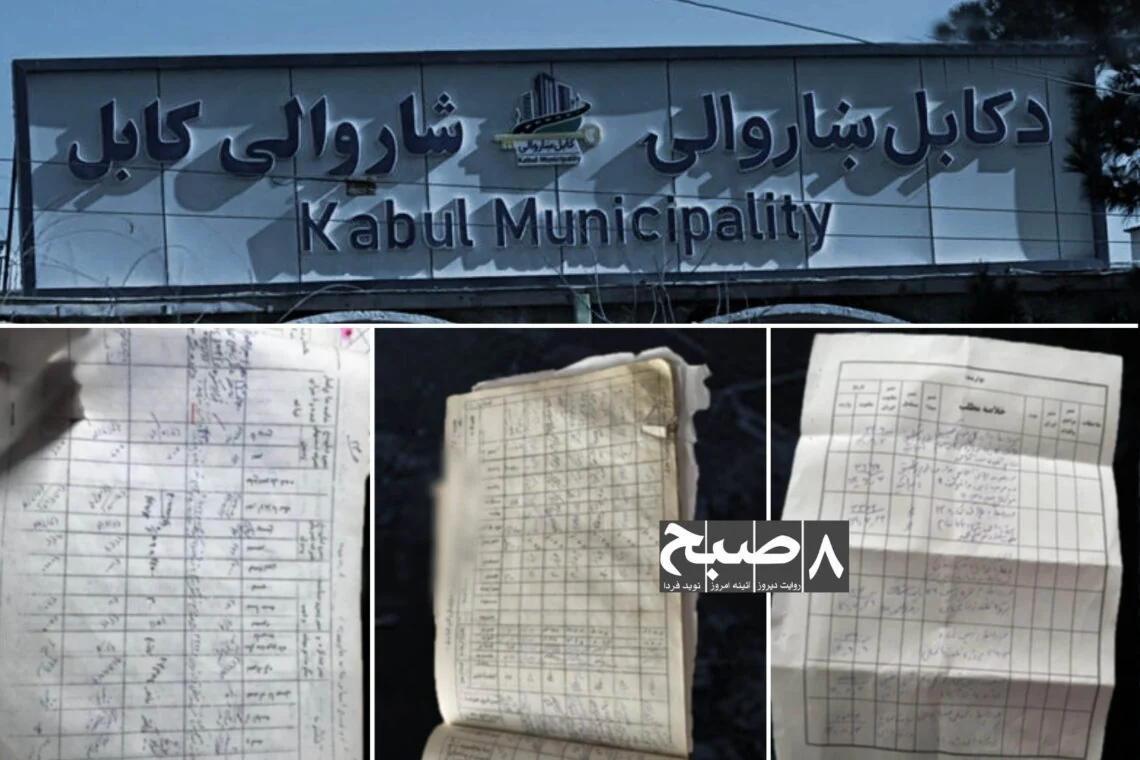
To examine the matter, the Hasht-e Subh Daily reviewed and photographed a number of sample registry books and archives of the Directorate of Properties at the Taliban-run Kabul Municipality. The documents show that detailed information about owners, applicants, land plots, area, price, plot boundaries, financial payments, allocation stages, and the execution of title deeds is recorded in these books. Samples from the register of incoming correspondence and petitions also show that the numbers and dates of letters, the sending authority, the subject of the case files, land-related inquiries, and administrative records are kept in the directorate’s archive. According to the sources, unauthorized access to this information could enable abuse, document forgery, and tampering with land ownership records.
According to the findings of the report, these books are among the confidential and important documents of the Directorate of Properties, and access to them is permitted only for employees who are authorized to view this information. All details of the land and the transactions carried out are recorded in these books, and unauthorized access to this information could enable abuse and the forgery of ownership documents.
Sources who spoke to the Hasht-e Subh Daily named two individuals who, according to them, hand the directorate’s confidential information to commission agents. The commission agents then share this information with traders and land buyers, and through this process identify the details and locations of plots.
Because it was unable to obtain the views of these two individuals, the Hasht-e Subh Daily is withholding their identities in this report. According to the sources, these two individuals provide the directorate’s most confidential books to commission agents and receive money from them in return for supplying the information.
A reliable source told the Hasht-e Subh Daily: “These books are the foundation of the documents for every plot of land. These books are strictly confidential, and no one except authorized employees has the right to access them. The information that matters to commission agents, and based on which they prepare documents, includes the name, father’s name, paternity details, place of residence, national ID card number, boundaries of the land, the payment voucher number, the numbers of letters, the property deed number, and the amount of money paid for the land. All of this information is recorded in these books.”
The source said: “Two currently serving employees of the Directorate of Properties at the Kabul Municipality are doing this. They receive between 2,000 and 5,000 US dollars for photographing each page of these books, whatever amount they can agree on with the commission agents.”
Another source, who did not want identifying details or information about their statements to be included in the report, said: “Commission agents prepare forged land ownership documents based on the very information they obtain from the Directorate of Properties. As far as I have looked into it, a large and widespread business is behind this.”
The Hasht-e Subh Daily reviewed and photographed some sample land registry books and archives at the Directorate of Properties of the Kabul Municipality, which is under Taliban control. These images show that owners’ details, plot numbers, area, the four boundaries, price, and information related to ownership documents are recorded in these books. In these samples, information including the owner’s name, father’s name, place of residence, plot number, its area in jerib and biswa, the plot’s boundaries on four sides, and the date and number of ownership documents has been entered.
In another sample from these books, the details of applicants, the history of land plot allocations, and the particulars of financial payments are recorded. This page includes information such as the case file serial number, the applicant’s name and father’s name, occupation, number of family members, national ID card number, place of residence, the plot’s number and area, the price of the land, the payment order number, the amount paid, the date of payment, and the details of the land handover receipt. In addition, the status of house construction and the stages of title deed execution are recorded in the administrative remarks section, and handwritten notes in red and blue ink can be seen in parts of this page.
In another sample of the directorate’s archival documents, a register of incoming correspondence and petitions can be seen, in which information about case files, inquiries, and administrative letters is recorded. This register contains the number and date of issuance and registration of letters, the serial number, the sending authority, a summary of the subject, and administrative remarks. Among the recorded items are letters related to the confirmation of land ownership, inquiries about land plots, the handover and payment of land costs, and petitions from citizens.
Meanwhile, the findings of a recently published investigative report by the Hasht-e Subh Daily indicate that Zabihullah Mujahid, the Taliban spokesperson, has started construction of a residential complex with his brothers in the green zone of Qala-e-Zaman Khan, located in District 16 of Kabul city. Sources at the Taliban-run municipality say the complex is being built in a green zone, yet the memorandum of understanding signed between the two sides makes no mention of the area being a green zone. These sources also claim that Mujahid has used his position and influence within the Taliban to create opportunities for economic activities and the construction of residential complexes for members of his family.
Likewise, a study by the George W. Bush Institute titled “Corruption and the Plunder of State Resources in Afghanistan Under Taliban Rule,” published in 2024, shows that after the Taliban took control of Afghanistan, the lack of transparency in the awarding of government contracts, the sale of properties, and the issuance of licenses and concessions has created room for the abuse of official powers.
The Bertelsmann Transformation Index (BTI) 2026 report on Afghanistan shows that corruption among the Taliban and their affiliated networks has undermined the rule of law. The report states that influential Taliban officials in many cases remain immune from punishment, and that when members of the group violate the law or abuse their powers, they are rarely prosecuted.
You can read the Persian version of this report here:
تجارت پنهانی با اسناد محرمانه زمین؛ در شهرداری طالبان در کابل چه میگذرد؟