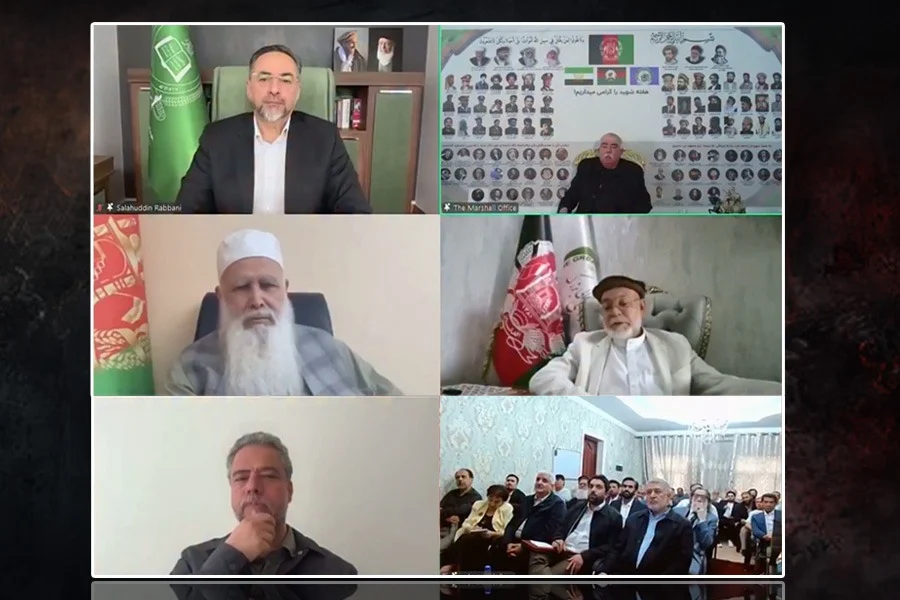
More than five years have passed since the Taliban’s return to power. During this period, opponents of the Taliban have repeatedly gathered, held virtual meetings, issued statements, and spoken of war and peace with the Taliban. The latest virtual meeting was held on the occasion of Martyrs’ Week and the anniversary of the assassination of Ahmad Shah Massoud, the well-known anti-Taliban commander. In this meeting, the Taliban were once again called upon to agree to talks, or else face consequences. But the question remains: for how long will these virtual meetings continue? For how long will these virtual warnings persist?
When the Taliban have refused to enter into talks with their opponents for more than five years, what is repeating the call for negotiations supposed to change? Can mere insistence on negotiation force a side that is entrenched, victorious, and in possession of exclusive power to sit at the negotiating table? If the answer is no, then what is the next step? If the Taliban once again remain silent in the face of virtual warnings, what other tools does the opposition have at their disposal? Will they hold yet another virtual meeting and issue another virtual warning? Or will they resort to the military option? The warnings issued by Marshal Abdul Rashid Dostum at the recent meeting were also largely focused on the Taliban’s indifference to dialogue and the consequences of a possible full-scale war. The warnings issued some time ago by Atta Mohammad Noor, the former governor of Balkh, which made considerable news at the time, were similarly focused on this same point. Although some anti-Taliban factions have tested the military option, it has not proven effective as it should have, unless they intend to expand the depth and scope of their military activity going forward, which is a separate discussion altogether.
The reality is that a political warning carries a deterrent effect only when it is backed by the capacity to impose costs on the opposing side. Otherwise, the warning gradually diminishes from a tool of pressure into a symbolic act, one that may generate wide media coverage but lacks binding force in the real calculations of power. We know that politics, unlike rhetoric, is not settled by wishes and aspirations. What shifts political equations is the relationship between seriousness, organization, and the capacity to exert pressure.
That said, criticism of the opposition’s virtual meetings and warnings should not lead us to dismiss them as irrelevant or without effect. Such an assessment would also be inconsistent with the political and social realities of Afghanistan. Indeed, the opposition has so far failed to pose a serious challenge to the Taliban, but they possess latent capacities that cannot be ignored. For instance, they influence citizens and regard themselves as representatives of a segment of the country’s population and geography. Even now, if an open political space existed in Afghanistan, thousands, and perhaps far more, would answer their call. Even now, if the world were to support a war against the Taliban, the Taliban’s opponents, particularly the traditional jihadi leaders, would undeniably play a role in mobilizing the masses. More importantly, among the opposition are figures and factions from various ethnic and religious groups. This very diversity gives them significance, in terms of social and political composition, that cannot be dismissed with a simple verdict. The Taliban, by contrast, are a group of clerics drawn from a single ethnicity, which is a major weakness for the group.
The issue here is not to dismiss the Taliban’s opponents, but to accurately identify their place within Afghanistan’s architecture of power. They are neither an insignificant force that can be considered without effect, nor have they yet reached the level of cohesion and operational capacity that would qualify them as a genuine, ready alternative for seizing power. Between these two conditions lies a political vacuum: a latent capacity that has not yet been converted into actual power.
This distinction must be taken seriously. Latent capacity is not, in itself, power. The fact that a collection of figures, factions, and social forces can sit around a table and discuss Afghanistan’s future is a form of political capital. But this capital only becomes power when it leads to organization, a shared strategy, a division of roles based on merit, political cohesion, social mobilization, and ultimately, bargaining power. What is in question today is not the existence of this capacity itself, but the timing and manner of its actualization.
Yes, the gathering of Dostum, Ahmad Massoud, Mohammad Mohaqiq, Abdul Rab Rasul Sayyaf, and other anti-Taliban figures under a single framework is notable from a symbolic and demonstrative standpoint. But if this “symbol” in politics is not transformed into an “organization,” it will remain at the level of display. If the coalition does not arrive at a shared strategy, it will amount to nothing more than a gathering of names. And if the warning lacks practical backing, it loses its deterrent quality.
On the other hand, the Taliban, too, cannot rely solely on their monopoly of power to permanently ignore the existence of capacities arrayed against them. The Taliban may keep their opponents out of the structure of power in the short term, but excluding a movement from the formal structure does not necessarily mean excluding it from the country’s social and political reality. Therefore, the Taliban’s opponents cannot be dismissed under the label of “virtual meetings,” nor can the mere holding of these meetings be equated with meaningful dynamism, mobility, and influence on their part. The central issue is precisely the distance between these two poles: the distance between latent capacity and actual power, between warning and the ability to impose costs on a rival, between calling for negotiation and the ability to compel the other side to negotiate.
And once again, the most difficult question remains: if five years of warnings and calls for negotiation have yielded no result, what is the next stage? If the answer to this question continues to be yet another virtual meeting, another statement, and another warning, then one must ask how long this cycle will continue, and when politics is expected to move from the “realm of rhetoric” to the “realm of action.”
Ultimately, Afghanistan faces, above all else, a crisis stemming from the absence of a “legitimate order.” In such a situation, neither the Taliban’s monopoly can be considered a final answer forever, nor can an opposition lacking binding tools serve as an alternative on its own. What will prove decisive is the emergence of a force capable of converting scattered capacities into real, unified power and using it effectively against the Taliban.
You can read the Persian version of this analysis article here: