• 8AM.MEDIA
  • ویب‌سایت فارسی
  • پښتو ویب‌پاڼه
  • اۉزبېکچه ویب‌سایت
  • Podcast
Sunday, September 20, 2026
Hasht-e Subh
  • Home
  • News
    • Afghanistan News
    • World News
  • Opinion
    • Editorial
    • Analysis
  • Reports
    • Daily Reports
    • Investigative Reports
  • Society
    • The story of people
  • Women’s Word
  • Columns
    • Three Years After Afghanistan’s Fall: The Taliban’s Resurgence
    • Towards Equality
    • The Resurgence of the Taliban: Two Years Since Afghanistan’s Fall
    • Hebatullah Report Special Edition
    • Resistance for Education Special Edition
    • Special Column on Taliban’s Education Curriculum
    • Nawroz
  • Interviews
  • Contact Us
    • About Us
    • 8AM MEDIA Annual Awards
    • Submit an Article to Hasht-e-Subh
  • 8am.mediaBack
Subscribe
No Result
View All Result
  • Home
  • News
    • Afghanistan News
    • World News
  • Opinion
    • Editorial
    • Analysis
  • Reports
    • Daily Reports
    • Investigative Reports
  • Society
    • The story of people
  • Women’s Word
  • Columns
    • Three Years After Afghanistan’s Fall: The Taliban’s Resurgence
    • Towards Equality
    • The Resurgence of the Taliban: Two Years Since Afghanistan’s Fall
    • Hebatullah Report Special Edition
    • Resistance for Education Special Edition
    • Special Column on Taliban’s Education Curriculum
    • Nawroz
  • Interviews
  • Contact Us
    • About Us
    • 8AM MEDIA Annual Awards
    • Submit an Article to Hasht-e-Subh
  • 8am.mediaBack
No Result
View All Result
Hasht-e Subh
No Result
View All Result

Taliban’s Roads: A Path to Development or an Escape Route for the Day of Reckoning?

Translated by Farhad Farhaad | Originally written in Persian by Abdul Karim Hashemi

Mohammad Farhaad Mohammad Farhaad
15 July 2026 - Solar Hijri Date: 1405/04/24 [t_time:1784136385]
A Taliban flag stands at a crossroads on a newly built highway in Afghanistan, symbolizing the debate over the true purpose of the group's road construction projects. (Photo credit: AI)

AI

Afghanistan has repeatedly witnessed the collapse of governments, changes in political systems, and the onset of new chapters of crisis and instability over the past four decades. This historical experience has caused the people of this country to view many political developments with skepticism and caution. As a result, every measure taken by governments, even one that appears developmental or reconstructive on the surface, is not evaluated by public opinion solely from the perspective of service delivery; it is sometimes accompanied by political questions and interpretations as well.

Following the Taliban’s return to power in 2021, the construction and reconstruction of roads, bridges, and certain infrastructure projects have become one of the main focuses of the group’s development activities. In official reports, these projects are presented as a sign of stability, development, and attention to the country’s infrastructure. Undoubtedly, given its mountainous geography and historical deprivation, Afghanistan needs standard roads, bridges, and transportation networks more than ever, since economic development is not possible without adequate infrastructure.

However, alongside this view, another question has also been raised among some segments of society: are these projects being carried out solely for national development, or do political, security, and strategic motives also lie behind them?

Some time ago, while passing one of the road construction projects, I was discussing this issue with a friend of mine. I said that regardless of the motive, road construction would ultimately benefit the people. But he responded sarcastically: “The Taliban do not have helicopters to flee with, so they build roads.”

This statement, perhaps more than being an analysis, reflects a mindset that has taken shape among a segment of Afghan society in recent years, a mindset rooted in the experience of the collapse of the previous government. Many still remember the scene of the sudden departure of officials of the republic government and the exit of the then president from the country, an event that became a symbol of political instability for the citizens of Afghanistan.

That said, judging the objectives of development projects based solely on speculation is not fair. The construction of transportation routes can serve multiple purposes, from facilitating transportation and boosting trade to increasing the government’s access to remote areas and strengthening security control. Therefore, the motives behind these projects should be examined through a combination of economic, security, and political factors, not merely from a single angle.

What is most questionable is the simultaneity of the development of certain infrastructure projects with the widespread challenges Afghanistan is grappling with today. Mineral extraction in various parts of the country continues at a faster pace than before, a process that, according to some experts, is a matter of debate and concern due to insufficient transparency and oversight mechanisms. Afghanistan is considered one of the richest countries in the region in terms of mineral resources, but these resources will only become national capital once the revenue generated from them is spent on sustainable development, education, health, job creation, and improved public services.

On the other hand, public protests in several provinces, including Herat and Badakhshan, showed that not all citizens are satisfied with the way natural resources are managed or with certain executive policies. Although the scope and causes of these protests have varied, a common message can be seen in them: people expect their voices to be heard in decisions that affect their lives and the resources of the areas where they live.

Alongside these issues, Afghanistan’s economy continues to face serious problems. A high unemployment rate, declining investment, the closure of many businesses, rising poverty, and the dependence of millions of people on humanitarian assistance have made daily life difficult for citizens. Many young people, particularly university graduates, do not see a bright future for themselves and view migration as the only way to continue their lives. This trend, in addition to the loss of human capital, has also weakened social hope.

On the other hand, restrictions imposed on girls’ education and on women’s presence in various sectors of society remain one of Afghanistan’s most significant challenges, both domestically and internationally. Depriving millions of girls of continuing their education is not merely an educational issue; its economic, social, and cultural consequences could cast a shadow over the country’s future for years to come.

Security also remains one of the key issues in Afghanistan. The Taliban have repeatedly spoken of establishing nationwide security, but attacks attributed to Islamic State Khorasan Province (ISKP) against civilians, as well as against certain Taliban officials, have raised questions about this claim. The killing of several Taliban commanders and senior officials in recent years has shown that security threats have not fully disappeared and that ISKP still retains the capacity to carry out targeted operations.

Meanwhile, some analysts have put forward various scenarios regarding Afghanistan’s security future. One such scenario is an increased role for ISKP in the event of internal rifts or a weakening of the governing structure. Although it is not currently possible to speak with certainty about such a possibility, the experience of past years has shown that a power vacuum in Afghanistan has always created conditions for the emergence of new actors.

The Taliban’s relations with Pakistan have also changed compared to the early years of the group’s rule. Rising border tensions, sporadic clashes, and political disputes between the two sides indicate that relations between Kabul and Islamabad are no longer as straightforward as they once were. This development could also affect regional security dynamics and the future of the Taliban’s interactions with its neighbors.

In the end, perhaps the central question is not why roads are being built, but where these roads will ultimately lead. Is their destination economic development, public welfare, and reduced deprivation, or are they merely part of the regime’s political and security strategies?

More than anything else, the people of Afghanistan need a future in which political stability, justice, employment, education, basic freedoms, and lasting security are guaranteed. The construction of infrastructure will show its true value only when it is accompanied by public trust, citizen participation, transparency in resource management, respect for people’s rights, and a clear plan for the country’s development.

Today, Afghanistan needs a clear destination more than it needs additional roads, a destination whose end is not migration, poverty, despair, and crisis, but development, national solidarity, and a secure future for coming generations.


You can read the Persian version of this analysis article here:
سرک‌های طالبان؛ راه توسعه یا راه روز مبادا؟

ShareTweetSendSendShare

Related Posts

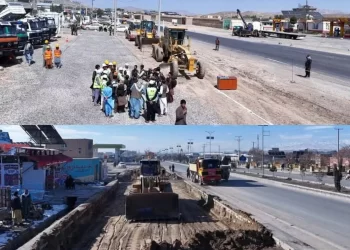
Construction work is underway on the Kabul-Kandahar Highway widening project in Ghazni city. (Photo Credit: Social Media)
Afghanistan News

Sources: Kabul-Kandahar Highway Widening Project in Ghazni Inaugurated Again

17 September 2026 [t_time:1789665327]
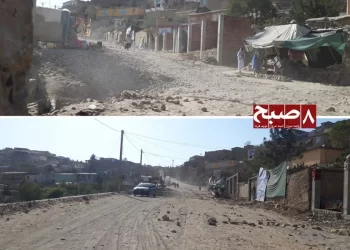
A stretch of unpaved, dust-covered road in Faizabad's Dasht-e Shuhada area shows the stalled construction project residents say has left them without a finished road. (Photo credit: 8am.media)
Daily Reports

Faizabad Residents: Road Construction Promises Left Us With Only Dust and Ruins

17 September 2026 [t_time:1789651002]
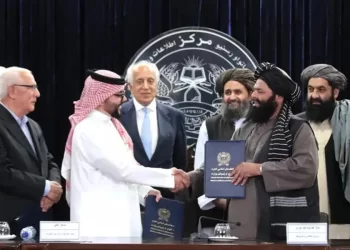
Zalmay Khalilzad looks on as a Saudi official shakes hands with senior Taliban figures during the signing of the Kashk-Tirpul agreement in Kabul. (Photo credit: Social Media)
Analysis

The Kashk-Tirpul Project: Khalilzad’s Gift to the Taliban

13 September 2026 [t_time:1789323124]

Latest

Loading latest news...

Popular stories

  • Hamza bin Laden - the son of Osama bin Laden (Photo: Social Media)

    Al-Qaeda Releases Hamza bin Laden Message on 9/11 Anniversary

    Share
    Share Tweet
  • UN Report Reveals Shifts in Family Attitudes and Rise in Domestic Violence in Afghanistan

    Share
    Share Tweet
  • German Politician Calls for Faster Deportation of Undocumented Afghan Migrants

    Share
    Share Tweet
  • Taliban Shoot Young Man from Herat After Torturing Him with Hands Tied

    Share
    Share Tweet
  • Pakistan Army Spokesperson: Afghanistan Has Become a Base for Dozens of Terrorist Groups

    Share
    Share Tweet

Podcast

Insights
Insights

Join Lynne O’Donnell for 8AM’s podcast series, Insights.
Lynne talks with generals, diplomats, soldiers, journalists, politicians, activists, people who have front row seats for conflicts around the world, and citizens with a story to tell, happy or sad. For this first series, Afghanistan is the focus. Lynne and her guests talk about the collapse of the republic in August, 2021, and the impact since — for the people of Afghanistan, for the security of the region, for the safety of the world. It’s important, interesting and insightful.

Insights/22: Controlling the Narrative with Mina Sharif
byinsights8am

Controlling the Narrative

Lynne O’Donnell talks with Mina Sharif, author, activist, women’s rights campaigner, educator and mentor. They discuss who controls the narrative and who speaks for Afghanistan’s people when the Taliban appear to have seized control not only of the country but of the message, too.

Have a listen

Insights/22: Controlling the Narrative with Mina Sharif
Episode play icon
Insights/22: Controlling the Narrative with Mina Sharif
Episode Description
Episode play icon
Insights/21: Media Meltdown with Zahra Joya
Episode Description
Episode play icon
Insights/20: Terror Inc with Scott Richards
Episode Description
Episode play icon
Insights/19: Busting Stereotypes with Bushra Gohar
Episode Description
Episode play icon
Insights/18: Media Matters with Waliullah Rahmani
Episode Description
Episode play icon
Insights/17: What Goes Around Comes Around with Sima Samar
Episode Description
Search Results placeholder
Hasht-e Subh

8AM Media, also known as Hasht-e-Subh Daily, stands as Afghanistan's premier independent and non-profit newspaper, resonating as a beacon of journalistic integrity since its establishment in June 2007 by esteemed Afghan journalists and human rights advocates. With a steadfast commitment to citizen journalism and civic education, Hasht-e-Subh Daily has earned its place as the most esteemed publication in the nation.

Publisher: Sanjar Sohail
Email: [email protected]
Executive Director: Parwiz Kawa
Email: [email protected]

Read More

Four Agreements, No Answers: Inside the Taliban Transport Ministry’s 132 Religious Sessions

Polio Vaccination Campaign to Begin Across Afghanistan Tomorrow

The Chapters No One Saw

World Cleanup Day: UNAMA Says Environmental Pollution Has Become a Serious Challenge

Bodies of Two Children Found in Herat’s Ghorian District

Editor’s Choice

Every Saturday morning, 8AM MEDIA English Services Department will guide you through the week’s biggest stories from Afghanistan and the international community.

Subscribe

© 2026 - ©Hasht-e Subh Daily

No Result
View All Result
8am.Media
پښتو ویب‌پاڼه
ویب‌سایت فارسی
اۉزبېکچه ویب‌سایت
  • Home
  • News
    • Afghanistan News
    • World News
  • Opinion
    • Editorial
    • Analysis
  • Reports
    • Daily Reports
    • Investigative Reports
  • Society
    • The story of people
  • Women’s Word
  • Columns
    • Three Years After Afghanistan’s Fall: The Taliban’s Resurgence
    • Towards Equality
    • The Resurgence of the Taliban: Two Years Since Afghanistan’s Fall
    • Hebatullah Report Special Edition
    • Resistance for Education Special Edition
    • Special Column on Taliban’s Education Curriculum
    • Nawroz
  • Interviews
  • Contact Us
    • About Us
    • 8AM MEDIA Annual Awards
    • Submit an Article to Hasht-e-Subh
  • 8am.media

© 2026 - ©Hasht-e Subh Daily