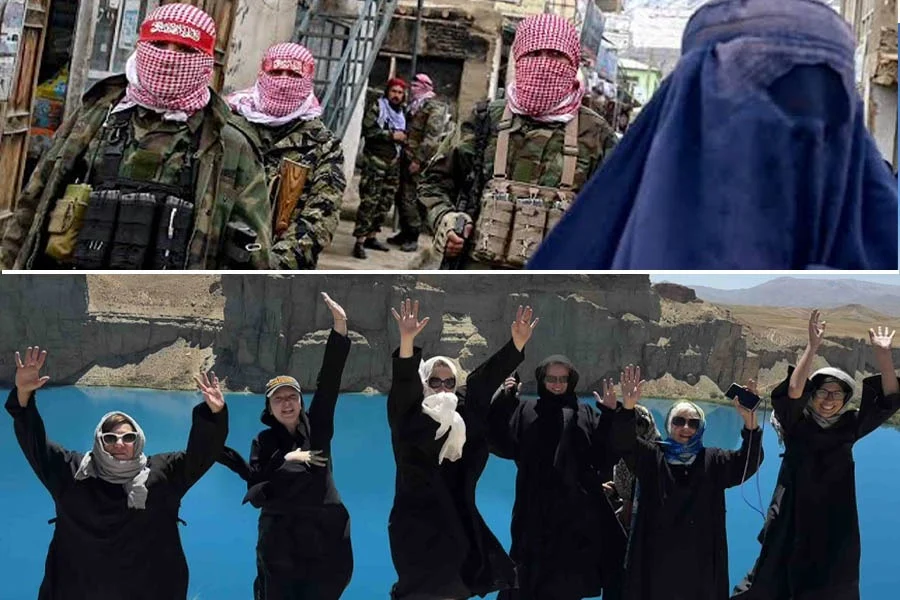
Women and girls in Afghanistan have also been barred from recreation and outings in parks due to Taliban restrictions. The findings of this report show that in some recreational areas, the Taliban’s Morality Police enforce gender segregation and, in some cases, treat women harshly to prevent them from entering these places. At the same time, foreign female tourists who visit these locations move about freely and are even escorted by Taliban fighters. Women and girls say that this double standard in the Taliban’s treatment of women shows that the group disregards even the values it has defined for itself to serve its own interests.
Women say one example of the Taliban’s differing treatment of local and foreign women can be seen at Band-e Amir in Bamyan province. According to them, before the Taliban imposed its restrictions, Band-e Amir hosted dozens of families along with their daughters from various parts of the country. Now, however, women who approach the area are met with bans, hostility, and insults from the Taliban’s Morality Police. They stress that, at the same time, foreign women smile and joke with the Taliban’s Morality Police, take photographs with them and are even allowed to go boating.
A women’s rights activist in Bamyan said, “Seeing a foreign woman who, with her passport, has the right to enjoy the beauty of my homeland, while I, as the owner of this land, must remain imprisoned behind the walls of my house, is the most painful psychological torture we experience every day.”
On the other hand, girls and women in several provinces, including Kabul, also complain of similar bans in recreational parks and tourist sites. They say that women in these parks face restrictions similar to those at Band-e Amir.
One woman says that City Park in Kabul used to be one of the family recreation spots in the city, but now numerous restrictions have been imposed there against women. Women are not allowed to go to the restaurant inside the airplane, and the Taliban’s Morality Police stand at the park’s entrance gate, denying entry to women who, in their view, lack a “mahram” (legal male guardian), while, in contrast, foreign women are allowed in and welcomed.
Women say that if this difference in treatment is justified as the enforcement of Sharia law against women, then why do the Taliban not consider foreign female tourists to be women, permitting their mingling with men in Afghanistan’s recreational sites, while depriving the women of Afghanistan of everything under the pretext of Sharia?
These women emphasize that for a woman who is turned away at the gate of a park or on the way to Band-e Amir, seeing a foreign tourist walking freely in the same place is not merely a simple difference in regulations. Rather, it serves as a reminder of the distance that has been created between her and her right to use the public spaces of her own country.
Previously, Khalid Hanafi, the Taliban’s Minister for the Propagation of Virtue and Prevention of Vice, said during his trip to Bamyan province that women are not permitted to go to Band-e Amir. A video of his remarks has been published in the media and on social networks, in which he says that until the group prepares its principles and regulations for women’s presence at Band-e Amir, they have no right to go to the area.
The main question is, if these places are part of Afghanistan’s territory and the country’s natural heritage, why is access to them more restricted for a woman from Afghanistan than for a woman who has entered Afghanistan with the passport of another country?
You can read the Persian version of this report here:
برخورد دوگانه طالبان با زنان در پارکها؛ بدرقه زنان خارجی و تازیانه بر زنان افغانستان