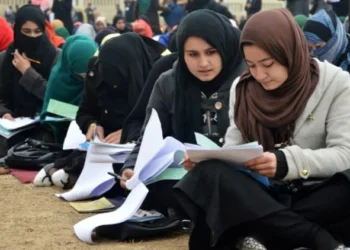
Several mothers who were deprived of the right to education during the first period of Taliban rule are now looking toward their daughters’ futures with concern. They say their greatest fear is that their daughters will face the same bitter fate of deprivation and regret they themselves have lived with for years. These mothers say no mother wants her child to fall victim to a denial of education. They do not have grand ambitions; they only want their daughters to have the chance to study, pursue their dreams, and build a better future. Several education activists warn that keeping school and university doors closed to girls will not harm a single generation alone. Its consequences will shadow Afghanistan’s development, education, and future for years to come.
Ziagul (pseudonym), a mother who was deprived of continuing her education at the age of 13 during the first period of Taliban rule, says her greatest fear now is that her daughters will suffer the same bitter fate she did.
“At that time, some girls studied secretly at home, but my family would not let me attend those home classes either,” she says. “They told me there was no longer any need for education and that I had to marry. I was given away at a young age to a man much older than me. After the fall of the Taliban, schools reopened, but by then, with children to raise, I could not return to my studies. Over these past 20 years, nothing has weighed on me more than the pain of illiteracy. I still cannot read the signs outside a hospital or a market, and that is very painful for me.”
Driven by that bitter experience, this mother did everything she could to ensure her daughters would not be denied an education. “I enrolled my daughters in school and always encouraged them to study so they would not grow up illiterate like me,” she says. “But they were still in school when the Taliban again seized control of Afghanistan and shut the doors of schools to girls. It felt as though the same fate was repeating itself.”
Ziagul says nearly five years have now passed since her three daughters were denied an education, and nothing troubles her more than this. “I suffer more than my daughters do,” she says. “We cannot go to Iran or Pakistan, because life is not easy for people of Afghanistan there either, and we cannot afford to move to another country. I am always worried about my daughters’ futures. One of my daughters married young at her father’s insistence. As for my other two daughters, my husband and I are always arguing about them. He says that with no school, no university, and no chance of work or advancement, what else can girls do but marry?”
Aziza (pseudonym), another mother who was deprived of continuing her education during the first period of Taliban rule, says no mother wants her child to endure the same pain and regret she herself has carried for years.
“Every time I hear that restrictions on girls’ education are continuing, my heart trembles,” she says. “Not because I can change my own past, but because my children’s future has not yet been written.”
Aziza recalls the days she walked to school full of hope, hopes that were cut short when the school’s doors were closed to her. “As a girl, I would eagerly hold my books close every morning and head to school,” she says. “I dreamed of becoming a doctor or a teacher one day, of serving my people. But then the doors of schools were closed to girls. They said there was no longer a place for girls in the classroom. My family, fearing the circumstances and social pressures, would not let me continue my studies. My books stayed in a trunk, and my dreams gathered dust along with them.”
“I am not afraid of my own past; I am afraid for my children’s future,” she adds. “I fear that one day they, too, will be denied the right to learn, just as I was. I know the deep wound illiteracy leaves on a person’s life, a wound that strips away one’s power to choose, destroys self-confidence, and leaves a person, for the rest of their life, alone with regret for opportunities that never returned.”
“Today, my only wish is for my children to study freely, to dream, and to choose their own futures,” Aziza says. “When a mother fears history will repeat itself, that fear does not come from weakness. It comes from experience. A mother who has herself been denied an education knows, better than anyone, that education is not just books and classrooms. It is the path to a future, to hope, and to life.”
Maryam Maroof Arwin, an education activist, says the pain of mothers who were themselves deprived of an education during the first period of Taliban rule, and who now watch the Taliban’s renewed rule impose the same fate on their daughters, is deep, painful, and devastating.
“Many assume that only literate mothers worry about their daughters’ educational futures,” Arwin says. “But the greatest concern actually comes from mothers who were themselves denied the chance to learn to read and write. I have heard these mothers say, again and again: ‘I am illiterate myself. I can neither read nor write, but I do not want my daughters to share my fate.’ No one can truly capture the depth of suffering carried by mothers who have lived the bitterness of illiteracy in every part of their lives. They know, better than anyone, what a heavy toll the denial of education takes.”
She adds, “The Taliban, like other authoritarian governments, will not rule forever. But the millions of girls denied an education will need generations to recover even part of what they have lost, and much of that damage can never be undone. Thousands of girls, once shut out of school, are pushed by their families into marriage, since no other path of study or activity remains open to them. Some fall victim to forced marriage as young as 11, and many struggle with serious psychological and emotional harm.”
Arwin stresses that rather than normalizing these restrictions or seeking temporary fixes, people must stand against them. “Women must stand together against these restrictions and refuse to let this situation continue,” she says. “Public awareness must grow, and families need to understand the consequences of these policies. For nearly five years now, the international community has failed to take any effective, practical action against the Taliban’s restrictions and violations of women’s rights. That is why protest and civil resistance must be strengthened from within Afghanistan itself. As long as the Taliban’s self-proclaimed government holds power, the future of education and freedom will remain under serious threat. Whether for boys or girls, a school under Taliban control produces a Talib. Afghanistan needs a legitimate government, one that rises from the will of the people and remains committed to them.”
Maryam Ahmadi, a women’s rights activist who was herself denied an education during the first period of Taliban rule, says this is exactly why she understands so deeply the fears of mothers now watching that same fate repeat itself for their daughters. “I am in touch with many women, and most of them are deeply worried about schools remaining closed,” she says. “No mother wants her daughter to endure the same pain, despair, and restrictions she herself endured. Being denied an education is not just about losing schooling. It is about losing the chance to build a future, gain independence, and realize one’s potential.”
Ahmadi says the continuation of these restrictions poses a serious threat to an entire generation’s future. Denying girls an education, she says, keeps them from continuing their studies, finding work, achieving economic independence, and playing a role in their society’s development, and as a result, poverty, dependency, and inequality will persist for years to come.
“The international community must offer real support for education in Afghanistan,” she says. “It must expand in-person and online learning opportunities, support students and teachers, and keep raising awareness about the importance of education. Another generation must not be allowed to suffer the fate that I and so many of my generation lived through during the first period of Taliban rule. Education is a fundamental human right, and it is what will secure Afghanistan’s future.”
This comes as women across Afghanistan have faced growing restrictions on their basic rights and civil liberties since the Taliban’s return to power.
In the most recent case, the Taliban detained several women in Herat province over clothing the group deemed unacceptable, an action that drew widespread condemnation from women’s rights activists, human rights organizations, and social media users.
You can read the Persian version of this report here:
دختران همسرنوشت مادران؛ تکرار زخم طالبان بر نسل زنان افغانستان