
The Taliban’s Ministry of Higher Education has formed a 55-member committee, comprising 30 mullahs and sheikhs from the group, 20 university professors, and five ministry representatives, to review and revise the country’s higher education curriculum with the aim of “Islamizing” it. Findings from a report by the Hasht-e Subh Daily indicate that the committee is removing all books deemed by the Taliban to conflict with their beliefs, Hanafi religious doctrine, policies, or regulations, or those considered to have inappropriate scientific content, from the university curriculum structure. The report’s findings reveal that the Taliban’s curriculum review committee, after examining subjects related to modern political thought in law and political science faculties, has proposed the complete elimination of these faculties. Sources state that committee members argued that political science and international relations textbooks are based on Western thought, and legal studies are derived from Western thinking and constitutional law, necessitating their total removal from university structures. Concurrently, several Kabul University professors have accused the institution’s Taliban-controlled administration of ethnic and linguistic purges. They claim that the replacement of professors is being conducted with a heavily ethnocentric and ideological approach, and if this trend continues, Kabul University will soon be devoid of specialized and experienced faculty.
The Hasht-e Subh Daily has obtained information indicating that the Taliban’s Ministry of Higher Education established a 55-member committee to “Islamize” the higher education curriculum based on the group’s specific interpretation. According to the report’s findings, several mullahs close to Hibatullah Akhundzada, the Taliban Supreme Leader, and Neda Mohammad Nadeem, the group’s Minister of Higher Education, have traveled from Kandahar to Kabul and are engaged in making fundamental changes to the country’s university curriculum content. This group of mullahs is based in the female dormitory building of Kabul University, where they review all university textbooks across the country. Sources indicate that if some university professors were not part of this committee, the Taliban would have already eliminated 25 academic disciplines entirely from university structures.
A credible source states that the committee was formed approximately two months ago. According to the source, the committee initially had 75 members but currently consists of 55 members. The source notes that 30 members are religious school sheikhs, 10 of whom are from Kandahar, 20 are university professors, and five are representatives of the Taliban’s Ministry of Higher Education.
The source explains that any book conflicting with the Taliban’s beliefs, Hanafi doctrine, policies, or regulations, or lacking suitable scientific content for teaching, has a 90 percent chance of being rejected. According to the source, if 50 percent of a book’s content aligns with the Taliban’s criteria and the author is domestic, the book is sent for revision. However, if the author is foreign, the book is rejected. The source adds that a covert policy pursued by the Taliban is the complete rejection of books published in Iran. The source states, “The hidden policy is exactly this.” The source further explains: “Books rejected by the committee require faculty to request alternative books from other universities. If no substitute is found, a professor may teach a foreign book for only one semester, but afterward, they are obligated to reproduce the subject’s content under the Taliban’s principles and perspectives.”
Additionally, sources indicate that alongside reducing positions for female professors and some professors ideologically opposed to the group, the Taliban are pursuing a complete overhaul of university structures and the removal of professors. According to these sources, the Taliban had previously left universities largely untouched due to a lack of alternatives.
Sources add that the Taliban believed initiating widespread changes in universities could negatively impact their international recognition process. The sources emphasize that the Taliban fear the publication of such information in the media, believing that information about academic institutions garners broader attention. For this reason, they have so far refrained from taking immediate and overt actions against these institutions.
Credible sources state that the Taliban’s covert and unannounced policy is to gradually remove all professors and even those who were active during the Republic era from the country’s education system. According to the sources, another reason the Taliban had not previously intervened in academic institutions was the lack of alternatives or replacement personnel. However, in Islamic disciplines, particularly in Sharia faculties, the group’s mullahs and sheikhs have been extensively recruited. The sources note that these individuals review “external appearances, foreign sources, and translated books.” Books published in Iran are particularly suspect to the group, and the Taliban strive to ensure no trace of Shia religious values remains in these books.
Another credible source states that an unannounced policy in the book review process is the complete, discreet removal of Iranian and Iran-published books from the curriculum. One source says, “Iranian books are absolutely rejected; that’s the policy. But it’s not announced.” The source adds: “They check book covers to see if they include the phrase ‘Bismillah.’ For Iranian books, they ensure there are no images of Khamenei. Generally, they review the internal structure and content of books to ensure they contain no modern ideas, political thought, or secular values.”
Sources also state: “These Kandahari mullahs who have arrived are making books entirely Afghan and Islamic. The use of chapters and course handouts is no longer permitted for professors. Every professor must author and publish a book and submit it to this group for approval to teach. While knowledge advances daily and new concepts emerge, professors are prohibited from discussing these new topics. Disciplines like political science and sociology will either be completely transformed or entirely eliminated. The Taliban are striving to rewrite and Islamize all these subjects according to their interpretation of Islam.”
Proposal to Eliminate Law and Political Science Faculties
Sources indicate that the Taliban’s curriculum review committee, after examining modern political thought in the subjects taught at law and political science faculties, has proposed the complete elimination of these faculties. According to sources, the mullahs on the committee argued that political science and international relations textbooks are rooted in Western thought. After reviewing law textbooks, they stated that the foundation of legal studies is based on Western thought and derives from constitutional law, and therefore, it should either be entirely eliminated or merged with the department of jurisprudence and law within Sharia faculties.
Findings from the report show that the Taliban have labeled the political thought taught in law and political science faculties as “heretical” and emphasized that these approaches are anti-Islamic, insisting that all textbooks must be rewritten from an Islamic perspective. The Taliban committee considers the content of law and political science faculty textbooks in the country to conflict with Taliban ideology and Hanafi jurisprudence.
One source states: “After extensive discussions, the Taliban agreed that if the law faculty is not eliminated, it should be merged with other faculties; for instance, the political science discipline could be integrated into public policy and administration, which primarily focuses on domestic policy.”
The report’s findings indicate that some professors, in response to the proposal to eliminate law and political science faculties, told the Taliban’s Minister of Higher Education that implementing this decision would further jeopardize the presence of diplomats, advisors to the Ministry of Foreign Affairs, Afghanistan’s seat at the United Nations, and the Taliban’s quest for international recognition.
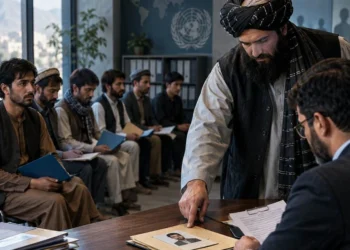
Sources present at a meeting with the Taliban’s Minister of Higher Education say: “In this meeting, the minister was told that if law and political science faculties are eliminated, where will the Ministry of Foreign Affairs recruit its staff? How will you conduct international negotiations? At the global level, diplomats are the ones who advocate for your recognition. Afghanistan’s seat at the United Nations requires diplomats trained in law. Law and political science faculties produce diplomats, advisors, and specialized personnel.”
The sources clarify: “The minister [Nadeem] stated that a group of elites and sheikhs should sit down and provide convincing reasons regarding three aspects: the importance, objectives, and needs of the political science discipline. If a convincing proposal is not presented, this discipline will be eliminated. Several meetings have taken place. There were conflicts between law, political science, and Sharia faculties, and some Sharia professors, aligned with the sheikhs, undermined law and political science. They have now been given time to assess the needs of this discipline in all its dimensions.”
Another source regarding the potential plan to eliminate law and political science faculties says that some professors advised the Taliban’s Minister of Higher Education that this action could escalate the “Emirate’s” controversies on the global stage, and the Taliban regime should not create larger crises for itself. According to the source, the minister remained silent after hearing this advice and did not respond. The source emphasizes that professors told the minister that currently, approximately 90 percent of the law curriculum aligns with Hanafi jurisprudence.
A professor at one of the country’s law and political science faculties says, “Currently, several subjects in this discipline have been eliminated. The subject of Afghanistan’s constitutional law has been removed. The subject of political systems has also been eliminated, because its foundation is constitutional law and the Republic’s specific definition of law. Additionally, Afghanistan’s political sociology has been removed from the curriculum.”
Concurrently, sources report an intensification of the process to remove university professors. They say that until now, the Taliban had refrained from widespread dismissals of professors due to a lack of alternative personnel and concerns about international backlash. However, sheikhs and mullahs affiliated with the group have undergone examinations at three levels, and bachelor’s, master’s, and doctoral degrees have been issued to them. The Taliban have begun recruiting these individuals into universities.
Before this action, Neda Mohammad Nadeem, the acting head of the Taliban’s Ministry of Higher Education, had described conducting examinations to determine the academic rank of Taliban members as “disrespectful to scholars.” He had stated that the “academic degree” of a “Taliban mujahid” should be calculated based on the number of mines they have planted.
Ethnic and Linguistic Discrimination at Kabul University
Sources report that the Taliban, in their efforts to purge universities of opposing forces, initially prioritize ethnicity, engaging in ethnic-based purges. According to sources, Tajik, Uzbek, and Hazara professors are the first to be removed. Subsequently, ideological considerations come into play, with Pashtun professors who adhere to Wahhabi or Salafi beliefs, or those with modern perspectives, being gradually eliminated from universities.
Meanwhile, sources indicate that Osama Aziz, the Taliban-appointed president of Kabul University, exhibits strong ethnic biases and is actively working to remove Persian-speaking professors. According to sources, he has formed a team at the university, operates under the support of the Haqqani network, and manages all affairs through the lens of ethnic nationalism. Sources add that he has converted all documents, regulations, and correspondence previously in Persian to Pashto and dismissed his administrative manager, a resident of Ghorband in Parwan province, for being unable to write correspondence in Pashto.
A Kabul University professor, in an interview with the Hasht-e Subh Daily, stated: “If you speak Persian, your work doesn’t progress. The majority of Persian-speaking professors, who were distinguished university faculty, have already left the university. Around 200 individuals from various disciplines have departed. Those who remained have had their space constricted to force them to leave. Once, one of our professors visited the former president, Ashraf Ghairat, who bluntly told him there was no longer any opportunity for advancement. He said, ‘Go abroad! If you don’t have a passport, I’ll help you get one.’ Appointments are exclusively from one ethnic group. Osama Aziz and Khairullah Khairkhwa, the former deputy for academic affairs at the Taliban’s Ministry of Higher Education, have formed a team and are hiring their preferred individuals.”
Sources say: “Most appointments are fabricated. They select the panel, conduct the exams, and create the shortlist themselves. No one can object. They fail doctors and master’s degree holders in favor of their own bachelor’s degree candidates, both to humiliate them and to create an environment where no one even considers applying for a position.”
A Kabul University professor says, “Currently, a list of 52 faculty members has reached the university president, but he refuses to approve it. I went to the president myself, and he explicitly said, ‘Don’t bother, there are 52 people on the list right now, and I won’t allow their processing.’”
Sources report that one day, a professor was administering an exam with the faculty and university logo printed on the exam papers, which sparked significant controversy, instigated by Osama Aziz. This professor was repeatedly exiled to Parwan and Balkh provinces and ultimately, due to connections and familiarity with ‘Sheikh Nadeem,’ received a scholarship and was reluctantly sent into exile. According to sources, when Osama Aziz saw the papers with the university and faculty names, he summoned the professor and asked, ‘Where are you from?’ The professor responded, ‘From [location withheld due to security threats].’ Osama then told him, “We’ve fought for 25 years for this very word. Do you understand? If not, understand this: we’ve shed blood for this terminology. You’re Iranian.”
Sources add: “This professor is a man of honor. Once, he went to the university presidency himself and told Osama Aziz, ‘Are you the university president or a language traffic cop?’ He was immediately transferred to Parwan University. When he resisted and returned, they exiled him to Balkh. His father is a prominent mullah from the north, and he used Sheikh Nadeem as an intermediary to return. This time, to get rid of him, Osama even granted him a doctoral scholarship. The professor has now gone to Iran. If he didn’t have connections or wasn’t the son of a mullah, he would have been sacked long ago.”
Security Screening or Systematic Elimination in Faculty Recruitment
Sources at Kabul University report that Osama Aziz, Khairullah Khairkhwa, and several others appointed during the tenure of Abdul Baqi Haqqani, the former Taliban Minister of Higher Education, are more deeply involved in ethnic issues than the Kandahari faction aligned with Neda Mohammad Nadeem. According to sources, the Taliban’s security screenings primarily target experienced and distinguished faculty, labeling them as “rebels,” “resistance members,” “Panjshiris,” or other derogatory terms, thereby excluding them from entering the examination and selection stages.
These sources indicate that the Taliban have established a “security filter” at Kabul University for inclusion in the final recruitment list. Every applicant is first referred to this filter, but the majority are eliminated at this stage and denied passage under various pretexts. According to sources, only those belonging to the Taliban’s preferred ethnic group and adhering to their ideology can pass this security screening.
Sources add that in numerous instances, a candidate favored by the Taliban has received low exam scores but was later favored through the formation of a committee that altered the process in their favor. The Taliban claimed the candidate’s rights were violated and needed rectification, resulting in the failed candidate being declared successful. Sources note that fear prevents anyone from protesting or voicing objections to this process.
However, a female professor recently dismissed from her position stated: “All of them [the Taliban] are biased, and Osama is no different. But in 2022, I taught girls and boys on separate days for two semesters, and he wasn’t strict about hijab or other women’s issues and didn’t exclude women from mixed committees that included men. Regarding staff reductions, Osama didn’t include active female professors on the list, but a letter from the minister regarding the reduction of female staff was sent to the university presidency again. I don’t know if his attention to women is strategic or if he genuinely has a slightly more enlightened perspective than others. But they all share linguistic bias; not a single official letter is sent to departments in Persian.”
This former Kabul University professor added: “In administrative offices, if you speak Pashto, your work is processed quickly and with open arms, but they treat others very poorly, making a thousand excuses and schemes.”
The Taliban have initiated the “Islamization” of the country’s academic curriculum based on their specific interpretation, following an order issued by Hibatullah Akhundzada, the Taliban Supreme Leader, in August 2022 to establish the Directorate of Curriculum Review. At the time, this institution was created with six departments and 25 staff members to “revise the curriculum of academic institutions in light of Islamic principles.” The Taliban’s Ministry of Higher Education also announced it had begun reviewing the syllabi of social science disciplines.
The report’s findings, which reveal extensive changes to the university curriculum, come as the Taliban are now openly promoting their ideological views in universities through seminars titled “Mullah Omar Studies.” Recently, the group held such a seminar at the Ghor Institute of Higher Education, introducing Mullah Omar as “Umar the Third,” a title equating him with the second Muslim caliph, Umar ibn al-Khattab. Additionally, the group organized a seminar at Faryab University titled “The Importance of the Beard in Islam” for professors and students. The Taliban-appointed president of this university described shaving the beard as “imitating the enemies of Islam and a result of ignorance of religious teachings.” He also claimed that shaving the beard is harmful from a health perspective.
Furthermore, the replacement of academic faculty with Taliban mullahs in public universities has intensified. Recently, the Taliban’s Ministry of Higher Education appointed 15 of the group’s mullahs as professors at Parwan and Al-Biruni universities while simultaneously dismissing 16 former academic faculty members from their academic positions and reassigning them to administrative roles. Some university professors state that the exclusion of women, censorship of academic content, selection of professors based on ideological loyalty to the Taliban, and the transformation of universities into propaganda tools are part of the Taliban’s policies to Talibanize universities.
Previously, the United Nations Assistance Mission in Afghanistan (UNAMA) has protested in its reports and official statements against the Taliban’s “academic purges,” the ban on women’s education, and discriminatory educational policies.
In a 2023 report, the United Nations Educational, Scientific, and Cultural Organization (UNESCO) warned that Afghanistan’s academic institutions face a profound crisis in academic independence, freedom of expression, and knowledge exchange.
Human Rights Watch has highlighted the dismissal of critical professors, restrictions on academic content, and ideological pressures on universities as part of the Taliban’s efforts to exert complete control over society.
Scholars at Risk, in a report titled “Academic Freedom Monitoring Project,” stated that researchers and students in Afghanistan face frequent and widespread attacks on academic freedom and the independence of the institutions in which they operate. The report adds that the Taliban have collected books deemed contrary to Hanafi jurisprudence and have arrested and imprisoned several university professors for facilitating education for women.
You can read the Persian version of this investigative report here:
دانشگاهها زیر تیغ ایدیولوژی؛ نصابسازی ملاهای طالبان برای تحصیلات عالی | روزنامه ۸صبح