
Some experts say the war between the Taliban and Pakistan has been overshadowed by U.S. and Israeli strikes against Iran, drawing less attention from international institutions and countries in the region and around the world. According to these experts, tensions in the Middle East have caused this war to fade from public consciousness. Meanwhile, some officials from the former government say “this war is not the war of the people of Afghanistan,” arguing that Pakistan is now engaged in a conflict with a “terrorist, usurper, and self-created” group, while the burden of the conflict falls on the people. They add that the presence of Tehrik-i-Taliban Pakistan (TTP) in Afghanistan, regional rivalries, and deep mutual mistrust between the Taliban and Pakistan have prolonged the conflict. On the other hand, several citizens of Afghanistan, while condemning Pakistan’s strikes, have pointed to civilian casualties caused by these airstrikes, stating that denouncing such actions does not mean alignment with or lobbying on behalf of the Taliban.
As Pakistan’s airstrikes continue and the war between the Taliban and Pakistan drags on, concerns over civilian casualties have mounted. Some experts, however, say that the escalation of U.S. and Israeli strikes against Iran and rising tensions in the Middle East have pushed the Taliban-Pakistan war further out of the spotlight, leaving its endpoint uncertain.
Afrasiab Khattak, a Pakistani regional affairs expert and political activist, told the Hasht-e Subh Daily that predicting when the war between the Taliban and Pakistan will end is difficult. He said the conflict is part of a broader proxy war waged by major powers.
Mr. Khattak added, “In fact, this war is also part of the proxy wars between superpowers for hegemony, and its goal is to create obstacles in the path of China’s expanding influence in South and West Asia. As such, it appears that if the U.S.-Israeli war against Iran is prolonged, this conflict will be even further eclipsed by it.”
Meanwhile, Mujeeb-ul-Rahman Rahimi, spokesperson for the High Council for National Reconciliation of the former government, said: “Given the current circumstances, this crisis will not end anytime soon, because its roots lie in the presence of Tehrik-i-Taliban Pakistan in Afghanistan, regional rivalries, and deep mistrust between the Taliban and Pakistan. Pakistan will increasingly rely on limited military pressure and targeted operations to push the Taliban toward changing their behavior. What we are therefore likely to witness is the continuation of an erosive, cyclical crisis, with tensions that sometimes intensify and sometimes ease, but do not simply come to an end.”
Mr. Rahimi added, “The reality is that the Taliban are trying to frame this conflict as resistance against Pakistani aggression. Certain Pashtun nationalist and ethnocentric circles may also reinforce this narrative, presenting it as a form of national resistance. But at the broader level of society, and among many of Afghanistan’s political and intellectual elites, the perception is entirely different.”
The spokesperson for the former High Council for National Reconciliation said, “Many people are well aware that this war was not fundamentally started in the interests of Afghanistan. It is the result of the Taliban’s own policies and their complex relationships with armed groups in the region. This is why many of the people of Afghanistan do not see this conflict as a war between Afghanistan and Pakistan, but rather as a conflict between Pakistan and an armed group that Pakistan itself once helped create. Moreover, one of the most critical duties of any government is to defend national sovereignty and territorial integrity. Yet Pakistan’s extensive strikes inside Afghan territory have demonstrated that the Taliban are, in practice, unable to effectively defend the borders or respond to these attacks.”
Mr. Rahimi further noted that this situation has raised a serious question among the people: if a government cannot defend its own territorial boundaries, how can it claim national sovereignty? He said that while a limited circle of nationalist elites may support the Taliban or sympathize with them out of ethnic sentiment, the majority of Afghanistan’s elites and a large segment of its society, particularly Tajik, Hazara, and Uzbek elites, view this crisis as a confrontation between a terrorist, usurper group and Pakistan, and consider it a sign of the Taliban’s weakness and political deadlock.
On the other hand, several political and media activists have strongly condemned Pakistan’s airstrikes on Afghan soil, stating that civilians have suffered significant casualties and losses in these attacks. According to them, these strikes constitute a blatant Pakistani aggression against Afghanistan’s territory. In response, many online users have accused these individuals of siding with the Taliban, arguing that under the guise of defending the homeland, they are effectively supporting the Taliban, while the Taliban themselves are the primary cause of the country’s current dire situation.
A group of Afghan refugees in the United Kingdom also held a protest in front of the British Parliament in London, demonstrating against the killing of civilians in the war between the Taliban and Pakistan, and calling for an end to the bloodshed and for the protection of civilians.
Nasir Ahmad Andisha, Afghanistan’s Ambassador to Switzerland, responding to a recent statement by Mohammad Yaqoob Mujahid, the Taliban’s Defense Minister, wrote: “While the country has entered an unprecedented military, economic, and national-social crisis, the Taliban’s Defense Minister has reappeared after an absence and is reaffirming their continued support for the TTP.”
Andisha added: “Mullah [Hibatullah] Sahib has published his new practical work, addressing the most vital challenges facing the country and the region, titled ‘Dakhil al-Sunnah wal-Jama’ah Aqeedah.’ These are the Taliban’s priorities. Our compatriots should no longer be swayed emotionally into supporting or whitewashing the Taliban.”
The continuation of this war and the prolonged closure of the borders have also inflicted severe financial losses on farmers and traders in Afghanistan. Videos circulating on social media show some farmers discarding a full year’s worth of crops that have spoiled due to closed borders and the lack of adequate domestic markets.
As the Taliban-Pakistan conflict continued, fighting between the two sides on Saturday in Torkham led to a fire in a commercial market, resulting in the burning of at least 150 shops. Abdullah Mustafa, the Taliban’s mayor in Torkham, stated that following Pakistan’s rocket attack on the market early Saturday morning, damages to shopkeepers amounted to nearly 300 million Afghanis.
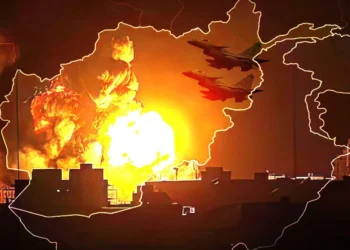
The Taliban announced on Saturday that Pakistan had bombed areas in the provinces of Paktia, Paktika, Khost, Maidan Wardak, and Kunar. This came as fighting between the Taliban and Pakistan continued in the border provinces, with both sides reporting casualties. The Taliban have called on tribal elders and former military personnel to stand alongside the group and cooperate by staging demonstrations and going to the front lines. Meanwhile, this war, which has now lasted nearly two weeks, has shown no signs of coming to an end.
Earlier, the United Nations High Commissioner for Refugees (UNHCR) had announced that as a result of the border clashes between the Taliban and Pakistan, approximately 118,000 people had been forced to flee their homes. The United Nations Mission in Afghanistan and the UN High Commissioner for Human Rights have also called on both the Taliban and Pakistan to immediately cease hostilities.
You can read the Persian version of this report here:
جنگ طالبان و پاکستان در سایه تنشهای جهانی؛ آیا درگیریها ادامه خواهد یافت؟