• 8AM.MEDIA
  • ویب‌سایت فارسی
  • پښتو ویب‌پاڼه
  • اۉزبېکچه ویب‌سایت
  • Podcast
Saturday, October 3, 2026
Hasht-e Subh
  • Home
  • News
    • Afghanistan News
    • World News
  • Opinion
    • Editorial
    • Analysis
  • Reports
    • Daily Reports
    • Investigative Reports
  • Society
    • The story of people
  • Women’s Word
  • Columns
    • Three Years After Afghanistan’s Fall: The Taliban’s Resurgence
    • Towards Equality
    • The Resurgence of the Taliban: Two Years Since Afghanistan’s Fall
    • Hebatullah Report Special Edition
    • Resistance for Education Special Edition
    • Special Column on Taliban’s Education Curriculum
    • Nawroz
  • Interviews
  • Contact Us
    • About Us
    • 8AM MEDIA Annual Awards
    • Submit an Article to Hasht-e-Subh
  • 8am.mediaBack
Subscribe
No Result
View All Result
  • Home
  • News
    • Afghanistan News
    • World News
  • Opinion
    • Editorial
    • Analysis
  • Reports
    • Daily Reports
    • Investigative Reports
  • Society
    • The story of people
  • Women’s Word
  • Columns
    • Three Years After Afghanistan’s Fall: The Taliban’s Resurgence
    • Towards Equality
    • The Resurgence of the Taliban: Two Years Since Afghanistan’s Fall
    • Hebatullah Report Special Edition
    • Resistance for Education Special Edition
    • Special Column on Taliban’s Education Curriculum
    • Nawroz
  • Interviews
  • Contact Us
    • About Us
    • 8AM MEDIA Annual Awards
    • Submit an Article to Hasht-e-Subh
  • 8am.mediaBack
No Result
View All Result
Hasht-e Subh
No Result
View All Result

Pakistan Strikes, Taliban Warn: A Pattern of Attack and Empty Threats

Translated by Farhad Farhaad | Originally written in Persian by Kiomars Samadi

Mohammad Farhaad Mohammad Farhaad
3 October 2026 - Solar Hijri Date: 1405/07/11 [t_time:1791028065]
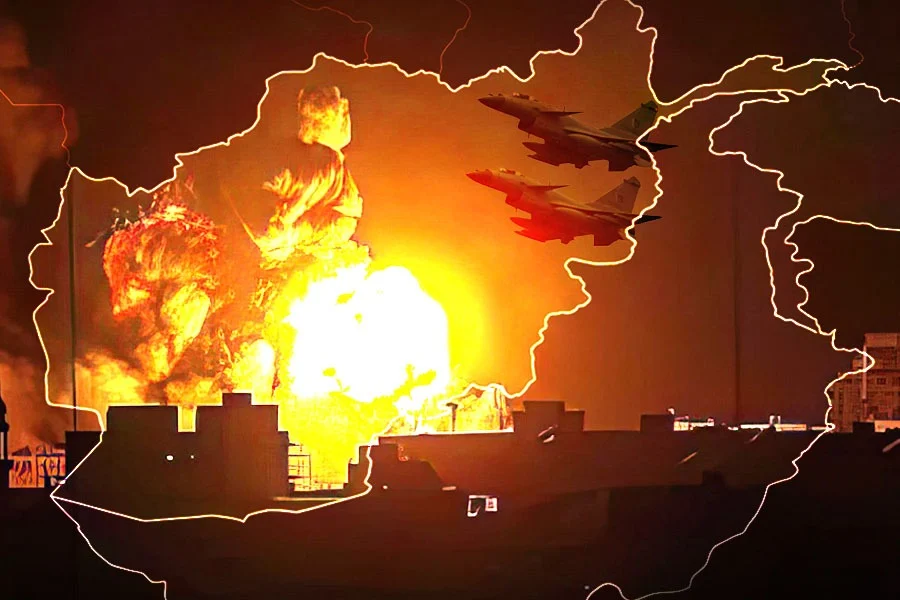
Pakistani fighter jets are seen over a map of Afghanistan as a massive explosion lights up the night sky above buildings. (Photo credit: Social Media)

Social Media

Pakistan’s airstrikes on Afghanistan have gradually shifted from an exceptional event to something routine and recurring. With each attack, several people are killed, and homes are destroyed. The Taliban respond only with warnings and promises, but in practice the group’s reaction does not reach a level that could create “deterrence.” This passivity, or at least the not-so-serious response of the Taliban to Pakistan’s repeated attacks, is as worthy of reflection as the attacks themselves. The fundamental question is not why Pakistan attacks. The question is why the Taliban, despite claiming full control over Afghanistan, show a limited and cautious response to the repetition of these attacks.

Yes, the Taliban have considerable military force and have maintained territorial control to some extent, but this is different from having the capacity to deter a country with a powerful air force. The Taliban can create clashes along the borders, carry out ground operations, deploy suicide fighters, and even, in some cases, claim to have inflicted casualties on the other side. But a ground response to an air attack is not the equivalent of establishing air deterrence.

This is where the gap between the claim of possessing power and the Taliban’s actual capacity becomes apparent. Therefore, the issue is not whether the Taliban are capable of fighting. The issue is whether, as the rulers of Afghanistan, they have the capacity and the will to impose a cost that would deter Pakistan from repeating its attacks. The gap between the “ability to fight” and the “ability to deter” is precisely what makes the Taliban’s position today different from their past.

Of course, the problem is not only military weakness. The Taliban’s bigger problem is the lack of a broad social and political foundation. The Taliban cannot confidently assume that every Pakistani attack is seen by all the people of Afghanistan as an attack on “Afghanistan,” because the group has not managed, or has not wanted, to establish itself as the “legitimate representative” of society as a whole. As a result, many remain silent in the face of Pakistan’s attacks, or even express optimism. Undoubtedly, some object, but this opposition does not necessarily mean support for the Taliban’s position against Islamabad. The Taliban have also tried to exploit Pakistan’s attacks to portray themselves as the champion defending “territorial integrity” and the victim of “foreign aggression,” and to mobilize part of society around the issue of “national sovereignty.” Yet once again, they have failed and have not been very successful. They now seem to have realized that every blow delivered by Pakistan does not turn into “political capital” for them.

The third layer is the Taliban’s loneliness and isolation at the international level. So far, no country except India has condemned Pakistan’s repeated and deadly attacks on Afghanistan. Even the United Nations (UN) has remained silent. It has expressed concern about civilian casualties, but there is a very large gap between concern over civilian casualties or opposition to the escalation of the conflict and standing alongside the Taliban. Even if India condemns Islamabad’s attacks because of its hostility toward Pakistan, this cannot automatically be regarded as support for the Taliban. Therefore, the Taliban cannot count every criticism of Pakistan as a diplomatic victory for themselves.

The main issue is that the Taliban have so far been unable to build an effective and broad regional diplomatic front against Pakistan, a front that could confront Islamabad with a serious political cost. Why is this the case? Part of the answer must be sought in the Taliban’s domestic policy. The Taliban demand that the international community recognize their regime and also prevent Pakistan from attacking Afghanistan, but at the same time they show not the slightest flexibility on many of the international community’s core demands, including the formation of an inclusive government, respect for women’s fundamental rights, and the removal of broad social restrictions.

Given this, it can be said that a government that restricts the circle of political participation at home and strongly opposes a large part of the international community’s demands abroad will have less capacity to build a broad political coalition when confronting a foreign power.

This is where the loneliness and isolation of the Taliban take on their real meaning. The Taliban’s isolation is not merely that a few countries do not have full diplomatic relations with the group. Isolation deepens when a government cannot bring all political and social groups along with it at home, cannot build a lasting network of partners in the region, cannot secure an effective consensus at the international level, and also cannot create proportionate deterrence on the battlefield against the pressure of a neighbor.

What more needs to happen for the Taliban to come to their senses? When a neighbor can repeatedly target Afghanistan’s territory; when the Taliban are compelled to limit their response against this neighbor; when there is no broad consensus within society condemning Pakistan’s attacks; when even anti-Taliban reactions can be seen among the majority of citizens in response to Pakistan’s attacks; and when, at the international level, the existing reactions are mostly limited to concern over civilian casualties, calls for restraint, and efforts to reduce tensions, what clearer sign is needed to grasp the depth of the isolation?


You can read the Persian version of this analysis article here:
پاکستان و طالبان؛ حمله از آن‌سو، اخطار از این‌سو

ShareTweetSendSendShare

Related Posts

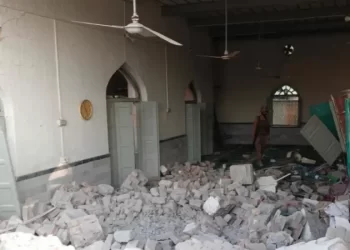
A mosque in Kohat, Pakistan, was damaged in a blast, with rubble covering the floor and parts of the building’s interior (Photo: AFP)
World News

Sharp Rise in Casualties in Pakistan; More Than 1,000 Killed in Three Months

3 October 2026 [t_time:1791026774]
People attend a ceremony marking Turkmen National Language Day in Faryab province (Photo: Exclusive)
Afghanistan News

Turkmen National Language Day Commemorated in Faryab

3 October 2026 [t_time:1791026248]
Panelists sit on stage during an International Parliamentarians' Congress session on human rights protection in Afghanistan and the responsibility of the UN, OIC and SCO. (Photo credit: Social Media)
Analysis

The Islamabad Declaration and the Myth of 42 Percent

3 October 2026 [t_time:1791026142]

Latest

Loading latest news...

Popular stories

  • Surveillance footage shows Taliban fighters surrounding and shooting a bound man in Herat. (Photo credit: Social Media)

    Taliban Shoot Young Man from Herat After Torturing Him with Hands Tied

    Share
    Share Tweet
  • UN Report Reveals Shifts in Family Attitudes and Rise in Domestic Violence in Afghanistan

    Share
    Share Tweet
  • Al-Qaeda Releases Hamza bin Laden Message on 9/11 Anniversary

    Share
    Share Tweet
  • Afghanistan Journalists Center: Taliban Have Detained Around 300 Journalists and Media Workers

    Share
    Share Tweet
  • Freedom Front Claims 37 Taliban Fighters Killed in Nuristan and Kunar

    Share
    Share Tweet

Podcast

Insights
Insights

Join Lynne O’Donnell for 8AM’s podcast series, Insights.
Lynne talks with generals, diplomats, soldiers, journalists, politicians, activists, people who have front row seats for conflicts around the world, and citizens with a story to tell, happy or sad. For this first series, Afghanistan is the focus. Lynne and her guests talk about the collapse of the republic in August, 2021, and the impact since — for the people of Afghanistan, for the security of the region, for the safety of the world. It’s important, interesting and insightful.

Insights/22: Controlling the Narrative with Mina Sharif
byinsights8am

Controlling the Narrative

Lynne O’Donnell talks with Mina Sharif, author, activist, women’s rights campaigner, educator and mentor. They discuss who controls the narrative and who speaks for Afghanistan’s people when the Taliban appear to have seized control not only of the country but of the message, too.

Have a listen

Insights/22: Controlling the Narrative with Mina Sharif
Episode play icon
Insights/22: Controlling the Narrative with Mina Sharif
Episode Description
Episode play icon
Insights/21: Media Meltdown with Zahra Joya
Episode Description
Episode play icon
Insights/20: Terror Inc with Scott Richards
Episode Description
Episode play icon
Insights/19: Busting Stereotypes with Bushra Gohar
Episode Description
Episode play icon
Insights/18: Media Matters with Waliullah Rahmani
Episode Description
Episode play icon
Insights/17: What Goes Around Comes Around with Sima Samar
Episode Description
Search Results placeholder
Hasht-e Subh

8AM Media, also known as Hasht-e-Subh Daily, stands as Afghanistan's premier independent and non-profit newspaper, resonating as a beacon of journalistic integrity since its establishment in June 2007 by esteemed Afghan journalists and human rights advocates. With a steadfast commitment to citizen journalism and civic education, Hasht-e-Subh Daily has earned its place as the most esteemed publication in the nation.

Publisher: Sanjar Sohail
Email: [email protected]
Executive Director: Parwiz Kawa
Email: [email protected]

Read More

Pakistan Strikes, Taliban Warn: A Pattern of Attack and Empty Threats

Sharp Rise in Casualties in Pakistan; More Than 1,000 Killed in Three Months

Canadian Prime Minister to Visit Turkey

Turkmen National Language Day Commemorated in Faryab

The Islamabad Declaration and the Myth of 42 Percent

Editor’s Choice

Every Saturday morning, 8AM MEDIA English Services Department will guide you through the week’s biggest stories from Afghanistan and the international community.

Subscribe

© 2026 - ©Hasht-e Subh Daily

No Result
View All Result
8am.Media
پښتو ویب‌پاڼه
ویب‌سایت فارسی
اۉزبېکچه ویب‌سایت
  • Home
  • News
    • Afghanistan News
    • World News
  • Opinion
    • Editorial
    • Analysis
  • Reports
    • Daily Reports
    • Investigative Reports
  • Society
    • The story of people
  • Women’s Word
  • Columns
    • Three Years After Afghanistan’s Fall: The Taliban’s Resurgence
    • Towards Equality
    • The Resurgence of the Taliban: Two Years Since Afghanistan’s Fall
    • Hebatullah Report Special Edition
    • Resistance for Education Special Edition
    • Special Column on Taliban’s Education Curriculum
    • Nawroz
  • Interviews
  • Contact Us
    • About Us
    • 8AM MEDIA Annual Awards
    • Submit an Article to Hasht-e-Subh
  • 8am.media

© 2026 - ©Hasht-e Subh Daily