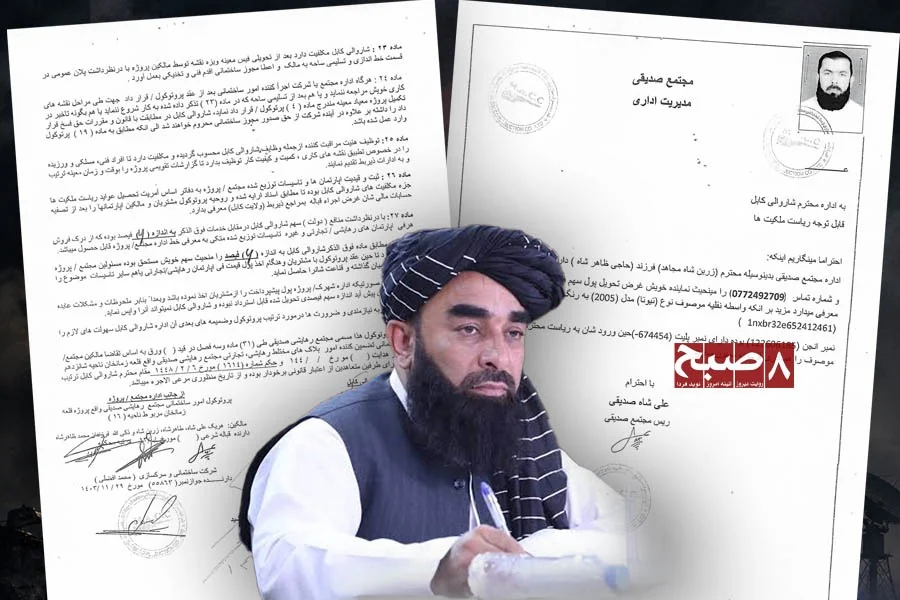
The Hasht-e Subh Daily has obtained documents showing that Zabihullah Mujahid, the Taliban spokesperson, has begun construction of a residential complex with his brothers in the green area of Qala-e Zaman Khan, located in the 16th District of Kabul city. A copy of the memorandum of understanding signed between the Taliban municipality and the Mujahid brothers, obtained by the Hasht-e Subh Daily, shows that the residential complex received approval on February 17, 2025. According to the memorandum, construction of the complex must be completed within five working years of the date the approval was issued. The memorandum lists the names of the Mujahid brothers as well as his real name. Sources in the Taliban municipality say that the work on the residential complex is taking place in a green area, and that in the documents signed by the two parties, the green area status was deliberately concealed and never mentioned. Sources also say that Zabihullah Mujahid, using his closeness to Hibatullah Akhundzada and his position as Taliban spokesperson, has abused his office, and that his brothers have all become engaged in building residential complexes in Kabul. This comes as reports by international bodies show that, despite the Taliban’s claims of reducing administrative corruption and nepotism, the lack of transparency in awarding contracts, the appointment of relatives of the group’s officials to posts, the abuse of authority, and the immunity of influential individuals from investigation remain serious challenges in Afghanistan under the group’s rule.
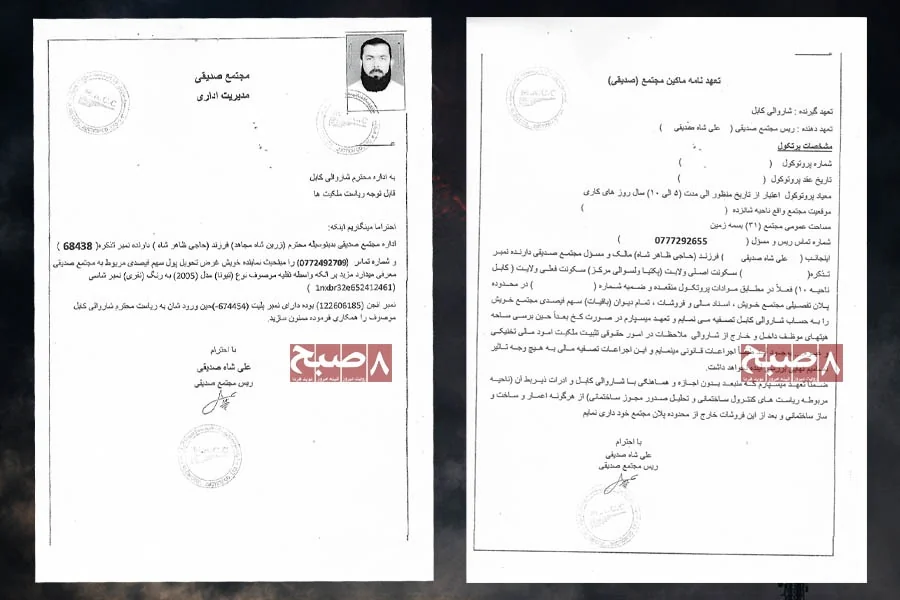
The documents obtained by the Hasht-e Subh Daily show that the residential complex is being built under the name “Siddiqi,” the family name of Mujahid and his brothers. However, sources say that the township in fact belongs to Mujahid, and that he included the names of his brothers so that no one would question his abuse of authority. The sources add that all work on the township was carried out on Mujahid’s orders, and that he obtained permission from the Taliban municipality to build it.
Sources say that this area, although privately owned, is designated as a green area in the Kabul municipal plan, and that construction and any building activity are not permitted in a green area. The sources stress that Mujahid ignored the green area status by abusing his position, and that the Taliban municipality, to curry favor with him, concealed the green area issue and issued the construction permit for the township in the name of his brother.
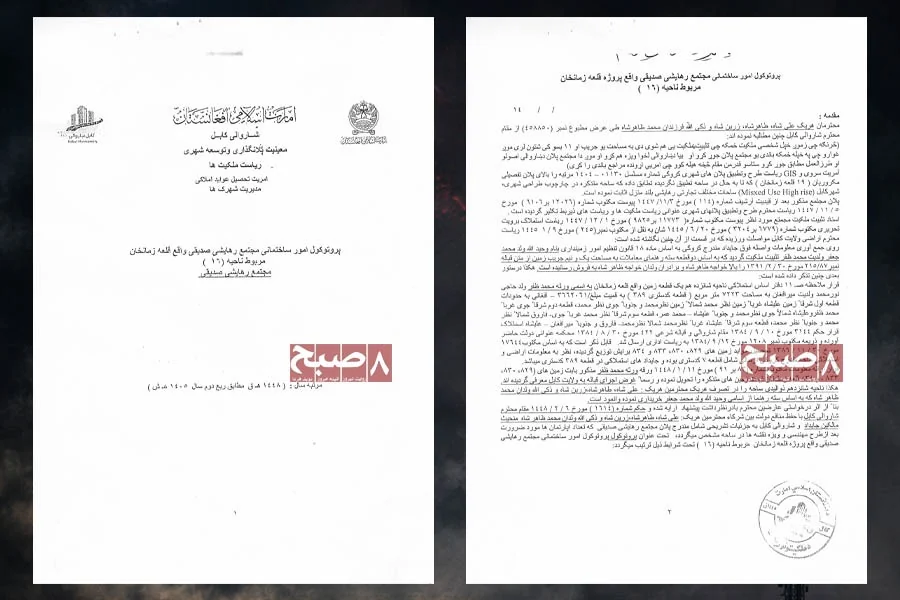
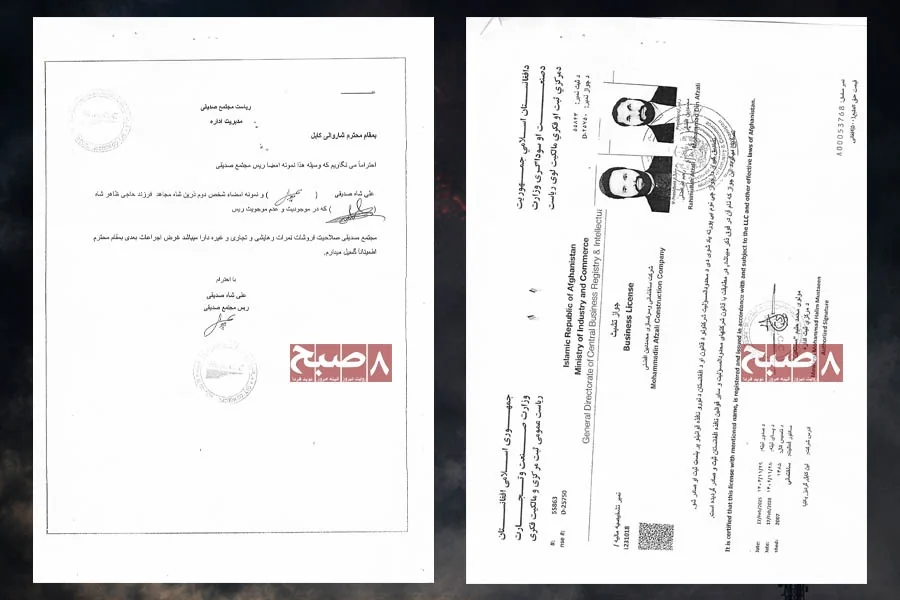
The document that Mujahid’s brother signed with the Taliban municipality in Kabul states that this residential complex, named “Siddiqi” and located in the Qala-e Zaman project in the 16th District of Kabul city, will be built by the Muhammad Din Afzali Construction and Road Building Company, license number 55863, which was established on February 18, 2025. Sources say that this company, too, belongs to one of the Taliban officials. Article 4 of the memorandum states that the period for starting and completing the project is set at five working years.
In the documents, the Siddiqi brothers are listed as Ali Shah, Tahir Shah (Zabihullah Mujahid), Zarin Shah and Zakiullah, sons of Muhammad Zahir Shah. According to the same documents, Ali Shah Siddiqi is introduced as the head of the complex and Zarin Shah Mujahid as his deputy.
According to the memorandum, the residential complex is to be built on land measuring two jeribs, but the area allocated to the complex in the pledge letter and the approved plan is listed as one jerib and 31 biswas. The basis of ownership is cited as Sharia deed No. 215, dated May 19, 2012, from the Taliban’s Bagrami court.
In a petition to the Taliban municipality, the brothers of Zabihullah Mujahid (Tahir Shah), named Ali Shah, Zarin Shah and Zakiullah, sons of Muhammad Zahir Shah, wrote that they hold one jerib and 11 biswas of land, whereas the memorandum for the construction of this township states the land area as two jeribs.
Article 2 of the memorandum states that the owners of the Siddiqi residential complex property hold legal and juridical standing under Sharia deed No. 215 of 87, dated May 19, 2012, covering two jeribs of land and issued by the Bagrami court [Taliban], whose registration was confirmed beforehand.
In a letter to the Taliban municipality in Kabul, the Siddiqi complex introduced Ali Shah Siddiqi as its head and also shared specimen signatures of him and Zarin Shah with that body. The document further states that the complex has the authority to sell residential, commercial, and other plots.
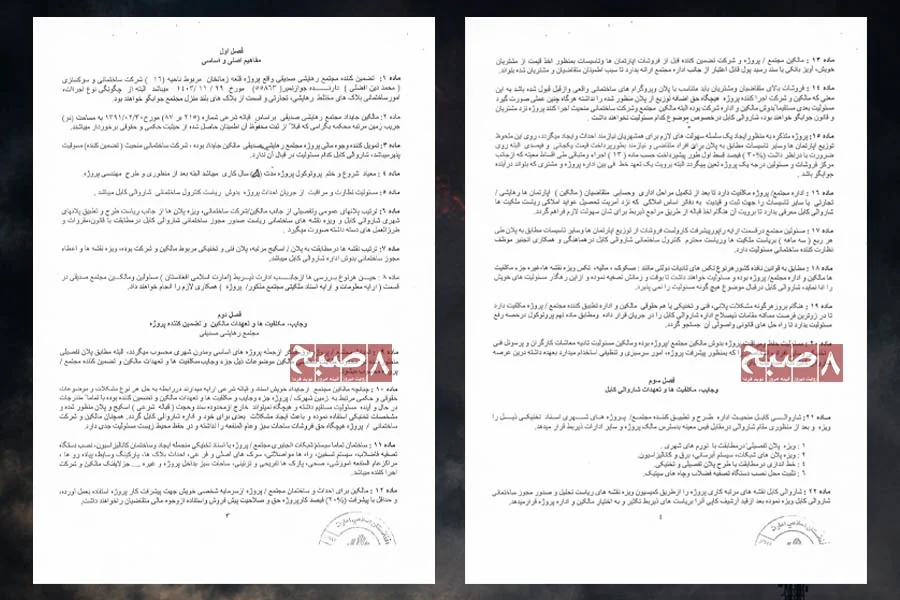
Pre-Sales Only After 20 Percent Progress
In this Taliban memorandum, it is stated that the Mujahid brothers are to start construction with their own capital and are not to pre-sell the building units before the project reaches at least 20 percent physical progress.
The protocol also sets the payment of 30 percent of the total price of a unit as the first installment, or down payment. In addition, the owners are obliged to pay taxes, levies, and other legal costs related to the project.
The Muhammad Din Afzali Construction and Road Building Company is also introduced in the protocol with license number 55863, and the responsibility for technical implementation and for guaranteeing the project has been assigned to Muhammad al-Din and Rahimullah.
Article 3 of the memorandum states that the financiers of the Siddiqi residential complex project are the property owners, and that the construction company is responsible as the guarantor.
Meanwhile, sources say that Zabihullah Mujahid and the Taliban municipality, using their influence, concealed the green area status of this land in the documents related to the complex. According to the sources, the land is part of a green area under the municipal plan, and until the city plan is changed, no authority can convert it into a residential and high-rise area.
The source stresses: “The green area has been concealed in these documents, because if it had not been concealed, construction would not have gone ahead in the green area. It makes no difference whether the land is private or state-owned. As long as it is designated as a green area in the municipal plan, the municipal plan remains in force, whether it is a school, a commercial area, or a land plot. It is like building a structure on a sidewalk, which is public space. Would that be possible?”
Zabihullah Mujahid, the Taliban spokesperson, revealed his real name in a media interview a while ago, saying that his real name is Tahir Shah Siddiqi. He confirmed that he has used, and continues to use, the pseudonym Zabihullah Mujahid as the Taliban spokesperson.
However, Kazim Humayun, an environmental expert, says: “Green areas and forest cover in Kabul city are smaller than in any other city, by international and even regional standards. In particular, unplanned construction has adverse consequences for public health and the urban environment. This trend, through rising air pollution, fine dust, and urban heating, increases the risk of respiratory and heart diseases and hurts the mental health of citizens. Likewise, the destruction of vegetation threatens the habitat of birds and other living creatures, and birds migrate to more distant areas to save themselves, which disrupts the ecological balance of the city.”
The environmental expert adds that building residential townships in the green areas of Kabul, without observing urban plans, conducting environmental impact assessments, and taking urban planning standards into account, is an irresponsible act that runs counter to the public interest. According to him, urban development must be managed in a way that, while meeting housing needs, protects green areas and provides citizens with an adequate per capita share of green space, because urban planners and pioneers of environmental protection regard green areas as fundamental elements of public health, environmental sustainability, and an improved quality of urban life.
Meanwhile, a study by the George W. Bush Institute titled “Corruption and Plunder of State Resources in Afghanistan Under Taliban Rule,” published in 2024, shows that after the Taliban took control of Afghanistan, the lack of transparency in awarding government contracts, selling properties, and issuing licenses and concessions created the ground for the abuse of official authority. According to the study, relatives of at least two Taliban ministers, working from offices in the Wazir Akbar Khan area of Kabul, gave domestic and foreign applicants access to government contracts and political concessions in exchange for payments outside the official framework. The study also points to the appointment of sons and other relatives of Taliban officials to government posts, pressure on private companies to meet the needs of the Taliban, and the difficulty for people without family or political connections in accessing public services. The report stresses that the absence of independent oversight and accountability mechanisms has limited transparency in these processes.
Likewise, the Bertelsmann Stiftung Transformation Index (BTI) 2026 report on Afghanistan shows that corruption among the Taliban and networks affiliated with them has undermined the rule of law. The report states that influential Taliban officials in many cases remain immune from punishment, and that when members of the group violate the law or abuse their authority, they are rarely prosecuted. The report refers to the case of Qari Saeed Khosti, the former spokesperson of the Taliban Ministry of Interior, who in 2023 was accused of abusing a girl in Kabul but faced no punishment. The report states that enforcement of the law is harsher and more arbitrary against people without political connections and backing, especially low-ranking employees, while influential individuals and Taliban affiliates are not treated equally. The report was published in 2026 and assesses the situation of Afghanistan during the period under review.
The United States Department of State (DOS) also published its annual human rights report on Afghanistan for 2023 on April 22, 2024, and exposed the widespread appointment of Taliban relatives to government posts and the abuse of authority by members of the group. According to the report, some Taliban forces in Kunar Province had asked non-governmental organizations to hire their relatives and affiliates and to rent their vehicles. After these requests were rejected, the Taliban reportedly instructed residents and district officials not to cooperate with the implementers of these organizations’ projects.
Despite the Taliban’s claims of reducing corruption and nepotism, numerous reports by international bodies show that Afghanistan under the group’s rule has become one of the countries with the worst administrative corruption in the world. The latest edition of the Corruption Perceptions Index (CPI), published in 2026 and covering the situation in 2025, shows that Afghanistan, with a score of 16 out of 100, ranks 169th among 182 countries.
You can read the Persian version of this investigative report here:
سخنگوی شهرکساز طالبان؛ مجاهد چگونه در ساحه سبز کابل شهرک میسازد؟