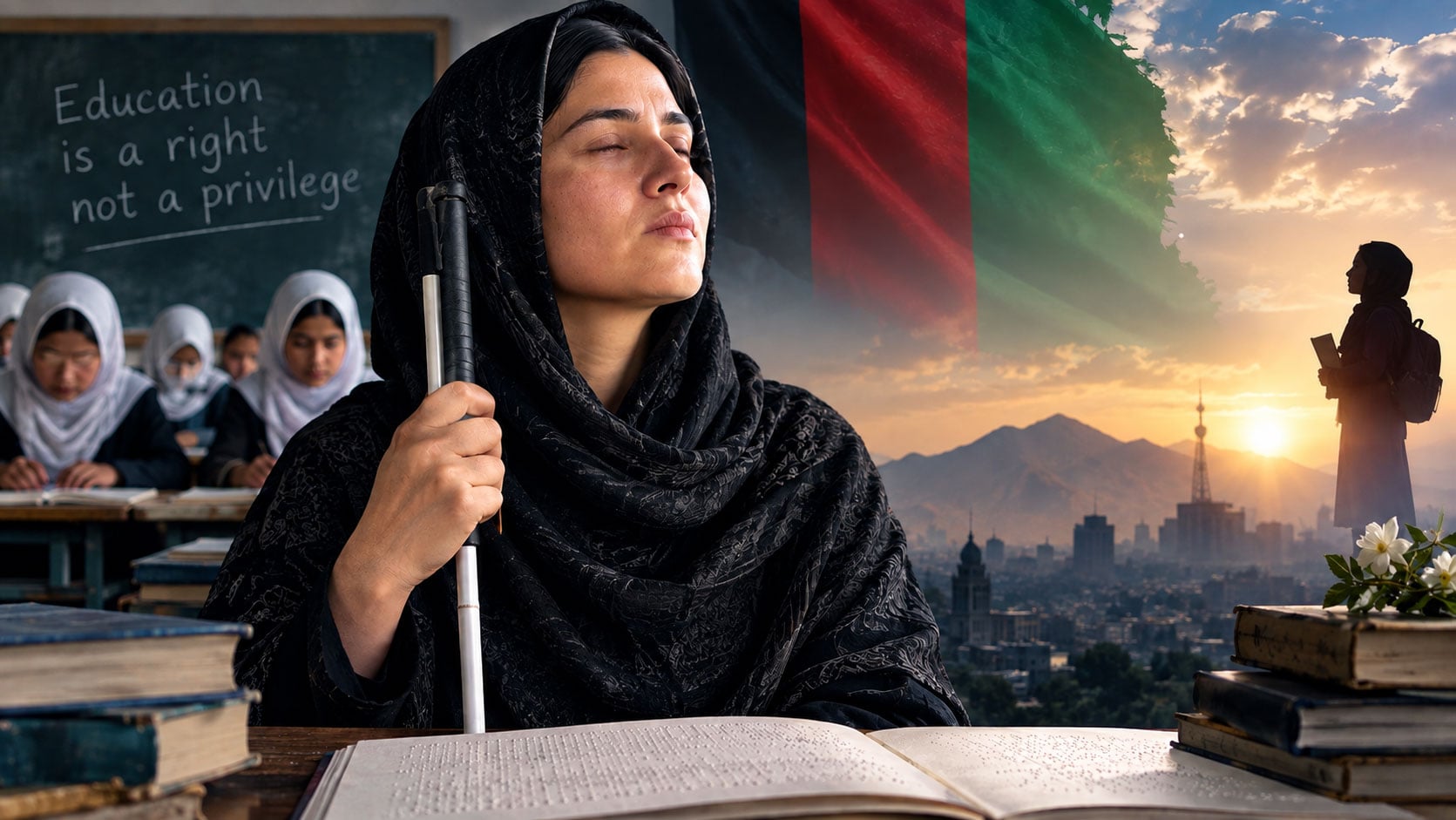
To those who claim to defend the rights of the blind: the international community, the United Nations, and human rights organizations
In the name of the God who, if He takes a person’s sight, does not take away their heart, their voice, or their dignity.
This is addressed to you, those who claim to defend human rights. To the international community. To the United Nations. To human rights bodies. To the organizations that for years have repeated the words “rights of persons with disabilities” in reports, conferences, and statements.
Peace be upon you.
I am a blind woman. I am a teacher at the Institute for the Blind in Kabul. I am a woman who does not see the world with her eyes, yet for years has seen many things that people with sight are unable to see.
I know darkness. But believe me: the darkness of the eyes is not as terrible as the darkness of human conscience.
I have a question for you: Where is the voice of Afghanistan’s forgotten generation of people with disabilities, especially the blind and the deaf? Have you still not heard our voice? Or have you heard it and chosen not to listen?
Your reports may be full of beautiful words: inclusion, disability, human rights, equal access, empowerment. But we, the blind people of Afghanistan, do not live by those words. We live with unemployment. With fear. With exclusion. With closed doors. With a future that grows smaller every day.
Blindness is not only the inability to see the color of the sky. When a blind person is denied work, denied education, denied economic independence, and when, because of both gender and disability, society’s doors are shut at the same time, then it is no longer only their eyes that cannot see. Society itself has denied them a future.
I ask you: If you know the situation of blind people in Afghanistan, what is your position? If you know that blind teachers and staff face joblessness and insecurity, what will you do? If you know that blind and deaf girls are being barred from education, which door will you open for them? If you know that, in the years since the Taliban took power, twenty blind employees have been dismissed- something that did not happen in previous periods- why have we not heard your protest? Does a blind person lose their human rights when they lose their job? Are human rights only for the days when a photograph with a blind person looks good in an annual report or at an international conference?
Silence may feel safer for some people. For the victim, the silence of others can hurt more than the violence itself.
We do not ask you to become our heroes. We do not want our names written on your projects. We do not want the suffering of blind people used to win budgets, prestige, titles, or positions. We are not a project. We are human beings. We are not numbers to be placed at the end of a report. We are not pictures for an organization’s brochure. We are not a ladder for anyone to climb on our pain.
We are women and men who want to work. We want to study. We want to teach. We want to earn our own bread with our own hands. We want a blind girl in Afghanistan to be able to touch her book and know that her future has not already been written for her.
But today we sometimes feel that, for some people, a silent blind person is more convenient than a blind person who makes demands. A blind person who stays quiet is acceptable. A blind person who poses for a photo is acceptable. A blind person who speaks of “empowerment” at a show event is acceptable. But a blind person who asks, “Why was my job taken from me? Why are blind girls barred from school? Why was my blind colleague attacked? Where is my safety? Where is my right?” suddenly becomes a problem.
To those who claim to defend human rights: if you hear our voice only when it costs you nothing, you are not our defenders. You are only selective listeners to our pain.
Real defense of human rights is not speaking about human dignity in grand halls. Real defense begins on the day when standing up for one human being costs the defender something.
Today one blind person has lost a job. Tomorrow it may be another teacher. Today one blind girl has been denied education. Tomorrow it may be another girl. Today one of our colleagues lives in fear of violence. Tomorrow it may be my turn. And perhaps one day it will be your turn to explain: when these people needed you, where were you?
I am a blind woman. My eyes may never see the buildings of the United Nations. I may never see the faces of the officials who give speeches about our rights. But I understand one thing clearly: honesty is not seen with the eyes. It is measured by actions.
So if you truly defend the rights of the blind, please be our voice today, not tomorrow, not in the next report, not at the next conference, not in a ceremonial statement.
Be the voice of the blind teacher who has been left without work. Be the voice of the blind employee who has lost job security. Be the voice of the blind girl who wants the right to learn. Be the voice of the blind colleague who fears violence and its consequences. Be the voice of thousands of blind people who, because of fear, poverty, and exclusion, cannot even cry out.
We do not ask you for miracles. Only do not let your silence help make our suffering normal.
And if you have truly been the voice of Afghanistan’s blind people, this time do not keep our voice inside your own rooms. Carry it to the world.
A request to the media
To journalists, media outlets, and writers in Afghanistan and around the world: I have a human request. If this letter deserves to be heard, please share it with responsibility and honesty.
I do not ask you to take sides. I do not ask you to pass judgment. I only ask that you not censor our voice and not push the suffering of blind people to the margins.
If a claim needs investigation, investigate it. If an official should answer, and I am certain they never will, try to demand an answer. If a right has been violated, hear the victim’s account. If we are wrong, let your reporting bring the truth to the public. But do not let the voice of a blind woman disappear into darkness simply because her eyes cannot see a camera or a podium.
Media: you may be the only window that opens from this darkness to the outside. If you find this letter worthy, share it with respect, not to spread hatred, not to incite violence, but so that the voice of a marginalized community can be heard.
We want nothing but the right to be heard. We want nothing but the right to live with dignity. We want nothing but the right to education, work, safety, and independence.
And perhaps the greatest request of a blind person from a world that claims to defend their rights is this: See us, even if we cannot see you.
With respect, and with a heart full of pain.