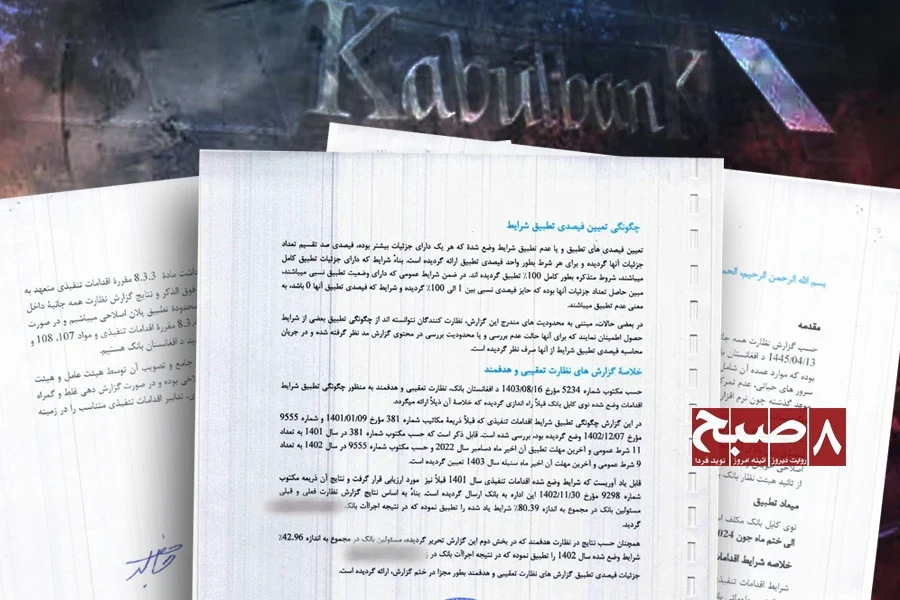
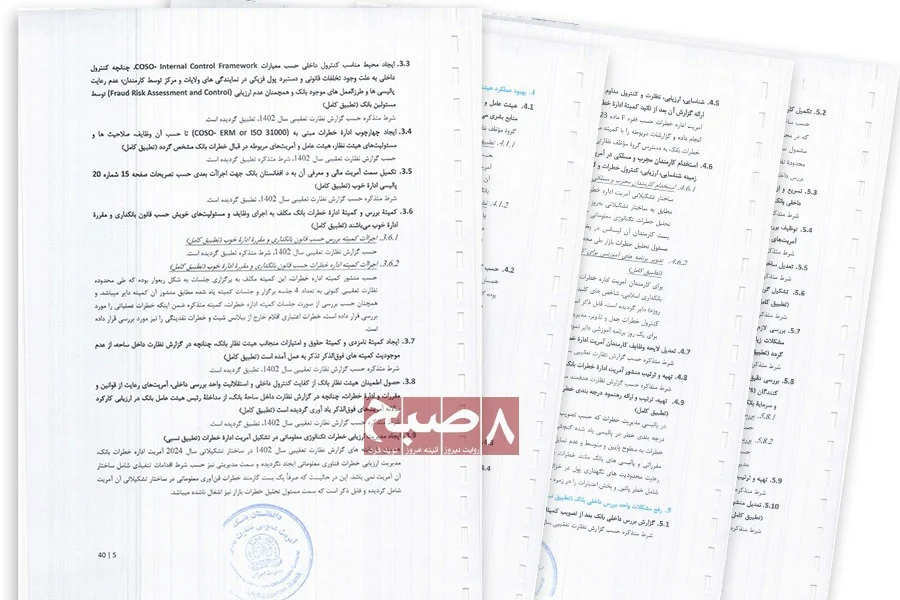
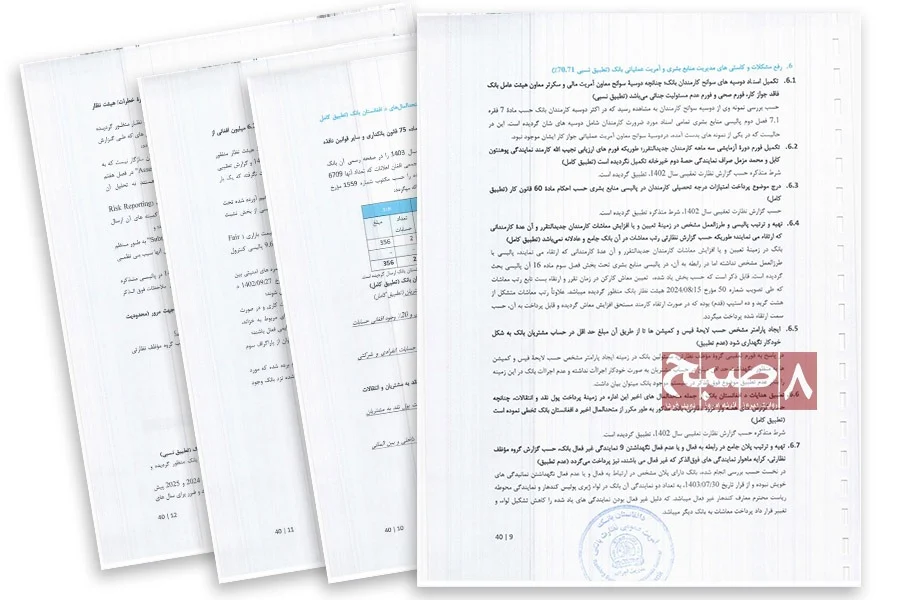
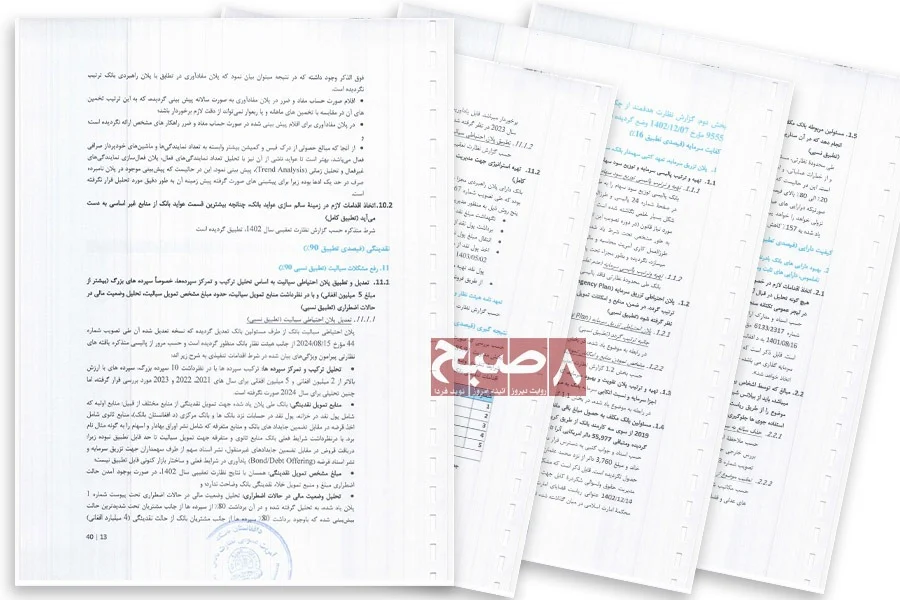
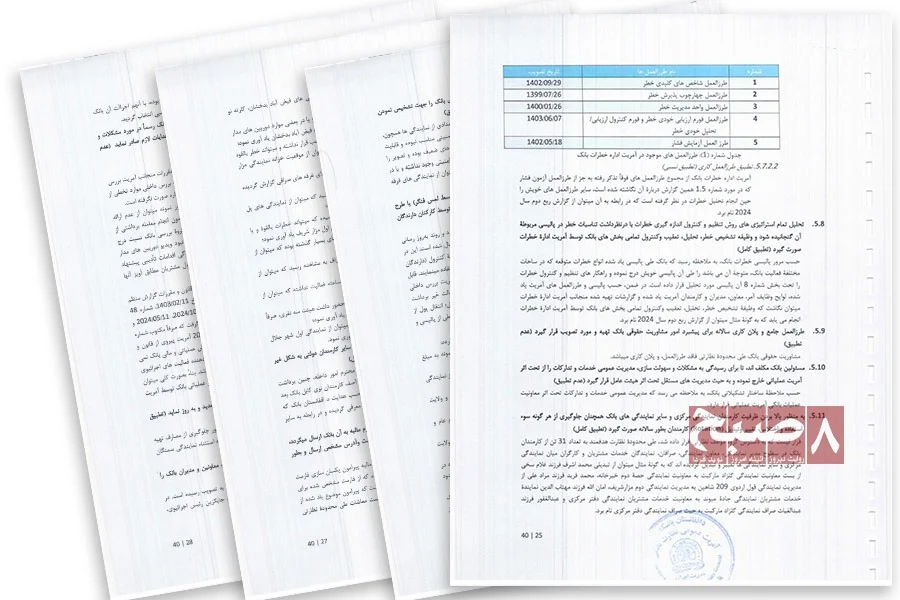
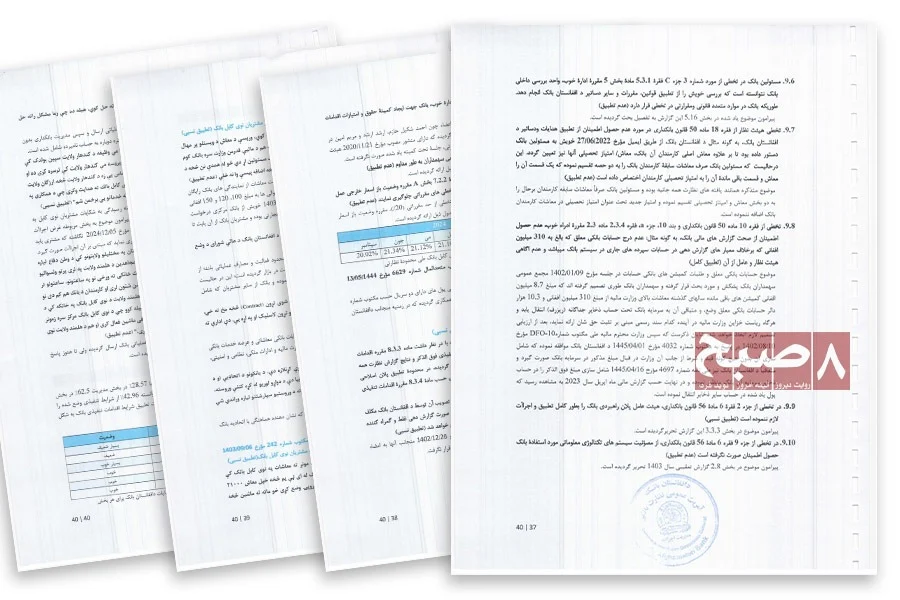
The Hasht-e Subh Daily has obtained a copy of a follow-up supervisory report by the Taliban-controlled Da Afghanistan Bank (DAB) on Kabul Bank. The report reveals persistent problems in the bank’s management, internal oversight, compliance with banking regulations, and implementation of corrective measures. The findings show that many of Kabul Bank’s problems remain unresolved. Weak control over customer transactions, deficiencies in vault management, thousands of dormant accounts left on the books, violations of banking regulations, a shortage of specialized staff, a heavy concentration of revenue on fees and commissions, and the lack of proven practical readiness to confront a liquidity crisis are among the bank’s major challenges.
According to the report, by the end of the review period, Kabul Bank had implemented 42.96 percent of the enforcement and corrective conditions set for it. The implementation rate was reported as 16 percent for capital adequacy, 28.57 percent for asset quality, 62.5 percent for management, 49.38 percent for earnings, and 58.33 percent for liquidity. Despite low implementation rates in some fundamental areas, the report rates overall implementation as “good.”
The review mainly covers Kabul Bank’s financial performance, annual plans, and regulatory ratios through the end of the third quarter of 2024, corresponding to September to October 2024. However, surprise inspections of branches and follow-up on complaints continued through Qaws 1403 (November and December 2024).
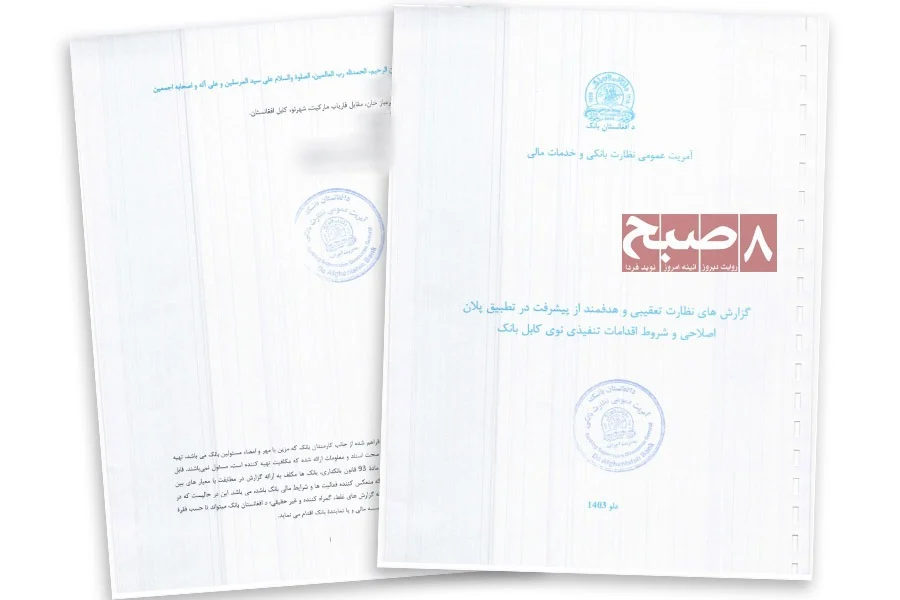
The report states that, in total, of the 10 legal and regulatory violations identified during the 2024 supervisory period, three have been resolved and seven remain. In addition, a number of corrective measures related to capital adequacy, updating the banking system, managing dormant accounts, translating and approving policies, and completing the bank’s organizational structure have not been fully implemented.
Deficiencies in Transaction Oversight and Vault Management
According to the report, weaknesses persist in the internal control system and in the handling of operational violations at Kabul Bank’s branches. The findings of a DAB review dated November 26, 2024, show that security facilities and transaction control procedures at some Kabul Bank branches did not meet expected standards.
The report states that the quality of security cameras at a number of branches, including the central branch in Mazar-e-Sharif and the first branch in that city, was not suitable for identifying the type of cash. In some vaults, CCTV cameras were either absent or not fully active around the clock. The Pamir Corps and Faizabad (Badakhshan) branches are among the locations where these deficiencies were recorded.
The bank’s policy also stipulates that security cameras must be active 24 hours a day during working hours when electricity is available, and that cameras covering the vault, archive, data center, entrance gate, and other key areas must be permanently active so that security monitoring of these areas is carried out effectively.
The report states that some Kabul Bank branches face problems in vault management and oversight. According to the report, these problems include the absence of a vault register at some branches, irregular recording of transactions between money exchangers, missing bands on some cash bundles, vaults being opened and closed without the presence of a three-member committee in some cases, an unsuitable location for the vault at the Mazar-e-Sharif branch, and cash being held above the set ceiling at some branches.
According to the report, in one case the vault balance at the Nimroz branch was recorded at 19.9 million Afghanis, while the permitted cash holding limit at that branch was 10 million Afghanis.
In addition, at the Karte Naw branch, 2,100 Afghanis in defective or invalid banknotes were found. The lack of a separate area for women and the shortage of female staff at some branches are other challenges noted in the report of the Taliban-controlled DAB.
According to the report, Kabul Bank’s Internal Audit Directorate carried out a total of 30 special audits in 2024. These audits covered issues such as the withdrawal of money from customer accounts in the customers’ absence, shortfalls in vault balances, the lifting of no-withdrawal status on accounts, payment of an amount lower than the figure recorded on the voucher, and the transfer of money from customer accounts.
Embezzlement of More Than Five Million Afghanis From the PRB Company Account
One of the significant cases raised in the report is the embezzlement of 5,173,000 Afghanis from the account of the PRB company at Kabul Bank. According to the report, the incident occurred before 2013 and involved three Kabul Bank employees and one employee of the company.
According to the documents reviewed, after the ruling of the three levels of courts in 2021, the bank paid 50 percent of the amount in question, about 2.5 million Afghanis, to the company’s account. Under the same ruling, payment of the remaining 50 percent was the responsibility of the company.
The supervisory report of the Taliban-controlled DAB states that Kabul Bank has not taken action to recover the remaining amount or to report on the matter to DAB. According to the report, the individuals involved in the case had been sentenced to eight years in prison.
Incomplete Implementation of the Annual Plan and Limited Supervisory Capacity
The report states that there was a gap between planning and performance at Kabul Bank’s Internal Audit Directorate in 2024. According to the report, of 18 comprehensive audits planned for directorates and general departments, 15 were carried out. Likewise, of 54 surprise audits planned for branches, only 30 were carried out. According to the Taliban-controlled DAB, no specific audit of the reporting department of the Finance and Accounting Directorate was carried out in the area of financial reporting. As a result, no separate report on this area was submitted to the Executive Board and the Supervisory Board.
The report also states that, despite brief references to the effectiveness of some policies in its general reports, the Internal Audit Directorate did not conduct a separate and comprehensive assessment of the effectiveness of all of the bank’s policies. In addition, the charter of the Internal Audit Committee, last approved on March 30, 2019, had not been amended by the time of the review, and Kabul Bank had no contract with academic institutions for training in new internal audit methods. The report also states that the internal audit unit has not been able to conduct the necessary reviews of compliance with the laws, regulations, and other directives of the Taliban-controlled DAB.
Capital Adequacy: Growth Plan and Capital Injection Remain Incomplete
Capital adequacy is described as one of Kabul Bank’s most vulnerable areas. According to the summary table, only 16 percent of the corrective conditions in this area have been implemented, and its status has been rated “very weak.”
In the official letter from the institution, it is stated that preparing a capital growth plan commensurate with the growth of the bank’s assets, and amending the contingency plan for capital injection in emergencies, are among the recorded corrective measures that had not been implemented by the time of the review.
The report states that capital growth indicators against the growth of deposits and risk-weighted assets were reviewed for the years 2019 to 2023, but no analysis of these indicators was carried out for 2024.
According to figures in the report, the ratio of capital adequacy to risk-weighted assets stood at 45 percent in 2019 and was reported at 275 percent in 2023. However, the ratio for 2024 was not analyzed, so the capital growth plan could not be assessed on that basis.
The Taliban-controlled DAB also criticized deficiencies in the amendment of the contingency capital injection plan. According to the report, the plan does not adequately specify the source and amount of capital to be injected in an emergency, and a written commitment from shareholders to provide capital has not been obtained. In addition, the various scenarios that could affect the bank’s capital have not been fully analyzed.
The report also criticized the incomplete analysis of the capital adequacy stress test. According to the report, a stress test is one of the tools for assessing a bank’s ability to withstand adverse financial conditions and potential shocks. The incompleteness of this analysis makes it difficult to accurately assess Kabul Bank’s capacity to withstand financial pressure.
Asset Quality and Unresolved Bank Receivables
The report states that asset quality, with an implementation rate of 28.57 percent of corrective conditions, has been assessed as one of Kabul Bank’s weak areas. According to the report’s findings, bank officials were unable to provide sufficient documents on the proper handling of direct-line loans. These loans had not been settled by the time of the review and were still reflected on the bank’s balance sheet.
Another part of the report refers to receivables arising from the outstanding balances of issued credit cards. Under one of the corrective conditions, the bank was required to recover and settle receivables related to the outstanding balances of credit cards from their holders, but this had not been done by the time of the review.
The embezzlement case involving the PRB company account, and the failure of bank officials to recover the remaining amount, are also among the matters raised in the report as weaknesses in following up on receivables and enforcing related rulings.
Dormant Accounts: Thousands of Accounts Still on the Bank’s Balance Sheet
One of the major concerns in the report of the Taliban-controlled DAB is the failure to transfer the funds of customers’ dormant accounts to Da Afghanistan Bank. According to the report, Kabul Bank has a specific policy for managing dormant accounts and transferring their funds to the central bank, but this requirement has not been fully put into practice. According to the report, about 12,500 dormant accounts remained on the bank’s balance sheet. Among these accounts, amounts equivalent to 287,504 US dollars had been changed to “Inoperative” status on September 10, 2024, but had not been transferred to DAB’s account.
The report states that, in addition, 8,211 other dormant accounts holding amounts equivalent to 101,586 US dollars remained on the bank’s balance sheet. The report explains that 53.81 Afghanis belonging to 18 customer accounts have remained inactive due to a change in the bank’s system, while the other amounts relate to other customers’ accounts.
According to the report, alongside the failure to transfer the funds, the bank has also taken steps to prevent abuse and embezzlement by employees in the process of reactivating dormant accounts.
According to the report, in Letter No. 61 dated April 30, 2024, the bank instructed operational departments at the head office and branches that inactive accounts with zero balances and balances above 100 Afghanis should remain inactive, and that the reactivation of accounts requested by customers should take place only after completion of a Know Your Customer (KYC) form and approval by the branch manager, the operations director, and the Executive Board.
Despite these precautionary measures, the requirement to transfer the remaining funds of accounts that have been inactive for more than six months has still not been fully implemented.
Central System Update: Outdated Hardware and Software
The supervisory report criticizes Kabul Bank for not updating the hardware and software of its banking system. According to the official letter, the economic life of the hardware and software used by the bank ended at the close of 2014. Nevertheless, during the supervisory period, these assets were not updated, and the bidding process for the bank’s new central system project had not been completed.
According to the report, in Letter No. 2440 dated July 16, 2024, and Letter No. 512 dated April 15, 2024, bank officials asked the Ministry of Finance (MoF) for cooperation in accelerating the procurement process for updating the banking system. However, by the end of the supervisory period, no practical action had begun on this matter.
Banking Policies: Incomplete Translation, Lack of Approval, and Delays in Review
Another case recorded in the report is deficiencies in the translation, review, and approval of the bank’s policies. According to the findings of the on-site supervision, all of the bank’s policies must be translated into one of the country’s official languages. However, the status of a number of policies did not comply with this requirement.
According to the report, the anti-money laundering and counter-terrorism financing policy and the laws and regulations compliance policy were reviewed in 2024, but their translated versions dated from 2023 and had not been approved by the Supervisory Board.
Likewise, the translated versions of the policy and procedure of the Financial Accounting Directorate, the policy of the Risk Directorate, and the policy of the Operations Directorate lacked Supervisory Board approval in 2024. The information technology policy was also not reviewed in the same year, and its translated version was not approved by the Supervisory Board.
Another part of the report states that the policies on conflict of interest, asset and liability management, and good governance have not been translated into one of the country’s official languages. In addition, the policy of the Compliance Directorate was not reviewed in 2024, and its translated version was also unavailable.
Human Resources: 14 Vacant Posts and Deficiencies in Completing Employee Records
The report states that 14 posts are vacant in various departments of Kabul Bank. These posts were in the areas of credit, risk management, internal audit, information technology, compliance, finance, and Islamic banking.
The report states that, alongside the shortage of specialized staff, the recruitment documents of some Kabul Bank employees were also incomplete. According to the supervisory findings, the personnel file of the deputy director of finance and the secretary of the deputy of the Executive Board lacked a work permit, a health form, and a criminal non-liability form. Also, in one of the sampled cases, the work permit of the deputy director of operations was not present in his personnel file.
According to the report, in Kabul Bank’s risk management department, the 2024 work plan was prepared and approved, and credit, operational, and market risk assessments were also carried out. However, there were deficiencies in the implementation of the stress testing procedure.
The report states that Kabul Bank’s Legal Advisory Office lacked a comprehensive procedure and an annual work plan. For this reason, the requirement to prepare and approve a comprehensive procedure and an annual work plan to run the affairs of this department had not been implemented by the time of the review.
Liquidity: Adequate Ratios, but Emergency Readiness Not Proven
On liquidity, the report presents a mixed picture. On one hand, all of the bank’s liquidity ratios in the follow-up report covering July 22 to August 21, 2024, were recorded above the regulatory limit, and this was assessed as compliance with the relevant requirement. On the other hand, the bank has not been able to prove its practical readiness to deal with a possible liquidity crisis.
Kabul Bank officials have said that no situation has arisen so far that would have required implementing the liquidity contingency plan. However, the supervisory authority stressed that the bank is obliged to test the resources anticipated in this plan.
The bank has identified the possible sources for covering a liquidity shortfall as the use of credit lines from other banks, borrowing from the central bank, and the sale of assets. However, these sources have not been tested to determine whether they would actually be available in an emergency.
Profitability and Revenue Structure: 84 Percent Dependence on Fees and Commissions
The supervisory report criticizes the absence of separate budgets for the bank’s directorates, departments, and branches. According to the findings, the bank’s annual budget was prepared and approved in general terms and was not prepared separately for each unit.
In response, the bank said that information technology requirements are prepared by the Information Technology Directorate and stationery requirements by the Operations Directorate. However, the supervisory team argued that centralizing the forecasting of needs in one directorate can increase interdependence between departments and prevent an accurate estimate of expenses.
On revenue, the bank’s heavy concentration on fees and commissions is one of the report’s main concerns. Projected revenue from fees and commissions in 2024 was about 635 million Afghanis, while projected revenue from interest was recorded at only 275,000 Afghanis.
The report states that the share of fees and commissions was about 84 percent of total projected revenue, and the share of interest was 0.34 percent. On this basis, the bank had been required to prepare a comprehensive profitability plan to examine ways of increasing revenue from other sources, especially term deposits with domestic and foreign banks, but this recommendation had not been fully implemented.
Gap Between Forecast and Financial Performance
The report states that the bank’s operational performance through September 2024 differed significantly from the initial forecast. According to the report, the bank’s operating revenue was 787 million Afghanis, operating expenses were 546 million Afghanis, and recorded profit was 193 million Afghanis, whereas the annual plan had forecast a loss of 24.5 million Afghanis.
The Taliban-controlled DAB noted that the financial year had not yet ended at that time and the figures were not final. Therefore, the difference between forecast and performance shows the need for further examination of the accuracy of the bank’s financial forecasts.
Government Salary Commission Receivables: 14.3 Million Afghanis Remain
Another matter of concern in the report is receivables arising from the government salary commission, which remained in the bank’s receivable accounts for several years. According to the report, of a total of 23 million Afghanis in government salary commission, 8.7 million Afghanis were deducted from suspended bank accounts worth 310 million Afghanis and transferred to the receivable commissions account, under a decision of the General Assembly of Shareholders on March 29, 2023. However, another 14.3 million Afghanis remained in the receivable accounts as of October 2024.
The report also refers to the General Assembly of Shareholders’ decision on suspended bank accounts, under which, in addition to the 8.7 million Afghanis in remaining commissions from previous years, 10,300 US dollars were to be deducted from suspended bank accounts, and the rest of the amount transferred to the bank’s capital, in a separate reserve account.
Corporate Governance: Weak Committee Performance and Oversight of Directive Implementation
In several sections, the report refers to the responsibility of the Executive Board and the Supervisory Board in overseeing the bank’s activities and following up on corrective measures. Among the issues raised are the failure to act to fully resolve regulatory violations, incomplete implementation of supervisory recommendations, and weak documentation of committee activities.
Human Resources Committee
The report states that the Human Resources Committee was complete in terms of membership, comprising the Chief Executive Officer, the Deputy of the Executive Board, the finance director, the operations director, and the human resources manager. However, the committee did not have an annual plan.
According to the committee’s charter, meeting agendas must be shared with members two days before the meeting. The bank has said that agenda items are communicated in person and by telephone, but the supervisory team did not receive any document to prove this claim. A review of emails dated October 9 and November 24, 2024, also showed that the meeting agenda had not been shared with the Finance Directorate and the Operations Directorate.
Remuneration and Benefits Committee
According to the report, the Remuneration and Benefits Committee was established within the Supervisory Board on December 5, 2024, with Ahmad Shakil Hazem, Arshad Arshad, and Maryam Amin as members. The committee has a charter approved on November 21, 2020, but it held no meetings during the supervisory period. The report stresses that the formal establishment of a committee, without holding meetings and carrying out its duties, is not enough to prove its effective activity.
General Assembly of Shareholders Meetings and the Responsibility of the Supervisory Board
The report notes the failure to convene General Assembly of Shareholders meetings regularly and refers to Article 48 of the Banking Law. In the section on compliance with the directives of the Taliban-controlled DAB, it also refers to Clause 18 of Article 50 of the Banking Law, which sets out the Supervisory Board’s responsibility for ensuring implementation of the directives and orders of the supervisory authority.
According to the report, in an email dated June 27, 2022, DAB instructed Kabul Bank officials to provide an education allowance for employees in addition to their base salary. However, Kabul Bank only divided employees’ previous salary into two parts and treated the second part as an education allowance, without adding any amount to their total salaries.
Bank Commissions: Dispute Over Extra Fees Charged to Customers
Another issue raised in the report is the collection of extra commissions from Kabul Bank customers. According to Letter No. 13405 dated June 5, 2024, the bank charges each account holder a one-time fee of 88 Afghanis and collects another 20 Afghanis when salaries are distributed, even though there is no agreement with customers or the Ministry of Finance (MoF) for collecting this additional amount.
The letter asked bank officials to refrain from this practice. However, in response to DAB’s letter, the bank described the collection of commissions from other customers as a commercial matter and said that customers have so far not submitted written complaints.
Citing limits on its operating license and high operating costs, Kabul Bank has demanded that its commercial rights be preserved. However, the report states that DAB has issued a different directive, yet Kabul Bank continues to collect commissions from customers who are not covered by the memorandum of understanding with the MoF.
According to the report, salary withdrawals at the bank’s branches are free, and the fee for transferring salaries is set at 100 Afghanis per transaction in Kabul, 120 Afghanis in the provinces, and 150 Afghanis in the districts. In addition, the bank has not provided any document showing coordination with the Afghanistan Banks Association (ABA) on reviewing the level of bank commissions.
Corrective Action Commitment Letter: Shareholders’ Document Not Made Available to Supervisors
According to the report, members of Kabul Bank’s Executive Board and Supervisory Board have pledged to prepare and implement a comprehensive corrective plan and to submit regular and complete reports on its progress. The commitment letter, signed on March 16, 2024, was submitted to the supervisory team, but the shareholders’ commitment letter was not made available to the team.
The text of the commitment letter states that, if the necessary measures are not carried out, officials are prepared to accept a prompt corrective action order under Article 8.3.4 of the Enforcement Actions Regulation, Articles 107, 108, and 173, and other provisions of the Banking Law.
Likewise, in another document that the Taliban-controlled DAB sent to Kabul Bank, titled “Information Technology Enforcement Action Conditions,” it is stated that, after inspecting the bank’s systems, the institution had set five enforcement conditions to address technical, security, and supervisory deficiencies. The deadline for full implementation of these conditions was set for the end of June 2024.
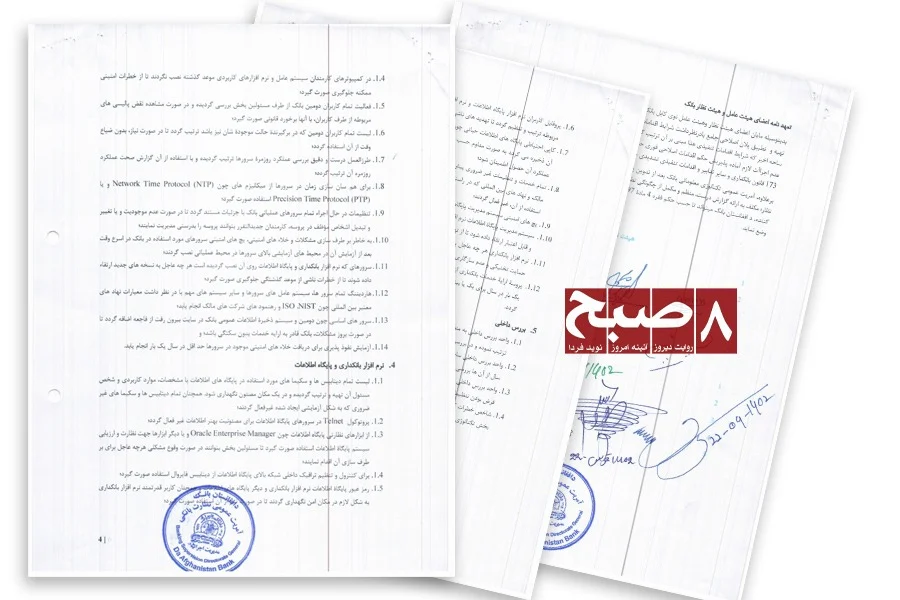
According to the letter, these conditions included reforming the information technology management and security system, developing and updating security policies and cyber risk management, strengthening network infrastructure and security, upgrading server operating systems and outdated software, updating the bank’s core banking software, Flexcube, and the bank’s database, testing the service recovery system in emergencies, and strengthening the Internal Audit Directorate’s oversight of the information technology sector.
Kabul Bank was also required to prepare standard internal audit procedures, review high-risk information technology areas at least twice a year, and submit separate reports on the risks and security status of this sector.
You can read the Persian version of this investigative report here: