• 8AM.MEDIA
  • ویب‌سایت فارسی
  • پښتو ویب‌پاڼه
  • اۉزبېکچه ویب‌سایت
  • Podcast
Monday, October 19, 2026
Hasht-e Subh
  • Home
  • News
    • Afghanistan News
    • World News
  • Opinion
    • Editorial
    • Analysis
  • Reports
    • Daily Reports
    • Investigative Reports
  • Society
    • The story of people
  • Women’s Word
  • Columns
    • Three Years After Afghanistan’s Fall: The Taliban’s Resurgence
    • Towards Equality
    • The Resurgence of the Taliban: Two Years Since Afghanistan’s Fall
    • Hebatullah Report Special Edition
    • Resistance for Education Special Edition
    • Special Column on Taliban’s Education Curriculum
    • Nawroz
  • Interviews
  • Contact Us
    • About Us
    • 8AM MEDIA Annual Awards
    • Submit an Article to Hasht-e-Subh
  • 8am.mediaBack
Subscribe
No Result
View All Result
  • Home
  • News
    • Afghanistan News
    • World News
  • Opinion
    • Editorial
    • Analysis
  • Reports
    • Daily Reports
    • Investigative Reports
  • Society
    • The story of people
  • Women’s Word
  • Columns
    • Three Years After Afghanistan’s Fall: The Taliban’s Resurgence
    • Towards Equality
    • The Resurgence of the Taliban: Two Years Since Afghanistan’s Fall
    • Hebatullah Report Special Edition
    • Resistance for Education Special Edition
    • Special Column on Taliban’s Education Curriculum
    • Nawroz
  • Interviews
  • Contact Us
    • About Us
    • 8AM MEDIA Annual Awards
    • Submit an Article to Hasht-e-Subh
  • 8am.mediaBack
No Result
View All Result
Hasht-e Subh
No Result
View All Result

School Doors Remain Closed: Girls Deprived of Education

Translated by Farida Fazili | Originally written in Persian by Shahrzad

8AM Media 8AM Media
19 October 2026 - Solar Hijri Date: 1405/07/27 [t_time:1792414379]
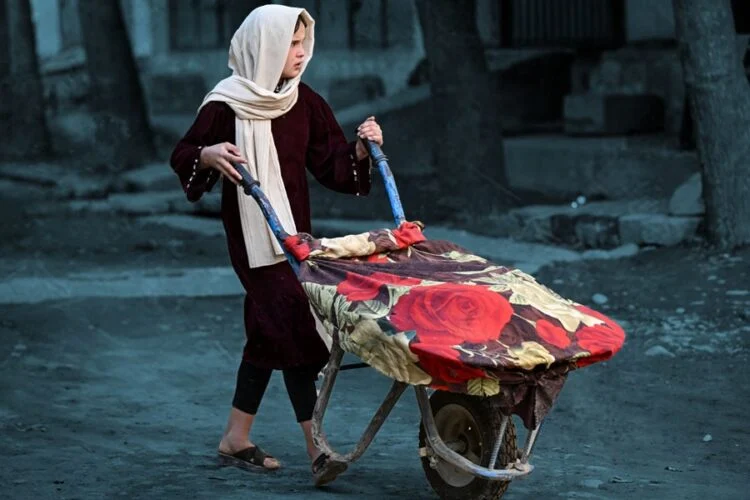
A young Afghan girl pushes a wheelbarrow carrying household belongings through a street (Photo: AFP) 

AFP

Thousands of teenage girls in Afghanistan are spending their days at home, despite having once planned to attend school and university and build independent futures. Some have been unable to continue formal education since completing sixth grade, and as the years pass, they grow increasingly distant from the educational environment.

In August 2026, the United Nations Children’s Fund (UNICEF) announced that more than 2.6 million girls in Afghanistan had been deprived of secondary education since restrictions on schooling for girls above sixth grade were imposed in 2021. For more than five years, Afghanistan has remained the only country in the world where secondary and higher education for girls and women are effectively banned.

For girls who have been kept out of school, home is more than just a place to live. For many, it has also become a place to read books and wait for the opportunity to return to the classroom. Maryam (a pseudonym), a 16-year-old girl, says she never imagined that she would be unable to return to school after completing sixth grade.

“When the schools closed, we thought they would reopen after a few months. But the months passed, and then they became years. I still keep my books. Sometimes I open them and study, but it is no substitute for school and a teacher,” she says.

Maryam says that before her education was interrupted, she hoped to attend university and pursue a specific profession. Now, however, she spends much of her time at home.

Being away from education for an extended period means more than losing an academic year. Girls who remain outside the educational environment for years risk losing some of their academic skills and facing fewer educational and professional opportunities.

In a report on the state of education in Afghanistan, UNICEF said that more than 2.13 million primary-school-age children were out of school in 2024, around 60 percent of them girls.

Zainab, another girl who has been denied access to school, says her biggest concern is that continuing her education will become more difficult as time passes.

“When I see my friends studying or talking about university and their fields of study, I feel that I have fallen behind them. I still want to study, but I do not know when I will have that opportunity again,” she says.

Some girls read books at home or use online educational programs and informal courses to stay connected to learning. However, internet access, course fees, a lack of equipment, and the absence of sustainable educational programs make online learning inaccessible to many girls.

Bahar (a pseudonym), a 15-year-old girl, says: “I try to study at home. I read books and sometimes find lessons online, but when the electricity is out for several hours or the internet is weak, I cannot study properly.”

UNICEF has also identified community-based education and alternative learning programs as ways to help children in Afghanistan continue their education. In 2025, around 442,000 children benefited from community-based education programs, 66 percent of whom were girls.

Sara (a pseudonym), another girl who has been out of school for several years, says she tries to maintain her skills through books and online learning.

“I do not want to feel, a few years from now, that I have forgotten everything. Every day, I try to learn something, whether it is English, computers, or reading a book. But this is different from going to school,” she says.

According to Sara, what she misses most is interaction with teachers and classmates.

Being deprived of education affects more than girls’ academic futures. UNICEF has warned that continued restrictions could leave Afghanistan facing a shortage of female professionals in the coming years, including teachers and healthcare workers.

According to UNICEF’s analysis, if the restrictions continue, Afghanistan could lose around 20,000 female teachers and 5,400 female healthcare workers by 2030. The number of female teachers in primary education also fell from nearly 73,000 in 2022 to around 66,000 in 2024.

Somaya, a mother, says her concerns extend beyond her daughter’s present circumstances.

“My daughter wants to become a doctor. I do not know how she will achieve her dream after spending several years away from education. We want her to study and build her own future,” she says.

For girls who have been kept out of school, every passing year means more than the passage of time. It represents years they could have spent in classrooms, taking exams, developing skills, and preparing to enter university and the workforce.

In August 2026, UNICEF said that more than 2.6 million girls had been deprived of secondary education and warned that out-of-school girls face increased risks, including child labor, early marriage, abuse, and gender-based violence.

Despite these circumstances, some girls have not put their books aside. Some continue studying at home, others turn to online education, while some participate in reading circles and informal educational programs.

For many of them, however, their wish is simple: to return to the classroom, have a teacher, see their classmates, and continue the path they had begun before the school doors closed.

“I still want to study. I still have dreams for my future. I just do not want to wait any longer,” Maryam says.
ShareTweetSendSendShare

Related Posts

A young Afghan girl sitting with her back to the camera (Photo: M. Elham)
No category

When “Yes” Is Not a Girl’s Choice: Forced and Child Marriages 

18 October 2026 [t_time:1792328939]
A young woman's side profile is displayed as she looks straight ahead with a sad expression (Photo: Pexels)
No category

I Was a “Photon” Trying to Pass Through the Cracks of Ignorance

17 October 2026 [t_time:1792242271]
Afghan girls sitting and reading books as part of a book club (Photo: AFP)
No category

Book Clubs: A Refuge for Girls Amid Educational Restrictions

15 October 2026 [t_time:1792068202]

Latest

Loading latest news...

Popular stories

  • Donald Trump – US President (Photo: AP)

    Trump Again Says War with Iran Will End “Very Soon”

    Share
    Share Tweet
  • UN Report Reveals Shifts in Family Attitudes and Rise in Domestic Violence in Afghanistan

    Share
    Share Tweet
  • US Defense Secretary Warns Iran of “Destruction”

    Share
    Share Tweet
  • US Senator Criticizes Netanyahu’s Remarks Justifying War Against Iran

    Share
    Share Tweet
  • Russian Foreign Intelligence Chief Arrives in Kabul

    Share
    Share Tweet

Podcast

Insights
Insights

Join Lynne O’Donnell for 8AM’s podcast series, Insights.
Lynne talks with generals, diplomats, soldiers, journalists, politicians, activists, people who have front row seats for conflicts around the world, and citizens with a story to tell, happy or sad. For this first series, Afghanistan is the focus. Lynne and her guests talk about the collapse of the republic in August, 2021, and the impact since — for the people of Afghanistan, for the security of the region, for the safety of the world. It’s important, interesting and insightful.

Insights/22: Controlling the Narrative with Mina Sharif
byinsights8am

Controlling the Narrative

Lynne O’Donnell talks with Mina Sharif, author, activist, women’s rights campaigner, educator and mentor. They discuss who controls the narrative and who speaks for Afghanistan’s people when the Taliban appear to have seized control not only of the country but of the message, too.

Have a listen

Insights/22: Controlling the Narrative with Mina Sharif
Episode play icon
Insights/22: Controlling the Narrative with Mina Sharif
Episode Description
Episode play icon
Insights/21: Media Meltdown with Zahra Joya
Episode Description
Episode play icon
Insights/20: Terror Inc with Scott Richards
Episode Description
Episode play icon
Insights/19: Busting Stereotypes with Bushra Gohar
Episode Description
Episode play icon
Insights/18: Media Matters with Waliullah Rahmani
Episode Description
Episode play icon
Insights/17: What Goes Around Comes Around with Sima Samar
Episode Description
Search Results placeholder
Hasht-e Subh

8AM Media, also known as Hasht-e-Subh Daily, stands as Afghanistan's premier independent and non-profit newspaper, resonating as a beacon of journalistic integrity since its establishment in June 2007 by esteemed Afghan journalists and human rights advocates. With a steadfast commitment to citizen journalism and civic education, Hasht-e-Subh Daily has earned its place as the most esteemed publication in the nation.

Publisher: Sanjar Sohail
Email: [email protected]
Executive Director: Parwiz Kawa
Email: [email protected]

Read More

School Doors Remain Closed: Girls Deprived of Education

Dawn: Trade Between Afghanistan and Pakistan Falls by 95 Percent

Residents Build School in Ghazni’s Qarabagh District at a Cost of More Than 6 Million Afghanis

A Festering Wound in Afghanistan’s Banking System: What Is Going On at Kabul Bank?

Taliban Ban Sports Gyms in Baraki Barak After 9 p.m., Sources Say

Editor’s Choice

Every Saturday morning, 8AM MEDIA English Services Department will guide you through the week’s biggest stories from Afghanistan and the international community.

Subscribe

© 2026 - ©Hasht-e Subh Daily

No Result
View All Result
8am.Media
پښتو ویب‌پاڼه
ویب‌سایت فارسی
اۉزبېکچه ویب‌سایت
  • Home
  • News
    • Afghanistan News
    • World News
  • Opinion
    • Editorial
    • Analysis
  • Reports
    • Daily Reports
    • Investigative Reports
  • Society
    • The story of people
  • Women’s Word
  • Columns
    • Three Years After Afghanistan’s Fall: The Taliban’s Resurgence
    • Towards Equality
    • The Resurgence of the Taliban: Two Years Since Afghanistan’s Fall
    • Hebatullah Report Special Edition
    • Resistance for Education Special Edition
    • Special Column on Taliban’s Education Curriculum
    • Nawroz
  • Interviews
  • Contact Us
    • About Us
    • 8AM MEDIA Annual Awards
    • Submit an Article to Hasht-e-Subh
  • 8am.media

© 2026 - ©Hasht-e Subh Daily