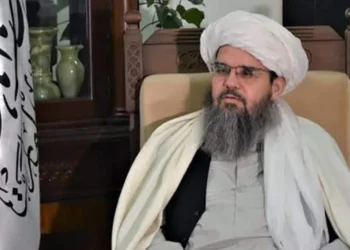
Hibatullah Akhundzada, the Taliban Supreme Leader, has issued a directive to the group’s security bodies, instructing that no one may distribute or use military equipment registered under the Ministries of Defense and Interior, the Intelligence Directorate, or other independent agencies without his explicit permission. Analysts view this order as a strategic move by Akhundzada to strip the Taliban’s Defense Minister, Interior Minister, and Intelligence Chief of their control over military resources, aiming to prevent an internal coup allegedly orchestrated by these three figures.
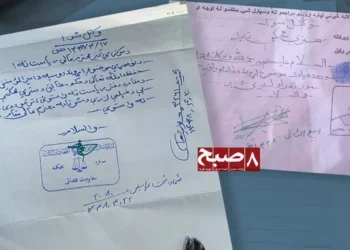
This eight-article order, a copy of which was obtained by the Hasht-e Subh Daily, reveals that Akhundzada has revoked the authority of Sirajuddin Haqqani, the Interior Minister; Mullah Mohammad Yaqoob Mujahid, the Defense Minister; and Abdul Haq Wasiq, the Intelligence Chief, concerning the distribution and use of military equipment.
The first article mandates that no one may distribute or authorize the distribution of registered military equipment from the stockpiles of the Ministries of Defense, Interior, and Intelligence without a direct order from Akhundzada. Issued on October 20, 2024, under the title “On the Distribution, Protection, and Supervision of Registered Military Equipment,” the order stipulates that any Taliban-affiliated entity in need of weapons, ammunition, night-vision devices, communication tools, or other military supplies must obtain prior approval from the Taliban Supreme Leader.
The second article states that if any Taliban military department requires equipment, it must submit a request to Akhundzada’s office in Kandahar. Article three emphasizes that any military equipment distributed or used without Akhundzada’s prior approval before this order must be returned to the stockpiles. Per this article, Akhundzada has tasked the Ministries of Defense and Interior, along with the General Intelligence Directorate, with providing a list of their available military assets to the Directorate of Registry, Protection, and Oversight for Military Equipment.
Under this order, the Registry, Protection, and Oversight Directorate for Military Equipment, overseen by Akhundzada’s office in Kandahar, is responsible for sealing military equipment, which may only be distributed upon the Supreme Leader’s directive. This office also manages the military equipment stockpiles.
This order is seen as another step toward consolidating power in Akhundzada’s hands in Kandahar. Many observers view it as an indication of growing distrust between Akhundzada and senior Taliban officials in Kabul. Previously, some Taliban leaders, including Sirajuddin Haqqani, have openly defied Akhundzada’s bans on photography and filming, disregarding their “Amir’s” directives.
Reports have previously surfaced regarding the sale of military equipment left behind by foreign and Afghan security forces. Former U.S. President Donald Trump frequently referenced this issue during his campaign. Recently, the Pakistani government announced that its forces had intercepted a vehicle transporting smuggled American weapons from Afghanistan.
On Monday, October 14, 2024, The Media Line reported that the intercepted equipment included M4 assault rifles, handguns, night-vision goggles, and thousands of rounds of ammunition concealed in a truck carrying vegetables. Pakistani security officials estimated the total value of the smuggled American weapons on this truck at USD 126,354.
Remaining American Equipment in Afghanistan
The U.S. Department of Defense previously disclosed that approximately $7 billion worth of military equipment fell into Taliban hands following the U.S. withdrawal from Afghanistan. This equipment was left behind after Afghanistan fell on August 15, 2021, raising serious concerns about its potential use by other terrorist groups within Afghanistan and the region.
CNN reported that, when U.S. forces withdrew, 78 American-made aircraft worth around $1 billion remained in Afghanistan. CNN also stated that more than 9,000 air-to-ground munitions, valued at over $6.5 million, were left behind as the U.S. military presence ended.
The report also noted that out of 96,000 military vehicles, more than 40,000—including 12,000 armored Humvees—were seized by the Taliban. According to the report, of the 400,000 weapons the U.S. had supplied to Afghanistan’s former government, around 300,000 remained in the country.
Additionally, nearly all communication equipment, including base stations, mobile and handheld radios, and encryption devices, was left behind. The report also mentioned that almost all night-vision devices, surveillance tools, biometric equipment, and GPS systems, totaling nearly 42,000 specialized items, stayed in Afghanistan. Five Mi-17 helicopters, which had been sent to Ukraine for repairs before Afghanistan’s fall, were ultimately given to the Ukrainian military.
Internal rivalries within the Taliban, especially between factions, have significantly contributed to Akhundzada’s distrust of certain officials. Some, including Sirajuddin Haqqani, the Interior Minister, and Mullah Mohammad Yaqoob Mujahid, the Defense Minister, gained substantial power during the Taliban’s conflict with foreign forces. Akhundzada may now fear that these officials are attempting to expand their influence, thereby posing a potential threat to his leadership position.
You can read the Persian version of this daily report here:
جنگ بر سر جنگافزار یا ترس از کودتا؛ بیاعتمادی هبتالله از چیست؟ | روزنامه ۸صبح