• 8AM.MEDIA
  • ویب‌سایت فارسی
  • پښتو ویب‌پاڼه
  • اۉزبېکچه ویب‌سایت
  • Podcast
Friday, October 16, 2026
Hasht-e Subh
  • Home
  • News
    • Afghanistan News
    • World News
  • Opinion
    • Editorial
    • Analysis
  • Reports
    • Daily Reports
    • Investigative Reports
  • Society
    • The story of people
  • Women’s Word
  • Columns
    • Three Years After Afghanistan’s Fall: The Taliban’s Resurgence
    • Towards Equality
    • The Resurgence of the Taliban: Two Years Since Afghanistan’s Fall
    • Hebatullah Report Special Edition
    • Resistance for Education Special Edition
    • Special Column on Taliban’s Education Curriculum
    • Nawroz
  • Interviews
  • Contact Us
    • About Us
    • 8AM MEDIA Annual Awards
    • Submit an Article to Hasht-e-Subh
  • 8am.mediaBack
Subscribe
No Result
View All Result
  • Home
  • News
    • Afghanistan News
    • World News
  • Opinion
    • Editorial
    • Analysis
  • Reports
    • Daily Reports
    • Investigative Reports
  • Society
    • The story of people
  • Women’s Word
  • Columns
    • Three Years After Afghanistan’s Fall: The Taliban’s Resurgence
    • Towards Equality
    • The Resurgence of the Taliban: Two Years Since Afghanistan’s Fall
    • Hebatullah Report Special Edition
    • Resistance for Education Special Edition
    • Special Column on Taliban’s Education Curriculum
    • Nawroz
  • Interviews
  • Contact Us
    • About Us
    • 8AM MEDIA Annual Awards
    • Submit an Article to Hasht-e-Subh
  • 8am.mediaBack
No Result
View All Result
Hasht-e Subh
No Result
View All Result

Afghan women sing for their rights

By Asyia Hamzaie, Hasht e Subh Daily (Afghanistan)

By Asyia Hamzaie, Hasht e Subh Daily (Afghanistan) By Asyia Hamzaie, Hasht e Subh Daily (Afghanistan)
18 June 2021 - Solar Hijri Date: 1400/03/28 [t_time:1623987045]

School Student Choir – Credit: Asiya Hamzaie, Hasht e Subh Daily

The protracted war in Afghanistan has fragilized the country’s entire education system. Both the quest for political power and religious extremism in the Islamic country have led to the politicization of education, with some circles seeking to introduce ideology into the school system. Officially, the Afghan government favors girls’ access to education, but culturally, some girls still face restrictions to attend school in certain areas of the country.

And while on paper the Afghan constitution guarantees gender equality, there are serious shortcomings in practice. Najiba Arian, a spokesperson for the Afghan Ministry of Education, said there are currently 9.7 million students in the country, 42% of whom are girls. But roughly 3.7 million children do not attend school — 60% of them are girls. Hardships to access the school system are worst in southern and eastern provinces, said Ms. Arian, not only due to security reasons but also because of tribal and traditional customs.  Most of these areas, which belong to particular etchnic groups, are controlled by the Taliban, who ruled the country in the 1990s and still oppose girls’ and women’s education, despite recent claims of change. Schools that have been built over the last 20 years are in fact getting destroyed by the armed group.

Yet facing these and other challenges has led Afghan women to fight for their rights, sometimes with successful outcomes.  In 2015, the country’s Ministry of Education presented a controversial plan involving female students’ uniforms that would cover girls’ bodies with long, dark-colored clothing, similar to that of extremist Islamist groups. Civil society activists contested the move, arguing that the dress not only promoted extremism, but was also too hot to wear during summertime — which is when schools are open in the country. Finally, the Ministry of Education had to abandon the plan. In some parts of the country, where conservatism and tribal customs still prevail, girls do wear body-covering long dark dresses —which also covers their faces—, despite often reaching high temperatures, making it hard for them to attend school or actually paying attention in class.
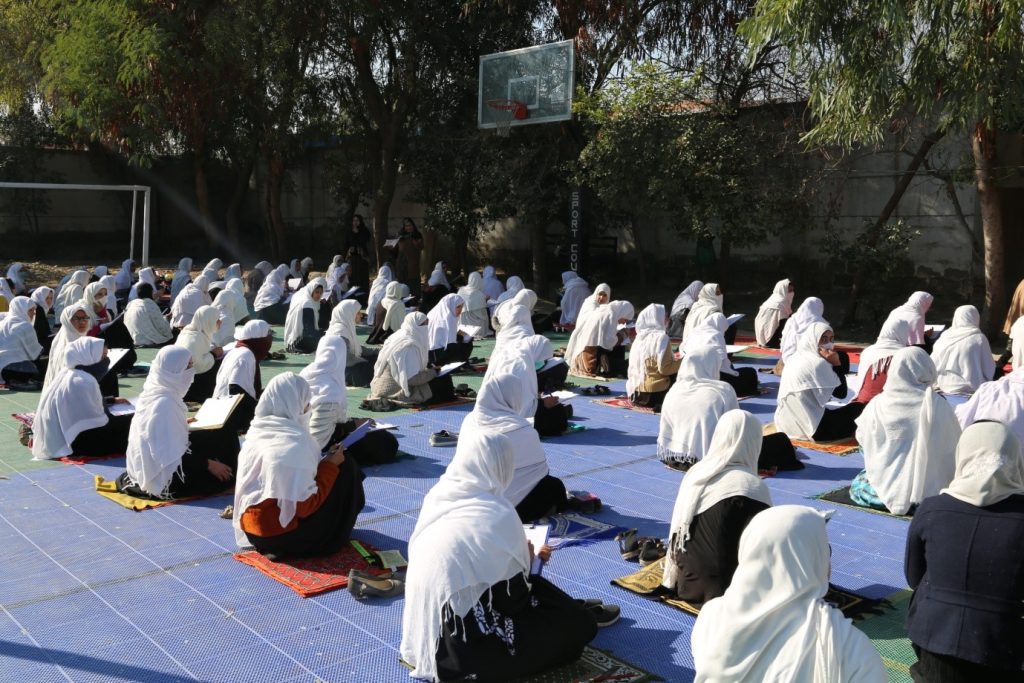
Nazo Ana High School in Nangarhar’s capital, Jalalabad, 2017 – Credit: Asiya Hamzaie, Hasht e Subh Daily

But now the battle for gender equality in Afghanistan’s educational environment has taken on a new color, thanks to an online women’s rights movement that hopes to raise the voice of those who have been silenced for too long — the “Ma’arif [which means Education] Choir Campaign.”

The campaign was born out of the outrage caused by an announcement from one of the Ministry of Education’s departments in March 2020, which forbade female students over-12 from singing in school choirs in public and in front of men. Spontaneous and leaderless protests began taking place online, due to the coronavirus pandemic, in a rather original way. More than 100 women posted videos of them singing their childhood songs on the Internet, asking why female students should be prevented from singing two decades after the fall of the dark Taliban rule, prompting widespread and long-lasting public support for the campaign.

Once again, the protests led the government to retreat, and the Ministry of Education finally issued a statement saying that the plan did “not reflect the official position and policy of the ministry.” Wahid Omar, an adviser to the Afghan president Ashraf Ghani Ahmadzai said, “No individual or institution is allowed to set limits for its citizens, [which is] contrary to the spirit of the country’s constitution.”
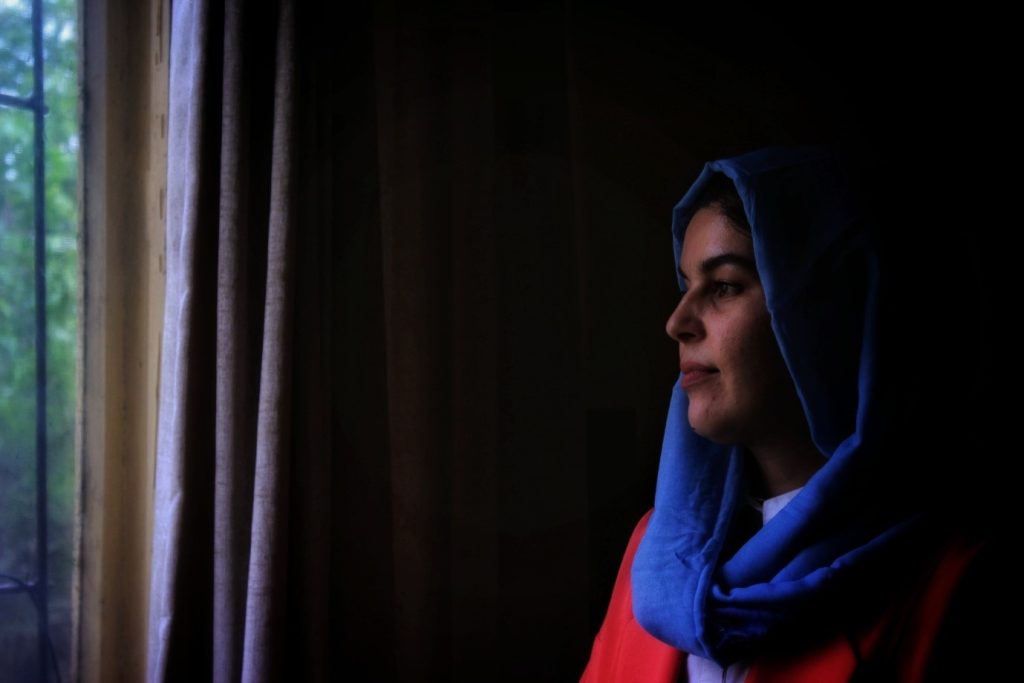
Fariha Esaar, Civil Activist and member of the Ma’arif Choir Campaign – Credit: Naseer Kawoshgar, Hasht e Subh Daily

Earlier this year, the government tried another move, this time to merge schools with mosques during the first three years of the elementary school programme —presumably to gain influence against radical Islamists groups such as the Taliban—, but it was also quickly shut down after online protests. The Minister of Education, Assadullah Hanif Balkhi, said the plan was for students to have access to education in areas without schools and that it had been misinterpreted. During the choir campaign, Fariha Esaar, one of the women activists who sang in front of a camera, said, “Both the plan to merge schools with mosques for the first three years of education and the plan to ban female students over-12 from singing in schools are efforts made to radicalize and Talibanize Afghanistan’s education system.” Now, with the withdrawal of foreign forces and the possibility of escalating civil war in the country, she added, there are serious concerns about the group’s influence in specific circles. “We can not remain silent in this regard. We will stand up and prevent the influence of extremism in the education sector. We have succeeded in this campaign, but we must have more structural plans to ensure gender equality so that political decisions don’t exclude women.”

Ghulam Dastgir Munir, an education expert, said he got suspended from his teaching position in a public school because of his heavy criticism of extremist initiatives such as educating children in mosques and banning girls from singing. According to him, the main challenge that remains ahead is that the seats and positions in the education sector are assigned not on the basis of expertise but depending on political affiliation, and that, in order to ensure gender equality and de-politicize schools, appointments must be free of political affiliation.

The Ma’aref Choir Campaign is one successful example of a civil society movement fighting for gender equality in Afghanistan. However, a long term action plan is needed to guarantee gender equality in the educational sector — one that raises female teachers rates and increases awareness among families, particularly in remote areas of the country, so that more girls can attend school.

[box type=”info” align=”” class=”” width=””]This article is being published as part of “Towards Equality”, an international and collaborative initiative gathering 15 international news outlets to highlight the challenges and solutions to reach gender equality.[/box]

ShareTweetSendSendShare

Related Posts

Gender bias in AI: “We underestimate the human component of these tools”
No category

Gender bias in AI: “We underestimate the human component of these tools”

12 March 2024 [t_time:1710279389]
India’s solar power push delivers an unexpected bonus – empowering rural women
No category

India’s solar power push delivers an unexpected bonus – empowering rural women

12 March 2024 [t_time:1710278475]
Mother’s Tree
No category

Mother’s Tree

12 March 2024 [t_time:1710277932]

Latest

Loading latest news...

Popular stories

  • An aerial view shows collapsed buildings and widespread damage following an earthquake in Panama (Photo: Reuters)

    More Than 200 Aftershocks Recorded in Panama Since Friday’s Earthquake

    Share
    Share Tweet
  • Axios: Trump Expects Ukraine Not to Attack Russian Oil Refineries

    Share
    Share Tweet
  • UN Report Reveals Shifts in Family Attitudes and Rise in Domestic Violence in Afghanistan

    Share
    Share Tweet
  • Trump Again Says War with Iran Will End “Very Soon”

    Share
    Share Tweet
  • The Politics We Inherited: Rethinking Afghanistan’s Political Culture

    Share
    Share Tweet

Podcast

Insights
Insights

Join Lynne O’Donnell for 8AM’s podcast series, Insights.
Lynne talks with generals, diplomats, soldiers, journalists, politicians, activists, people who have front row seats for conflicts around the world, and citizens with a story to tell, happy or sad. For this first series, Afghanistan is the focus. Lynne and her guests talk about the collapse of the republic in August, 2021, and the impact since — for the people of Afghanistan, for the security of the region, for the safety of the world. It’s important, interesting and insightful.

Insights/22: Controlling the Narrative with Mina Sharif
byinsights8am

Controlling the Narrative

Lynne O’Donnell talks with Mina Sharif, author, activist, women’s rights campaigner, educator and mentor. They discuss who controls the narrative and who speaks for Afghanistan’s people when the Taliban appear to have seized control not only of the country but of the message, too.

Have a listen

Insights/22: Controlling the Narrative with Mina Sharif
Episode play icon
Insights/22: Controlling the Narrative with Mina Sharif
Episode Description
Episode play icon
Insights/21: Media Meltdown with Zahra Joya
Episode Description
Episode play icon
Insights/20: Terror Inc with Scott Richards
Episode Description
Episode play icon
Insights/19: Busting Stereotypes with Bushra Gohar
Episode Description
Episode play icon
Insights/18: Media Matters with Waliullah Rahmani
Episode Description
Episode play icon
Insights/17: What Goes Around Comes Around with Sima Samar
Episode Description
Search Results placeholder
Hasht-e Subh

8AM Media, also known as Hasht-e-Subh Daily, stands as Afghanistan's premier independent and non-profit newspaper, resonating as a beacon of journalistic integrity since its establishment in June 2007 by esteemed Afghan journalists and human rights advocates. With a steadfast commitment to citizen journalism and civic education, Hasht-e-Subh Daily has earned its place as the most esteemed publication in the nation.

Publisher: Sanjar Sohail
Email: [email protected]
Executive Director: Parwiz Kawa
Email: [email protected]

Read More

Taliban Accuse UNAMA of Portraying Them Negatively

UNICEF: Over Four Million Children in Afghanistan to Need Malnutrition Treatment in 2027

FAO: Returning Migrants and Rising Prices of Essential Goods Worsen Afghanistan’s Humanitarian Crisis

UNICEF: Access to Safe Water in Afghanistan’s Schools Helps Protect Children’s Health

OCHA: Sweden Contributes Over $1 Million to Afghanistan Humanitarian Fund

Editor’s Choice

Every Saturday morning, 8AM MEDIA English Services Department will guide you through the week’s biggest stories from Afghanistan and the international community.

Subscribe

© 2026 - ©Hasht-e Subh Daily

No Result
View All Result
8am.Media
پښتو ویب‌پاڼه
ویب‌سایت فارسی
اۉزبېکچه ویب‌سایت
  • Home
  • News
    • Afghanistan News
    • World News
  • Opinion
    • Editorial
    • Analysis
  • Reports
    • Daily Reports
    • Investigative Reports
  • Society
    • The story of people
  • Women’s Word
  • Columns
    • Three Years After Afghanistan’s Fall: The Taliban’s Resurgence
    • Towards Equality
    • The Resurgence of the Taliban: Two Years Since Afghanistan’s Fall
    • Hebatullah Report Special Edition
    • Resistance for Education Special Edition
    • Special Column on Taliban’s Education Curriculum
    • Nawroz
  • Interviews
  • Contact Us
    • About Us
    • 8AM MEDIA Annual Awards
    • Submit an Article to Hasht-e-Subh
  • 8am.media

© 2026 - ©Hasht-e Subh Daily