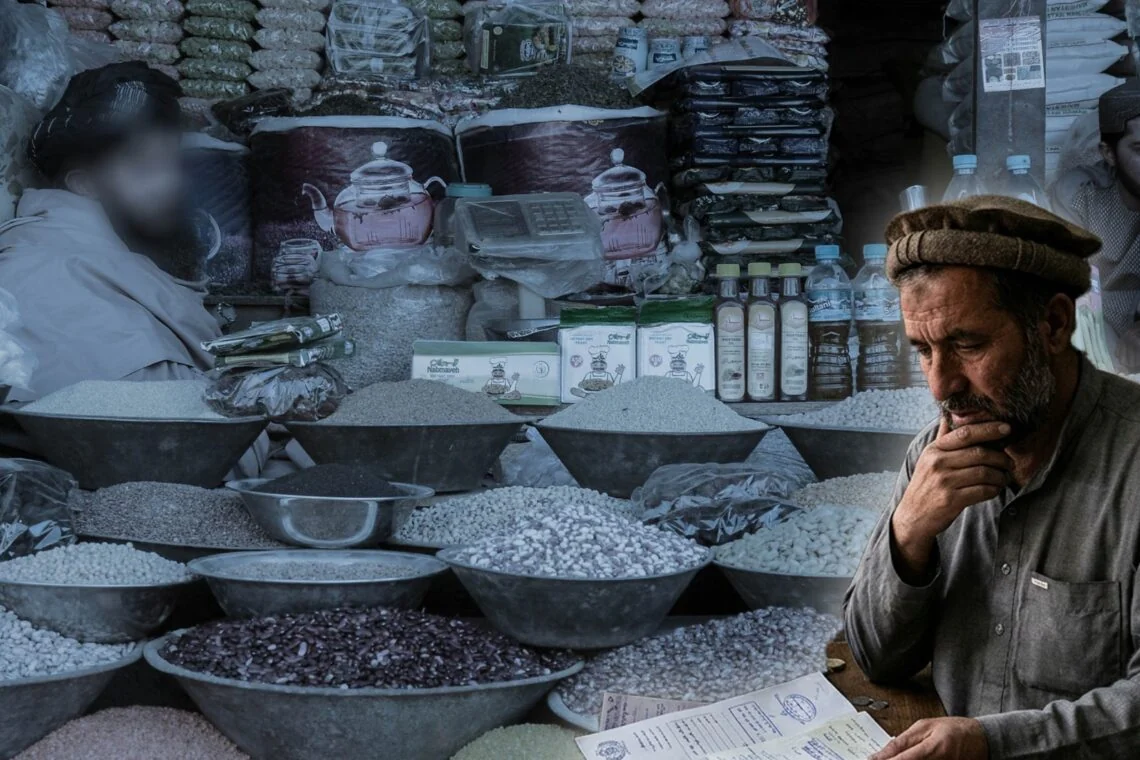
A number of traders in various provinces of Afghanistan who are engaged in medium-scale commercial activities complain about a business slump and a lack of income. In conversation with the Hasht-e Subh Daily, these traders stress that dozens of business licenses are revoked every day and that shop owners have been forced to sell or shut down their businesses. According to sources, the main cause of this situation is, on the one hand, heavy tax pressure, the numerous costs of business licenses, municipality fees and other expenses, and on the other hand, a sharp decline in people’s purchasing power.
These traders in Kabul, Ghazni, Paktika and Maidan Wardak provinces say that many owners of small and medium-sized businesses have grown weary of continuing their commercial activities. They stress that the Taliban collect money from traders under various headings, including income tax, trade guild licenses, license renewal fees, sanitation fees, signboard tax, environmental licenses, public health licenses and several other charges.
According to them, in addition to these items, the cost of property rent, electricity consumption, and daily living expenses has become so heavy that the small profit from sales does not even cover the current costs of the businesses. As a result, many owners of these businesses lose their capital in a short time.
Alongside these factors, citizens also regard the lack of job opportunities and income sources as another fundamental cause of the slump in economic activity. They cite the decline in people’s purchasing power as another factor that has pushed the market into stagnation. According to citizens, widespread unemployment, reduced wages, and rising food prices have led families to forgo even many of their essential needs.
Mohammad Ali is a resident of the Naw Abad area of Ghazni city, where he recently opened a shop selling clothing and other apparel. Having been forcibly deported from Iran not long ago, he complains about the lack of job opportunities and suitable conditions for earning an income inside the country.
He says: “People’s economic conditions are very bad. There are days when I do not sell even a single pair of clothes. There is a lot of foot traffic in the markets, but because they do not have enough money, people are forced to buy the essential goods they need only as far as their financial means allow. Few families can afford clothing and apparel.”
Shafiullah, a resident of District 3 of Kabul city, describes his observations of the slump in medium-scale commercial activities in the city in conversation with the Hasht-e Subh Daily: “These days, as you may have noticed yourselves, both on social media and across the city and the market, we come across dozens of announcements of shops for sale along with their goods. All of this shows the lack of work and income, and people are forced to halt their commercial activities.”
A resident of Maidan Wardak province, who asked that his identity be withheld, tells the Hasht-e Subh Daily that because of high tax costs and running expenses, he intends to cancel his business license and sell the goods in his shop at a low price.
The owner of a grocery store and a small factory producing detergents, he says: “Expenses are extremely high. The municipality, the environment department, public health,h and the finance department collect taxes and cleaning fees under various headings. On top of that, we must also pay property rent, workers’ wages, es and electricity costs. On the other hand, our sales are very low, to the point that the revenue from sales does not match our expenses. I have kept going only so that I would not be left unemployed, but now I have decided to halt the operations of the production plant and the store before I lose all of my capital.”
Meanwhile, a source in the Finance Directorate of Paktika province confirms to the Hasht-e Subh Daily that, on average, five people in this province cancel their business licenses every day and bring their trade and businesses to an end.
This comes as the World Food Programme (WFP) recently announced that the purchasing power of unskilled workers has declined by about 25 percent compared to last year and by about 30 percent compared to the three-year average.
It is worth noting that two years ago the Taliban announced measures to reduce some taxes, including exempting businesses with annual sales of up to two million afghanis from paying tax. However, a number of citizens say that this decision has not been implemented in practice and that tax continues to be collected from shopkeepers as before.
You can read the Persian version of this report here:
مالیات گزاف و کاهش قدرت خرید مردم؛ فعالیتهای اقتصادی متوسط با رکود مواجه است