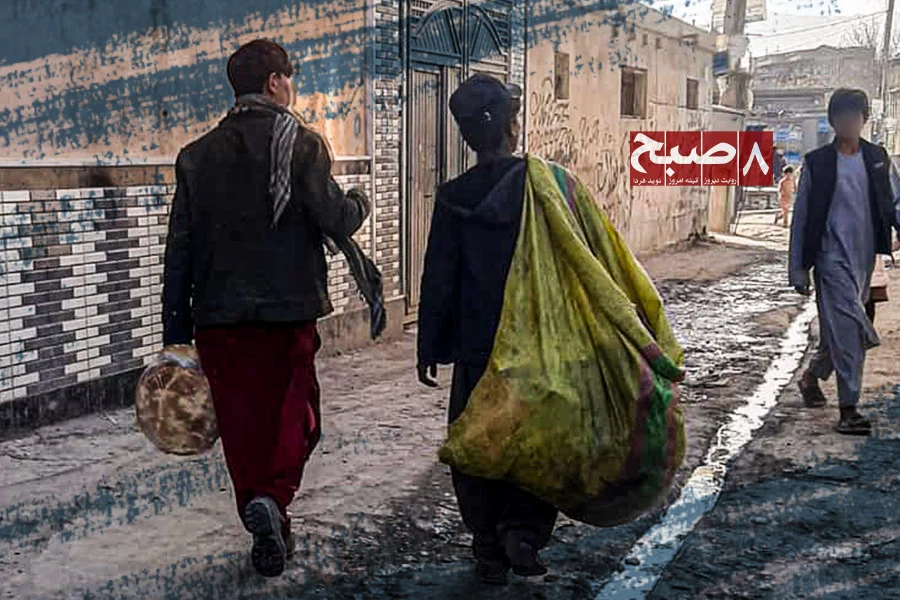
Several children who have been forced to shoulder the responsibility of covering their families’ expenses say that, following the illness, addiction, or incapacity of their family’s breadwinners, they have had to set aside school, play, and their childhood dreams and work to provide for their families. They say that because of their family responsibilities, they have been cut off from school and from the activities they love, and they have no opportunity to pursue their aspirations. Meanwhile, several child rights activists warn that imposing work and adult responsibilities on children pushes them into adult roles earlier than is natural, and can negatively affect their education, health, and development.
Osman, 14, is the eldest son of his family. After his father fell ill, he was forced to take on the responsibility of meeting the family’s needs. He says that at first he sold water along the roadsides, and that he now sells carrot juice from a handcart, trying in this way to cover his family’s expenses.
Osman adds: “My father had a stroke and became paralyzed. I have three sisters and two younger brothers, and I did not know what to do. At first I sold water, and now I sell carrot juice from a handcart. With great difficulty, I cover the house rent, the family’s expenses, and the cost of my father’s medicine.” Once a seventh-grade student who played on the school football team and dreamed of becoming both a doctor and a footballer, he now says in despair that he can no longer go to school because he has to work to cover his family’s expenses.
The child says: “I was in seventh grade and ranked second in my class. I played on the school football team. I wanted to become a doctor and a footballer as well. But since my father fell into his sickbed, I have buried all my wishes and childhood games. I can never go to school or play football again. I have to work to cover the expenses of my sisters and brothers and my sick father.”
Seddiq (pseudonym) is a 15-year-old child who says his father became addicted to narcotics and sold most of the household items to buy drugs. According to him, they have gone through hard days, and his father has now left the house, and they do not know where he is. He adds that he is forced to take on the responsibility of caring for his three brothers and one sister.
Seddiq says: “At two in the morning, I go with the other boys from the area and we load grapes from the orchards onto a vehicle, and then we take them to Khost Province. There we unload the packages of grapes again. The trader pays us 300 Afghanis a day, and then we return home. I sleep no more than three hours and go back to work.”
The child adds: “I have been doing this same work for two years. I was in sixth grade when I was forced to leave school. This work has also made me ill. Sometimes I pass out and lose awareness of myself, but I have not seen a doctor so far. The money I earn, I spend on household expenses. I pay 4,000 Afghanis in rent. The house is in ruins, but we get by in these conditions.”
Meanwhile, Maryam Maroof Arwin, a child rights activist, says that imposing work and adult responsibilities on children is a form of forced and coercive adultification that can lead to the violation of their fundamental rights and freedoms.
Ms. Arwin says: “Placing a child in the role of the family’s breadwinner can violate his or her fundamental rights. Among other things, the child’s right to protection from economic exploitation and hazardous work is ignored. This situation can also severely restrict the child’s right to education and destroy the opportunity for his or her physical, psychological, social, and moral development.”
This child rights activist adds: “Children who enter heavy and dangerous work because of poverty, the absence of a guardian, unemployment, and the economic crisis are, above all, victims of circumstances in which they themselves have played no part. Therefore, dealing with this situation must be supportive, humane, and based on children’s rights, not violence, suppression, detention, and harassment.”
Abdul Jalal Amarkhel, a psychologist, says that when a child is forced to take on responsibilities beyond his or her age and ability, the child may feel that he or she must behave like an adult.
This psychologist says: “In the short term, this situation causes anxiety, psychological pressure, fear of making mistakes, fatigue, a decline in play and happiness, and sometimes sleep problems. In the long term, the child’s self-confidence may be damaged, and perfectionism, feelings of guilt, difficulty saying ‘no,’ difficulty establishing healthy boundaries, and psychological burnout may develop in adulthood. Of course, age-appropriate responsibilities are beneficial. The problem arises when responsibilities exceed the child’s capacity.”
This comes as António Guterres, Secretary-General of the United Nations (UN), said in his latest report last week that around 280 cases of grave violations of children’s rights in Afghanistan were recorded between April 1 and June 30.
Some time ago, a number of Kabul residents also expressed concern about the growing number of working and street children in different parts of the city. They said that instead of going to school and engaging in childhood games, these children spend long hours on the roads doing jobs such as collecting plastic, selling water, shining shoes, and cleaning car windows to provide for their families.
You can read the Persian version of this report here: